For most B2B companies with a physical location, a service area, or a multi-location footprint, the Google Business Profile is the single most consequential piece of digital real estate they don’t fully control. It sits outside your website, outside your CRM, and largely outside your direct authority — governed instead by an opaque set of Google policies that can suspend, demote, or lock a listing with little warning and even less explanation. And yet for many companies, it’s also the first thing a prospective client sees before they ever visit the homepage.
This is the paradox at the center of local digital presence: the platform with the highest conversion intent is the one businesses treat with the least ongoing attention. Google Business Profile management gets set up once, glanced at occasionally, and then forgotten — until a listing vanishes from the map pack, a competitor’s fake reviews start eroding trust, or a “reinstatement request” turns into a weeks-long standoff with an automated support system that never responds the same way twice.
Why “Set It and Forget It” No Longer Works
Google’s local algorithm has grown considerably more aggressive over the past several product cycles, particularly around spam detection, duplicate listing enforcement, and identity verification. Profiles that would have quietly persisted five years ago are now routinely flagged for review — sometimes correctly, often not. A change of address, a new phone number, a well-meaning employee editing business hours, or even an unusually high volume of reviews in a short window can trigger automated scrutiny.
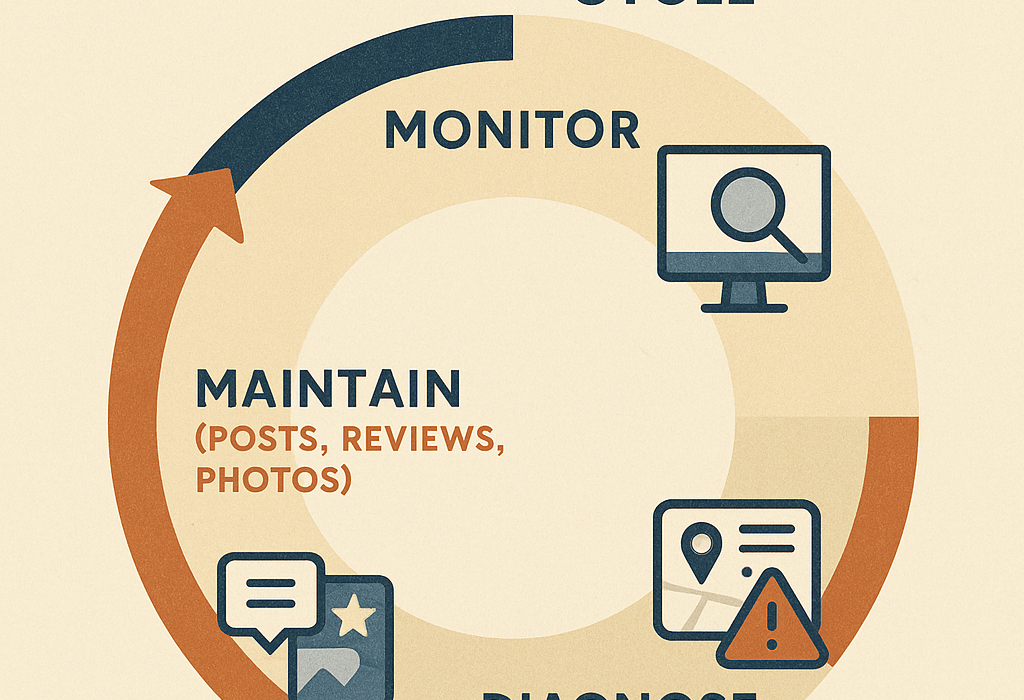
The businesses that weather this well are the ones treating their profile as a living asset rather than a static directory entry. That means:
- Weekly or biweekly Google Posts that keep the profile active and signal legitimate ongoing operation
- Timely, individualized responses to reviews — both positive and negative — rather than templated replies
- Regular audits of NAP (name, address, phone) consistency across the profile and linked citations
- Monitoring for unauthorized edits, since Google allows suggested changes from the public that can alter your listing without your knowledge
- Photo and Q&A maintenance, which quietly but measurably affects both trust signals and ranking factors
Done consistently, this kind of maintenance is unglamorous. It’s also exactly why so many companies underinvest in it — until the absence of that maintenance becomes an emergency. Organizations serious about their Google Business Profile management tend to treat it the way they’d treat server uptime monitoring: invisible when it’s working, urgent the moment it isn’t.
The Map-Pack Reality
Local map-pack optimization is often misunderstood as a one-time SEO project rather than an ongoing discipline. The three-pack that appears above organic results for local searches is influenced by proximity, relevance, and prominence — and prominence, in particular, is a moving target shaped by review velocity, engagement signals, category accuracy, and even how competitors in your area are behaving. A profile that ranked third in the map pack six months ago can quietly slip to page two without any single dramatic change — just the cumulative effect of neglect while competitors kept posting, responding, and refining.
For B2B service businesses — IT providers, consultancies, agencies, specialty contractors — this matters more than most decision-makers realize, because local intent searches (“managed IT services near me,” “marketing agency [city]”) often carry higher purchase intent than broader organic queries. Losing map-pack visibility isn’t a cosmetic SEO problem; it’s a pipeline problem.
When Things Go Wrong: Suspensions, Hijacking, and Verification Locks
The more urgent end of this discipline is account recovery — and it’s where we see the most acute pain from clients who come to us mid-crisis.
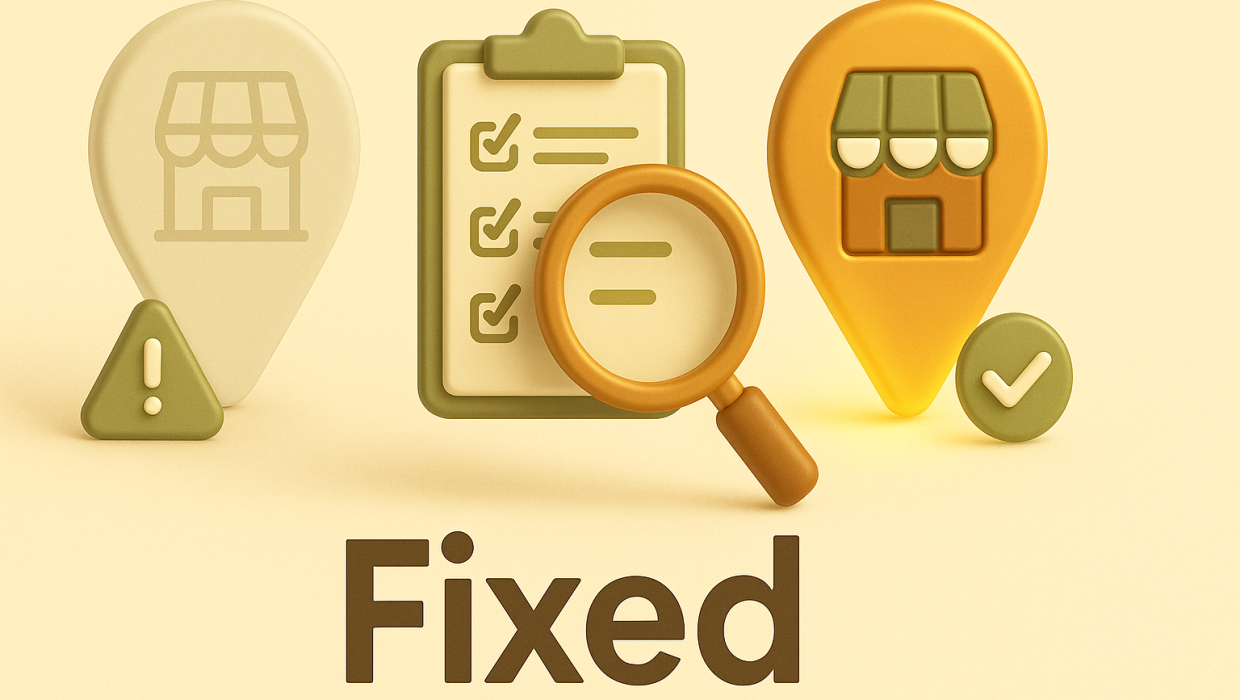
Suspended listings typically fall into two categories: soft suspensions, where the listing remains visible but loses certain features (posts, Q&A, messaging), and hard suspensions, where the listing disappears from Search and Maps entirely. Triggers range from policy violations (real or algorithmically misjudged) to sudden profile edits that resemble spam behavior, to a competitor filing a bad-faith report against you. Suspended listings recovery requires understanding which category you’re dealing with, because the reinstatement paths — and the required documentation — differ substantially.
Hijacked listings occur when someone else gains edit access to your profile, often through the “suggest an edit” function or by claiming an unclaimed duplicate. We’ve seen competitors change a business’s listed hours to make it appear closed during peak periods, alter the primary category to bury it in irrelevant searches, or redirect the website link entirely. This is quietly more common than most business owners assume, and it rarely triggers an obvious notification.
Verification lock is its own particular frustration. Google account verification issues — especially for businesses without a traditional storefront, or those in categories Google treats as higher-risk for spam (contractors, agencies, healthcare-adjacent services) — can leave a legitimate business unable to claim or edit its own listing for weeks. The video verification and postcard processes are inconsistent in practice, and support escalation paths are not intuitive to navigate without prior experience.
What Effective Recovery Actually Looks Like
Recovering a suspended, hijacked, or verification-locked listing is rarely a single support ticket. It typically involves:
1. Diagnosing the specific trigger — policy violation, spam flag, ownership dispute, or verification failure — since misdiagnosis leads to rejected reinstatement requests and resets the clock
2. Assembling the documentation Google’s review team actually requires (business licenses, utility bills, photos of signage, tax documents) rather than what generic advice suggests
3. Filing through the correct channel — the Business Profile forum, the Google Business Profile help community, or direct support escalation — since routing errors add days or weeks to resolution
4. Monitoring for silent re-suspension, which happens more often than businesses expect when an underlying issue wasn’t fully resolved
This is precisely the kind of work where a diagnosis-before-build approach matters most. Rushing straight to a generic reinstatement template without first understanding why Google flagged the listing in the first place is how businesses end up in repeated suspension loops. If your listing is currently down, or you suspect unauthorized changes have been made, it’s worth having a direct conversation about your specific situation before taking action that could complicate an eventual fix — you can start a conversation with our team to walk through what’s actually happening with your profile.
Building a Resilient Local Digital Presence
The businesses that avoid these crises entirely tend to share a few structural habits, regardless of industry or size.
They separate ownership from access. Too many companies have a single former employee’s personal Gmail account as the sole manager of their profile. When that person leaves, access — and institutional knowledge of what’s been changed and why — leaves with them. Establishing proper Business Profile ownership groups with redundancy is a basic but frequently skipped safeguard.
They treat reviews as a two-way channel, not a scoreboard. Review response isn’t just reputation management — it’s a ranking signal and a conversion signal simultaneously. A thoughtful response to a negative review, visible to every future prospect who reads it, often does more to build trust than another five-star review would. Generic “Thank you for your feedback” replies are worse than no reply at all; they signal a business on autopilot.
They align local presence with broader digital strategy rather than treating it in isolation. A Google Business Profile doesn’t exist in a vacuum — it interacts with your website’s technical SEO, your broader SEO, AEO, and GEO strategy, and increasingly with how AI-driven answer engines source and cite local business information. A profile with strong, consistent signals feeds those systems better than one that’s inconsistent or stale.
They monitor rather than react. The businesses that recover fastest from suspension or hijacking are the ones who noticed within hours, not weeks. That requires someone — internal or external — actually watching the profile on a recurring basis, not just checking it after a client mentions they couldn’t find the business on Maps.
Where This Fits Into a Broader Technology Strategy
For B2B decision-makers evaluating partners in this space, it’s worth asking a pointed question: is local presence management being treated as a checkbox add-on, or as a genuine discipline with its own methodology? Agencies that bundle Google Business Profile work as an afterthought to a broader retainer rarely have the specialized experience needed for account recovery scenarios, which are far more technical and policy-dependent than routine posting and review responses.
This is a category where ongoing local services management — posts, review response, profile maintenance, map-pack optimization, and recovery expertise together — needs to function as a coordinated system rather than disconnected tasks handled by whoever has time. It’s also a category where the “augment, don’t replace” principle applies directly: automation and templated tools can handle a portion of routine posting and monitoring, but the judgment calls — how to respond to a defamatory review, which documentation will actually satisfy a Google reviewer, whether a sudden ranking drop reflects a genuine policy issue or a temporary algorithm fluctuation — still require experienced human diagnosis.
Local digital presence isn’t a project with an end date. It’s an operating condition of doing business in a search-driven economy, and it rewards the same discipline that governs any other critical business system: monitor consistently, diagnose before acting, and build in redundancy before you need it.
Is Your Google Business Profile One Algorithm Update Away from Disappearing?
Start a conversation with Sapiens + Machines to discuss your goals, challenges, and next steps.