Most enterprises don’t have an automation problem. They have a diagnosis problem. They’ve bolted RPA scripts onto broken processes, layered chatbots over unclear customer journeys, and called it transformation. The result is a patchwork of disconnected tools that automate the wrong things faster. Intelligent automation is different — and increasingly, it’s the difference between companies that scale gracefully and companies that scale their chaos.
Intelligent automation combines artificial intelligence, machine learning, and workflow orchestration to handle tasks that used to require human judgment: interpreting unstructured data, routing exceptions, predicting outcomes, and adapting in real time. It’s not about replacing people. It’s about giving enterprise systems the capacity to think a little, so people can think a lot more.
What Intelligent Automation Actually Means
Traditional automation follows rules: if X happens, do Y. It’s fast, but brittle. The moment a process deviates from the script — a malformed invoice, an ambiguous customer request, a data field that doesn’t map cleanly — traditional automation fails or, worse, fails silently.
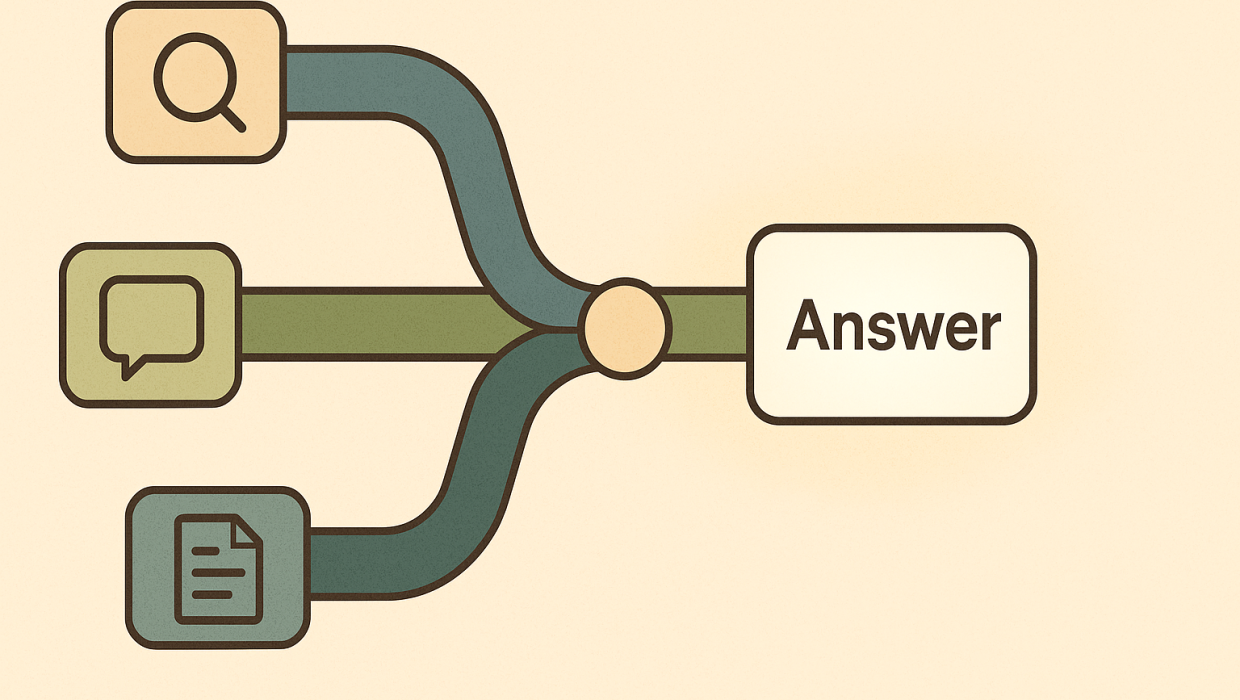
Intelligent automation adds a layer of reasoning. Machine learning models classify and route ambiguous inputs. Natural language processing extracts intent from emails, contracts, or support tickets. Predictive models flag anomalies before they become incidents. The system doesn’t just execute — it interprets, decides, and escalates only what genuinely needs a human. This is the core of what we build through our AI integration and automation services: systems that get smarter as they get busier, rather than more fragile.
The distinction matters because most enterprise inefficiency doesn’t live in the obvious, high-volume tasks — those get automated eventually, one way or another. It lives in the exceptions, the edge cases, the “someone will figure it out” processes that quietly consume 20-30% of skilled labor hours across departments.
Why Enterprise Systems Break Without It
Enterprise systems fail predictably. Not through catastrophic outages, but through erosion — the slow accumulation of manual workarounds that were never supposed to be permanent.
The Cost of Fragmented Workflows
Consider a mid-sized manufacturer running separate systems for ERP, CRM, inventory, and field service. Each system is competent on its own. But data doesn’t move between them without someone exporting a spreadsheet, reformatting it, and importing it somewhere else. Multiply that across departments and you get an organization where the “system of record” is actually three systems and a shared drive full of version-conflicted files.
This is where workflow efficiency quietly dies. Not in any single broken process, but in the friction between processes — the handoffs, the re-entry, the reconciliation. Intelligent automation targets exactly this seam. Integration layers can synchronize data across platforms in real time, apply business logic during the handoff, and flag discrepancies before they propagate downstream. The fix isn’t a bigger system. It’s a smarter connective layer between the systems you already have — which is often far less disruptive, and far cheaper, than a full platform replacement.
The Diagnosis-Before-Build Approach to Business Automation
Here’s where most automation initiatives go wrong before a single line of code is written: they start with a tool instead of a process map. Someone reads about an AI platform, buys a license, and then goes looking for a problem to justify it. Six months later, adoption is low, ROI is unclear, and the vendor gets blamed for what was actually a scoping failure.
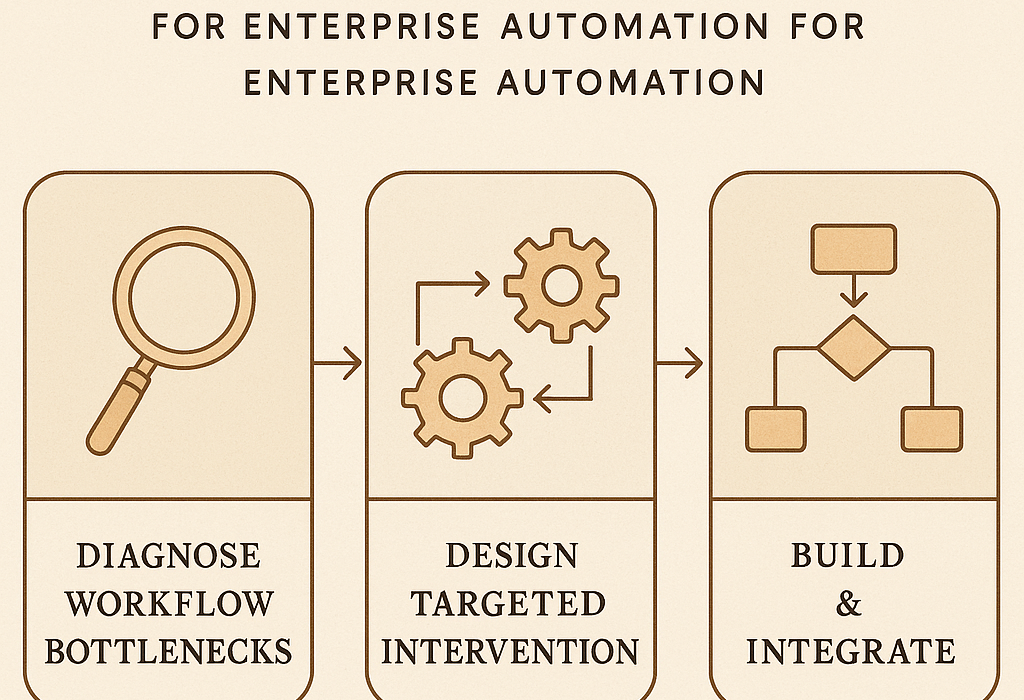
The alternative is diagnosis before build. Before recommending any automation, the real question is: where does this organization actually lose time, accuracy, and money? That means mapping workflows end to end, interviewing the people who do the work (not just the people who manage it), and quantifying friction in hours and dollars, not vague dissatisfaction. Only once that diagnostic is complete does it make sense to design the intervention — whether that’s a targeted automation, a custom-built tool, or in some cases, a recommendation to leave a process alone because it’s already efficient. You can see this approach applied across different industries in our case studies, where the automation built was often narrower and more surgical than clients initially expected — and more effective because of it.
This discipline is what separates business automation that sticks from automation that becomes another abandoned pilot. Diagnosis isn’t a preamble to the “real work.” It is the real work. The build is just execution of a decision that’s already been made correctly.
AI Integration in Practice
Abstractions are easy to nod along to and hard to act on, so it’s worth grounding this in specifics.
Real-World Applications
- Accounts payable: AI models read invoices in any format, match them against purchase orders, flag mismatches, and route only genuine exceptions to a human — cutting processing time from days to hours.
- Customer service triage: NLP classifies incoming tickets by intent and urgency, auto-resolving common requests and routing complex ones to the right specialist with full context already attached, instead of a cold handoff.
- Sales operations: Predictive scoring models rank leads by likelihood to convert, feeding a CRM automatically so sales reps spend time on prospects worth the effort rather than working a list top to bottom.
- Field service and maintenance: Sensor data feeds predictive models that flag equipment likely to fail, converting reactive maintenance into scheduled maintenance — a shift that alone can cut downtime costs significantly.
None of these examples require a moonshot AI platform. They require a clear-eyed read of where judgment is currently being spent on repetitive pattern recognition, and a well-integrated model that can do that recognition faster and more consistently. The underlying technology stack matters less than the fit between the tool and the actual bottleneck — which is exactly why diagnosis has to come first.
Workflow Efficiency as a Strategic Asset
It’s tempting to treat automation as a cost-cutting exercise — and it often does cut costs. But framing it purely that way undersells what’s actually happening. Workflow efficiency, done well, is a competitive asset. It compounds.
An enterprise that automates its exception-handling doesn’t just save labor hours; it responds to customers faster, which improves retention. It catches billing errors before they reach a client, which protects trust. It frees senior staff from data reconciliation, which means they’re actually available for the strategic work they were hired to do. These second-order effects are usually larger than the first-order labor savings, but they rarely show up in the initial business case because they’re harder to quantify in advance.
This is also where automation intersects with broader infrastructure decisions. If your enterprise systems are running on aging, poorly documented, or siloed infrastructure, intelligent automation will expose that fragility faster than it fixes it — which is why automation initiatives often surface the need for parallel work with IT infrastructure and systems support to make sure the foundation can actually support the intelligence being layered on top of it.
Building for Augmentation, Not Replacement
There’s a reason our approach centers on augmenting people rather than replacing them, and it’s not purely philosophical — it’s practical. Fully autonomous systems that remove humans from the loop entirely tend to fail in exactly the moments that matter most: novel situations, judgment calls, relationship-sensitive interactions. The organizations getting the most out of intelligent automation are the ones using it to remove the repetitive 80% of a role so people can focus on the 20% that actually requires expertise, context, and relationship.
That reframing changes how automation gets adopted internally, too. Teams resist tools they perceive as threats. They adopt tools that visibly make their own work better. Designing automation with that adoption dynamic in mind — not just the technical architecture — is often the difference between a six-month pilot and a five-year system of record.
If any of this sounds like it’s describing gaps in your own organization, that’s usually the right moment to talk it through before committing budget to a direction that hasn’t been diagnosed yet. You can start a conversation with our team to walk through where your specific bottlenecks actually live.
Where to Start
The honest answer is: not with a platform decision. Start with a process audit. Identify where time, accuracy, or revenue is leaking — not where it’s most visible, but where it’s most persistent. Quantify it. Then design the smallest intervention that addresses the actual cause, not the most impressive one that addresses a symptom.
Enterprise systems don’t need more automation for its own sake. They need the right automation, applied precisely, in the right sequence, with room to expand as it proves out. That’s the operating principle behind our intelligent automation and AI integration work — diagnose thoroughly, build precisely, and let the results justify the next phase rather than the pitch deck.
Ready to Diagnose Where Automation Actually Belongs?
Start a conversation with Sapiens + Machines to discuss your goals, challenges, and next steps.