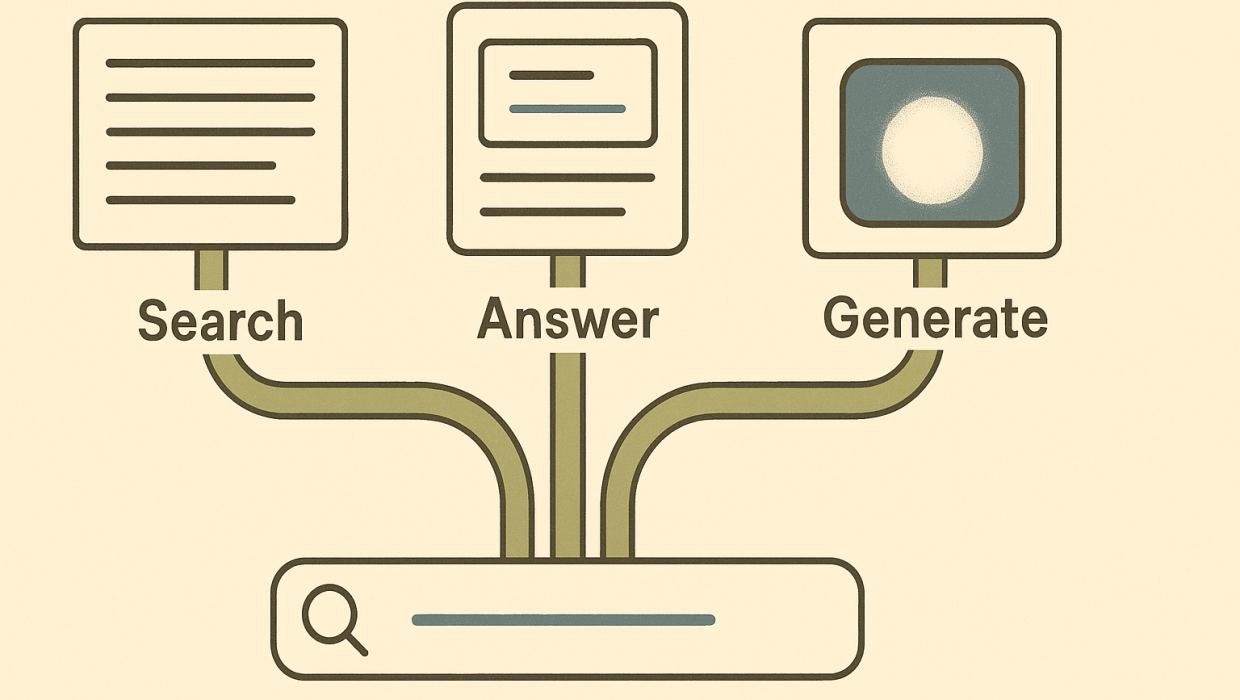
If your SEO strategy still treats Google as the only audience that matters, you’re already behind. Search has quietly split into three parallel systems — traditional search engines, AI-powered answer engines, and generative engines that summarize rather than list — and each one evaluates your content by different rules. SEO strategy adaptation isn’t a future consideration for B2B marketing leaders anymore. It’s the difference between being cited by an AI answer engine tomorrow and being invisible to it.
The Ground Has Shifted Under Search
For two decades, search engine optimization meant one thing: earn a high position on a results page built from ten blue links. That model is eroding fast. Google’s AI Overviews now answer a growing share of queries before a user ever scrolls to organic results. ChatGPT, Perplexity, and Claude field research and purchasing questions that used to start with a Google search. Each of these systems pulls from different signals, weighs authority differently, and rewards content structured in ways traditional SEO never demanded.
Three Engines, Three Sets of Rules
Traditional SEO still matters — technical health, backlinks, and page experience remain foundational. But Answer Engine Optimization (AEO) and Generative Engine Optimization (GEO) layer entirely new requirements on top. AEO strategy is about winning the featured snippet, the voice assistant response, the “position zero” moment where a direct question gets a direct answer. GEO optimization goes further: it’s about being the source a generative model synthesizes into its own language, often without a click-through at all. A page that ranks beautifully on Google can be completely absent from an AI Overview if it isn’t structured for extraction and synthesis.
A page that ranks beautifully on Google can be completely absent from an AI Overview if it isn’t structured for extraction and synthesis.
Why SEO Strategy Adaptation Can’t Wait
Here’s the uncomfortable math: industry data increasingly shows that a meaningful share of informational queries now resolve without a single click to a website. For B2B companies whose entire funnel depends on being found during research-phase queries, that’s not a marginal shift — it’s an existential one for organic visibility. If your target buyer asks an AI assistant “what’s the best CRM integration partner for a mid-size manufacturer,” and your company never appears in that synthesized answer, you’ve lost the lead before your sales team ever knew it existed.
This is precisely why generative AI SEO has moved from “interesting trend” to boardroom conversation. CTOs are asking whether their content infrastructure can even be parsed by large language models. Marketing directors are watching organic traffic hold steady while lead quality erodes, because the easy informational queries are being absorbed by AI answers and only the harder, more qualified searches make it to a website. Agency owners are fielding client questions about AI visibility they don’t yet have frameworks to answer.
What Generative AI SEO Actually Changes
From Keywords to Context
Traditional keyword optimization assumed a search engine matched strings of text. Generative models don’t work that way — they build a contextual understanding of a topic and then generate a response drawing from the sources that best represent that context. This means content built around keyword density is increasingly irrelevant, while content built around genuine topical authority, clear entity relationships, and well-structured claims is rewarded. Comprehensive, well-organized answers to specific questions consistently outperform generic, broad-strokes pages.
From Rankings to Retrieval
The second shift is architectural. Generative engines rely heavily on structured data — schema markup, clear headings, consistent entity naming — to retrieve and correctly attribute information. A page can have excellent writing and still be functionally invisible to an AI crawler if it lacks the technical scaffolding that makes its claims machine-readable. This is where technical SEO and AEO strategy intersect: the sites winning AI visibility today are the ones that treated structured data as infrastructure, not an afterthought. We go deeper into this technical layer on our SEO, AEO, and GEO service page, where we break down exactly how our audits assess machine-readability alongside traditional ranking factors.
GEO Optimization: Optimizing for Machines That Summarize, Not Link
GEO optimization requires a mental model shift that a lot of experienced SEO practitioners resist, because it de-emphasizes the click. If a generative engine can answer a user’s question directly, citing your company as the source, that’s a win for brand visibility and trust — even without a visit. The metric that matters shifts from “traffic” to “share of voice within AI-generated answers.” Measuring that requires new tools and new reporting frameworks, and most legacy SEO dashboards simply weren’t built to track it.
For B2B search strategy specifically, this matters more than most categories realize. B2B buying cycles are long and research-heavy, with multiple stakeholders independently verifying vendors before a sales conversation ever starts. If your company is absent from the AI-generated comparisons and summaries those stakeholders are quietly consulting, you’re losing influence in the decision before your sales team gets a seat at the table.
A Diagnosis-Before-Build Approach to Generative Adaptation
The temptation, when a new discipline like GEO emerges, is to bolt on tactics — add some schema, tweak some headers, publish an “AI-optimized” blog post, and call it done. We don’t work that way, and we’d caution any B2B leader against a partner who does.
Real SEO strategy adaptation starts with diagnosis: what does your current content actually look like to a large language model? Which pages are structured for extraction and which are effectively invisible to it? Where is your technical foundation solid, and where are outdated CMS decisions or thin content actively working against you? Only once that diagnostic picture is clear does it make sense to build — new content architecture, updated schema, a content strategy that treats AEO and GEO as extensions of a unified search presence rather than separate initiatives bolted onto old SEO habits.
This is the same discipline we apply across every engagement, and you can see it play out in practice across different industries in our case studies, where technical and content changes were sequenced deliberately rather than thrown at a problem all at once.
What This Looks Like for B2B Teams
For a CTO evaluating technology partners, this often means an infrastructure conversation first: is your site’s technical foundation — page speed, crawlability, structured data — capable of supporting AEO and GEO work at all, or does it need remediation before content strategy can even be effective? That conversation frequently overlaps with broader AI automation planning, since the same structured, machine-readable data that helps a generative engine understand your content is often the same data your internal systems need to function well together.
For a marketing director, the shift usually shows up in content operations: how questions are researched, how FAQ-style content is structured, how existing high-performing pages get retrofitted for extraction rather than abandoned in favor of starting over. For an agency owner, it’s often a capability gap — recognizing that AEO strategy and GEO optimization require technical fluency that traditional content teams weren’t hired for, and deciding whether to build that capability internally or bring in a partner who already has it.
Whichever seat you’re in, the underlying question is the same: does your current search strategy account for how buyers actually find information today, across all three engines, or only for how they found it five years ago?
Where to Start
The honest answer is that most companies don’t need a total rebuild — they need a clear-eyed audit of where they stand across traditional search, answer engines, and generative engines, and a sequenced plan to close the gaps that matter most. That’s exactly the kind of diagnostic work we do on our SEO, AEO, and GEO services page, and it’s also the kind of conversation worth having before committing budget to any single tactic.
The technology underpinning generative search is evolving quickly, and staying current with how these models actually retrieve and synthesize information is part of what separates effective adaptation from guesswork — you can see how we track that shift on our technology page. If you’re weighing whether your current search visibility is holding up under this shift, that’s a conversation worth having now, not after the next algorithm update makes the gap impossible to ignore. You can start that conversation with our team whenever you’re ready to look at what’s actually happening under the hood.
Search didn’t get harder because the rules changed once. It got harder because three different rule sets now run simultaneously, and most companies are still only playing to one of them.
RELATED QUESTIONS
What is the difference between SEO, AEO, and GEO?
SEO (search engine optimization) focuses on ranking web pages in traditional search results. AEO (answer engine optimization) targets direct-answer formats like featured snippets and voice assistant responses. GEO (generative engine optimization) focuses on being cited or synthesized as a source within AI-generated answers from tools like ChatGPT or AI Overviews, often without a click-through at all.
Why is generative AI changing SEO strategy for B2B companies?
Generative AI tools increasingly answer research-phase questions directly, meaning B2B buyers can evaluate vendors and solutions without ever visiting a company’s website. If a company’s content isn’t structured for AI retrieval and synthesis, it becomes invisible during exactly the research stage where B2B buying decisions are most influenced.
Do I need to rebuild my whole website for generative engine optimization?
Usually not. Most companies need a diagnostic audit to identify which pages are already well-structured for AI extraction and which need updated schema, clearer headings, or restructured content, rather than a full rebuild. Sequencing fixes based on impact is more effective than starting over.
How do I know if my content is visible to AI answer engines?
You can test this by asking AI tools like ChatGPT or Perplexity questions your target buyers would ask and checking whether your company appears as a cited source. A proper technical audit also examines structured data, schema markup, and content organization to assess machine-readability beyond what manual testing can reveal.
What should come first when adapting an SEO strategy for AI search?
Diagnosis should always come before tactical changes. Understanding where your current technical foundation and content structure are already working, and where they’re actively blocking AI visibility, prevents wasted effort on fixes that don’t address the actual gap.
Ready to Adapt Your Search Strategy Before Your Competitors Do?
Start a conversation with Sapiens + Machines to discuss your goals, challenges, and next steps.