Most B2B teams don’t lose leads because they aren’t generating enough of them. They lose them because the leads they’ve already earned get stuck, mislabeled, or dropped somewhere between the form fill and the first sales conversation. These CRM lead barriers are rarely dramatic — no one notices a single field mapping error or a stalled webhook — but compounded over months, they quietly erode pipeline in ways that look, from the outside, like a demand generation problem.
If your marketing team is hitting its traffic and conversion targets but sales still says the pipeline feels thin, the issue usually isn’t upstream. It’s inside the machine you already built.
The Hidden Cost of CRM Lead Barriers
A CRM is supposed to be the connective tissue between marketing, sales, and customer success — the single source of truth that tells everyone who’s interested, how interested, and what to do next. In practice, most CRMs accumulate years of workarounds: fields added for one campaign and never used again, integrations built by a vendor who’s long gone, routing rules that made sense for a five-person sales team but not the twenty-person team that exists today.
None of these things fail loudly. A lead doesn’t bounce back with an error message when it’s assigned to the wrong rep or dropped into a stale list. It just sits there, aging, until someone notices — usually a sales director asking why close rates have slipped, or a CTO auditing tool spend and wondering why the company pays for three systems that don’t talk to each other.
This is the core problem with sales funnel blockages: they’re invisible by design. The system keeps functioning. Leads keep coming in. But the flow rate — how many prospects move cleanly from awareness to a qualified conversation — quietly drops, and nobody can point to the exact moment it happened.
Where Sales Funnel Blockages Actually Hide
Diagnosing CRM lead barriers means looking past the dashboard and into the actual mechanics of how a lead moves through your stack. In our work helping B2B teams rebuild their lead generation infrastructure, the same handful of failure points show up again and again.
Broken or Brittle Integrations
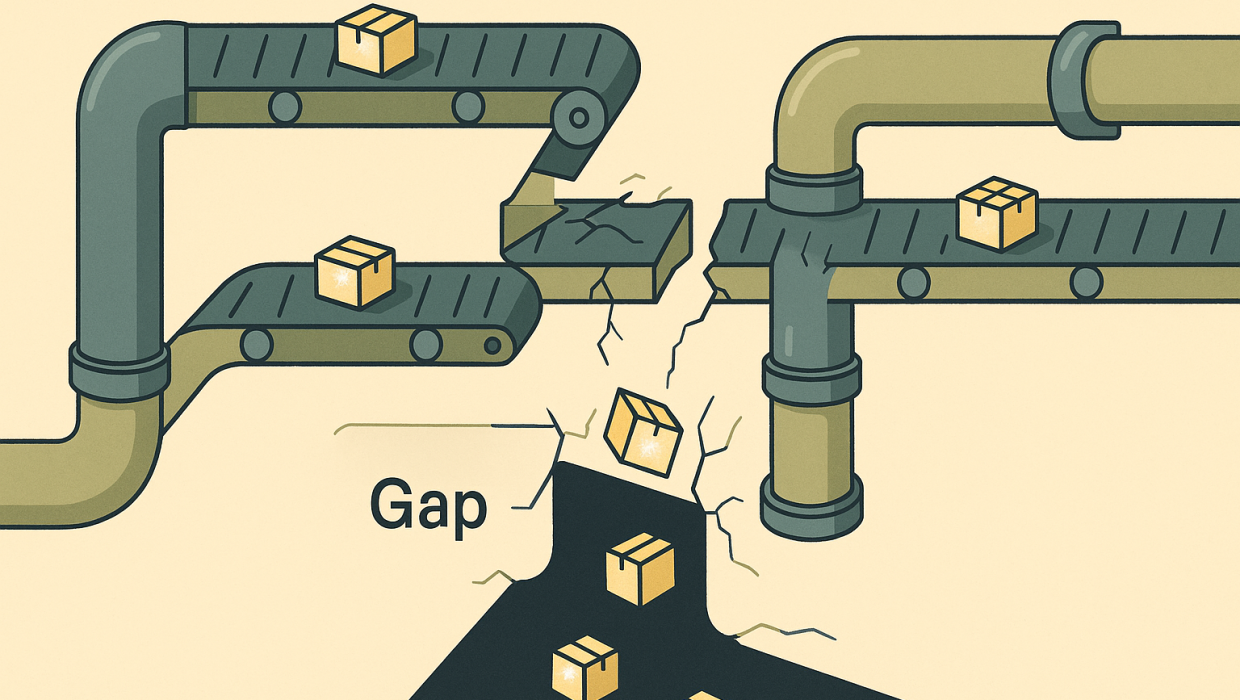
Marketing automation platforms, ad platforms, chatbots, scheduling tools, and the CRM itself are usually connected through a patchwork of native integrations, Zapier workflows, and custom API calls built at different times by different people. Each connection point is a place where data can silently fail to pass through — a field that doesn’t map correctly, an API rate limit that gets hit during a traffic spike, an authentication token that expired six months ago and nobody renewed. These CRM integration issues rarely trigger alerts. They just result in leads that exist in one system but never make it to the next.
Manual Handoffs and Dead Zones
Even in reasonably automated stacks, there’s often a manual step hiding somewhere — a rep who has to log into a separate tool to check for new form submissions, a marketing coordinator who exports a spreadsheet every Monday, a sales development rep who’s supposed to claim leads from a shared inbox. Manual steps are where speed dies. Research on lead response time consistently shows that the odds of qualifying a lead drop sharply after the first five minutes of inactivity — and a single manual handoff can turn a five-minute delay into a five-hour one.
Inconsistent or Incomplete Data
A lead scoring model is only as good as the data feeding it. If your forms collect inconsistent fields, if lead source attribution breaks between your website and your CRM, or if duplicate records fragment a single prospect’s history across three entries, your routing logic is making decisions on bad information. This is one of the most common — and most fixable — causes of poor lead flow optimization, because it doesn’t require new technology, just better data hygiene and clearer field governance.
Routing Rules Built for a Different Company
Routing logic that made sense when you had one sales rep and one product line often breaks down as teams, territories, and offerings grow. Leads get sent to the wrong queue, sit unassigned because a rule references a rep who left the company, or get double-routed and worked by two reps simultaneously — which damages the prospect experience more than a delay ever would.
The biggest lead flow problems are rarely visible on a dashboard — they live in the gaps between systems that were never designed to talk to each other.
Diagnosing Before You Build
It’s tempting, when pipeline feels sluggish, to respond by adding something — a new scoring tool, a new automation platform, a new headcount to manually patch the gaps. But bolting technology onto a broken process usually just adds a more expensive layer on top of the same blockage.
The more useful first step is a genuine audit: mapping every stage a lead passes through, from the moment it’s captured to the moment a rep engages with it, and identifying exactly where volume, speed, or data quality drops. This is the diagnosis-before-build principle we apply to every engagement, and it’s especially critical here, because CRM problems are so easy to misdiagnose as marketing problems. We’ve seen companies increase ad spend to compensate for a funnel that was actually leaking leads internally — solving the wrong problem at real cost.
A proper audit typically traces a handful of test leads through the entire system in real time, checks every integration point for silent failures, and reviews routing and scoring rules against how the sales team actually operates today, not how it operated when those rules were written.
What Lead Flow Optimization Looks Like in Practice
Once the actual blockages are identified, the fixes are usually more surgical than people expect. Sometimes it’s rebuilding two or three integrations with proper error handling and monitoring, so a failed sync triggers an alert instead of a silent data gap. Sometimes it’s consolidating duplicate records and standardizing form fields so scoring models have clean data to work with. Sometimes it’s automating a handoff that a person was doing manually — not to remove human judgment from the process, but to make sure the right lead reaches the right person’s attention fast enough for that judgment to matter.
This is where thoughtful automation earns its place — not as a wholesale replacement for sales process, but as the connective layer that keeps leads moving at the speed your team already intends. We’ve applied this same logic in engagements documented in our case studies, where the highest-leverage fix wasn’t a new platform but a properly diagnosed and rebuilt handoff between existing systems.
For companies whose CRM sits inside a broader web of custom tools and internal systems, the fix sometimes extends beyond the CRM itself into the surrounding software architecture — particularly when lead data needs to flow between a CRM, a proprietary quoting tool, or an internal operations platform that was never built with integration in mind.
The Fix Isn’t Always More Technology
Here’s the insight worth sitting with: the biggest lead flow problems are rarely visible on a dashboard — they live in the gaps between systems that were never designed to talk to each other. Dashboards report what made it through. They don’t report what got lost along the way. That’s precisely why so many CRM lead barriers persist for years — everyone is looking at conversion rates and cost-per-lead, and nobody is looking at the seams between platforms where leads quietly disappear.
Fixing this isn’t about buying a more sophisticated CRM or layering on another automation tool. It’s about understanding, in granular detail, how a lead actually moves through your specific stack — and being honest about where that movement breaks down. That diagnostic clarity is worth more than almost any feature upgrade.
If your team suspects leads are getting lost somewhere between marketing and sales but can’t pinpoint exactly where, that’s usually the sign of a system that needs a real audit rather than another patch. Our lead generation and funnel diagnostics work is built around exactly this kind of forensic review — tracing leads step by step until we find the actual point of failure, not just the symptom.
Getting Started
The good news is that most CRM lead barriers are fixable without a full platform migration or a six-month rebuild. The bad news is that they’re almost impossible to see from inside the day-to-day operation of the business — which is exactly why an outside diagnostic perspective tends to surface problems that internal teams have stopped noticing.
If pipeline has felt thinner than your top-of-funnel numbers would suggest, it’s worth having a conversation before assuming the answer is more spend or more headcount. You can start a conversation with our team to talk through what a diagnostic audit of your current CRM and funnel would actually look like for your business.
Lead flow optimization isn’t a one-time project — it’s an ongoing discipline of watching where volume and velocity change as your team, tools, and offerings evolve. But it starts with the same principle behind everything we build: understand exactly what’s broken before you decide what to fix.
RELATED QUESTIONS
What are CRM lead barriers?
CRM lead barriers are the hidden points of friction inside a company’s CRM and connected sales tools that cause qualified leads to stall, get lost, or reach the wrong person. They typically stem from broken integrations, manual handoffs, inconsistent data fields, or outdated routing rules rather than any single obvious system failure.
How do I know if my CRM is losing leads?
Common warning signs include a gap between strong marketing conversion numbers and thin sales pipeline, leads that sit unassigned for hours or days, duplicate records for the same contact, and reps reporting that they’re missing leads marketing says were sent. The most reliable way to confirm it is tracing several test leads manually through your entire stack from form submission to sales engagement.
What causes sales funnel blockages between marketing and sales?
Sales funnel blockages usually occur at the handoff points between systems — where marketing automation platforms pass leads to a CRM, and where the CRM routes them to individual sales reps. Failed API syncs, expired authentication tokens, mismatched field mapping, and manual steps in an otherwise automated process are the most frequent culprits.
Should I buy a new CRM to fix lead routing problems?
Not usually. Most lead routing problems stem from how an existing CRM is configured, integrated, and maintained rather than a limitation of the platform itself. A diagnostic audit typically finds that rebuilding specific integrations and cleaning up routing rules resolves the issue far more cheaply and quickly than a full platform migration.
How often should a company audit its CRM for lead flow issues?
A full CRM and funnel audit is worth doing at least annually, and immediately after any significant change such as adding a new sales team, launching a new product line, or switching marketing automation tools. Smaller data hygiene checks — reviewing duplicate records, stale routing rules, and integration error logs — are worth doing quarterly.
Let's Diagnose What's Actually Blocking Your Lead Flow
Start a conversation with Sapiens + Machines to discuss your goals, challenges, and next steps.