Every enterprise eventually hits the same wall: the software that once ran the business now runs against it. Spreadsheets multiply, workarounds calcify into “process,” and three different departments quietly maintain three different versions of the truth. This is usually the moment leadership starts asking whether custom software solutions are worth the investment — and it’s the right question to ask, because the answer has less to do with technology and more to do with competitive advantage.
The enterprises pulling ahead in their markets right now aren’t necessarily the ones with the most software. They’re the ones whose systems actually match how their business works. That distinction — subtle on paper, enormous in practice — is where custom software stops being an IT line item and starts being a strategic asset.
Why Off-the-Shelf Software Hits a Ceiling
Commercial software is built for the average customer, which means it’s built for no one in particular. It solves the 70% of a workflow that’s common across an industry and leaves the other 30% — the part that actually differentiates your business — to manual effort, duct-taped integrations, or outright neglect.
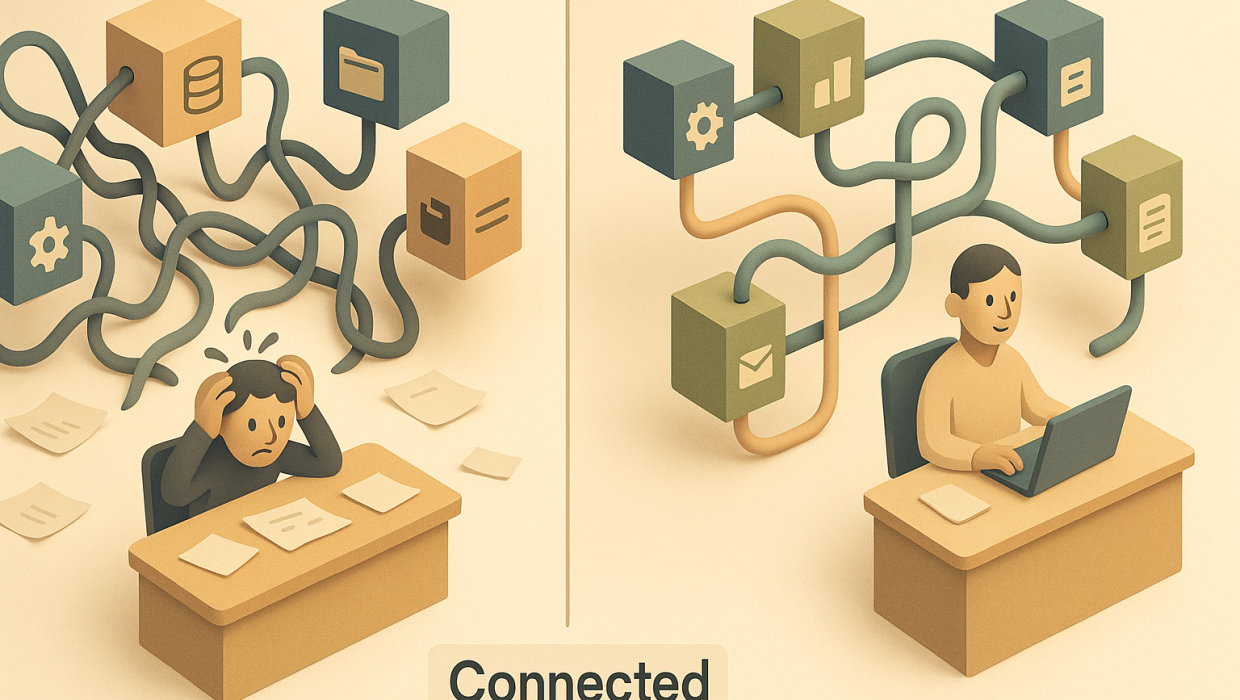
For a while, that’s a tolerable trade-off. Then the enterprise scales, adds product lines, enters new markets, or acquires a company with an entirely different tech stack, and the cracks widen into structural problems. Data lives in five systems that don’t talk to each other. Reporting takes days instead of minutes. Every new hire has to learn not just the job, but the improvisation required to make the tools do the job.
This is the point at which enterprise technology decisions stop being tactical and become existential. A platform that can’t flex with the business isn’t neutral — it’s actively constraining growth.
A platform that can’t flex with the business isn’t neutral — it’s actively constraining growth.
How Custom Software Solutions Drive Competitive Advantage
Custom software solutions close that gap by inverting the logic of commercial tools: instead of forcing the business to conform to the software, the software is built to conform to the business. That sounds obvious, but it’s rarely how enterprise technology actually gets procured. Most organizations buy a platform, then spend years bending internal process around its limitations.
Enterprise Technology Built Around Actual Workflow
When a system is designed around how work genuinely happens — not how a vendor’s product roadmap imagined it might happen — friction disappears in places leadership didn’t even know it existed. Approval chains that used to take days move in hours. Sales and operations stop reconciling numbers manually because they’re pulling from the same source. The advantage isn’t a single dramatic feature; it’s the compounding effect of removing dozens of small frictions that were quietly taxing every employee, every day.
This is precisely the terrain covered by our software solutions practice, where the goal is never to ship technology for its own sake, but to rebuild the parts of an operation that are costing the business time, accuracy, or opportunity.
B2B Innovation as a Byproduct, Not a Slogan
“Innovation” gets thrown around loosely in B2B marketing, but real B2B innovation is usually unglamorous: it’s a pricing engine that can handle a contract structure your industry actually uses, or an internal tool that lets account managers see churn risk before a client says a word. Custom systems create room for this kind of innovation because they aren’t locked into a vendor’s release cycle. If a new capability would meaningfully change how the business competes, it can be built — not requested, voted on, and maybe delivered eighteen months later.
Diagnosis Before Build: Why Most Custom Software Fails
The uncomfortable truth is that plenty of custom software projects fail — not because custom development is inherently risky, but because most of them skip the diagnostic work and jump straight to building. A development team hands over exactly what was specified, and six months later everyone discovers the specification was solving the wrong problem.
A rigorous approach starts by mapping how information, decisions, and bottlenecks actually move through the organization — including the unofficial workarounds nobody wants to admit exist. Only once that picture is clear does the build begin. This diagnosis-before-build sequence is slower at the start and dramatically faster everywhere after, because the resulting system is solving a problem that’s been properly defined rather than one that was assumed.
Enterprises that treat this diagnostic phase as optional tend to end up with expensive software that automates a broken process instead of fixing it.
Where Custom Software Solutions Deliver the Most Value
Not every function needs a bespoke build — and part of good diagnosis is knowing when a commercial tool is genuinely the right call. But certain categories of enterprise work consistently reward custom investment.
Internal Tools That Remove Friction at Scale
Internal tools rarely get the attention that customer-facing products do, but they’re often where the most competitive advantage is hiding. A custom dashboard that gives regional managers real-time visibility into inventory, or a tool that automates the tedious parts of compliance reporting, doesn’t generate headlines — it generates margin. When these tools are purpose-built rather than adapted from generic project management software, employees stop fighting the system and start using it the way it was intended.
Systems Integration Across a Fragmented Stack
Most enterprises aren’t short on data; they’re short on data that talks to itself. CRM, ERP, marketing automation, and finance systems frequently operate as isolated silos, each producing its own version of reality. Custom integration work — often paired with automation that removes manual handoffs between systems — turns that fragmented stack into a single coherent operating picture. That coherence is itself a competitive advantage: decisions get made on current, accurate data instead of last week’s export.
Enterprises that have gone through this kind of overhaul are worth studying directly; our case studies walk through what the diagnostic-to-build process actually looked like in practice, including the missteps that shaped the final approach.
The Real Cost of Waiting
The instinct in many organizations is to defer custom development until the pain becomes unbearable. That instinct is expensive. Every quarter spent on a workaround is a quarter of accumulated technical debt, lost institutional knowledge (because the workaround usually lives in one person’s head), and competitors quietly closing the gap with systems that already work the way they need them to.
There’s also a talent dimension that’s easy to underestimate. Skilled employees don’t enjoy fighting bad software. Retention suffers when the tools people rely on daily are visibly worse than what they’d have access to elsewhere. Custom software solutions aren’t just an operational upgrade — they’re a signal, internally, that the business is serious about removing unnecessary friction from people’s jobs.
This is also where enterprise technology decisions intersect with broader IT resilience. A custom system built without attention to infrastructure, backups, or access controls creates new risk even as it solves old problems — which is why software strategy and IT infrastructure planning need to be considered together rather than as separate conversations.
Getting Started Without Overcommitting
The path into custom software doesn’t have to start with a sweeping, multi-year platform rebuild. The more reliable pattern is to start narrow: pick the single workflow causing the most visible pain, diagnose it properly, and build a focused solution before expanding scope. This limits risk, builds internal trust in the process, and generates early proof points that make the case for further investment.
It’s also worth evaluating custom development alongside the rest of the technology stack — including how well internal systems connect to customer-facing infrastructure like a company’s web platform, since disconnected front-end and back-end systems create many of the same reconciliation headaches as disconnected internal tools. A broader view of the current technology landscape, and where the gaps genuinely are, is available on our technology overview page.
Enterprises that get this right treat software the way they’d treat any other strategic asset: with a clear diagnosis of what’s actually broken, a build process grounded in that diagnosis, and a willingness to invest before the pain becomes a crisis. Our custom software solutions team works from that same premise on every engagement — understand the operation first, then build only what actually moves it forward.
The Bottom Line
Competitive advantage in enterprise technology rarely comes from having more software. It comes from having systems that reflect how the business genuinely operates — systems that make good judgment easier to act on, not harder. If your internal tools are quietly working against your team instead of for it, that’s a solvable problem, and it’s worth solving before a competitor solves it first. If you’re ready to talk through where the friction actually lives in your operation, you can start a conversation with our team.
RELATED QUESTIONS
What are custom software solutions and how are they different from off-the-shelf software?
Custom software solutions are systems built specifically for one organization’s workflows, data structures, and goals, rather than designed to serve a broad market of similar businesses. Off-the-shelf software solves the common denominator of a problem, while custom software is shaped around the specific processes, exceptions, and priorities of a single enterprise, which is why it often removes friction that generic tools can’t.
How do custom software solutions create a competitive advantage for enterprises?
They create competitive advantage by aligning technology with how the business actually operates, which speeds up decisions, reduces manual reconciliation between systems, and frees employees from workarounds that off-the-shelf tools force onto them. Over time, this compounding efficiency and accuracy becomes difficult for competitors relying on generic platforms to match.
Why do so many custom software projects fail to deliver value?
Most custom software projects fail because teams skip proper diagnosis and jump straight into building, which results in a system that automates a poorly understood or already-broken process. A diagnosis-before-build approach, where the actual workflow and its exceptions are mapped first, prevents this by ensuring the build addresses the real problem rather than an assumed one.
Is custom software a good investment for a mid-sized enterprise, or only for large companies?
Custom software can be a strong investment for mid-sized enterprises, especially when a single high-friction workflow is causing disproportionate cost or delay. The most reliable approach is to start with a narrow, well-diagnosed problem rather than a full platform rebuild, which limits risk while still proving the value of the investment.
What’s the first step a company should take before investing in custom software?
The first step should be a thorough diagnosis of how work actually flows through the organization today, including informal workarounds that official documentation doesn’t capture. Building before this diagnosis is complete is the most common reason custom software projects underdeliver, so this discovery phase should be treated as a required part of the process, not a formality.
Ready to Turn Your Systems Into a Competitive Edge?
Start a conversation with Sapiens + Machines to discuss your goals, challenges, and next steps.