Most enterprises are automating pieces of the customer journey — a chatbot here, a lead-scoring model there — without ever stepping back to ask whether those pieces add up to something coherent. That’s the gap AI-driven customer journey automation is meant to close: not another point solution, but a connected system that senses where a customer is, predicts what they need next, and acts on it faster than any human team could alone. The question worth asking isn’t whether your enterprise has “some AI” running somewhere. It’s whether that AI is actually orchestrating a journey, or just decorating one.
The Customer Journey Has Outgrown Manual Orchestration
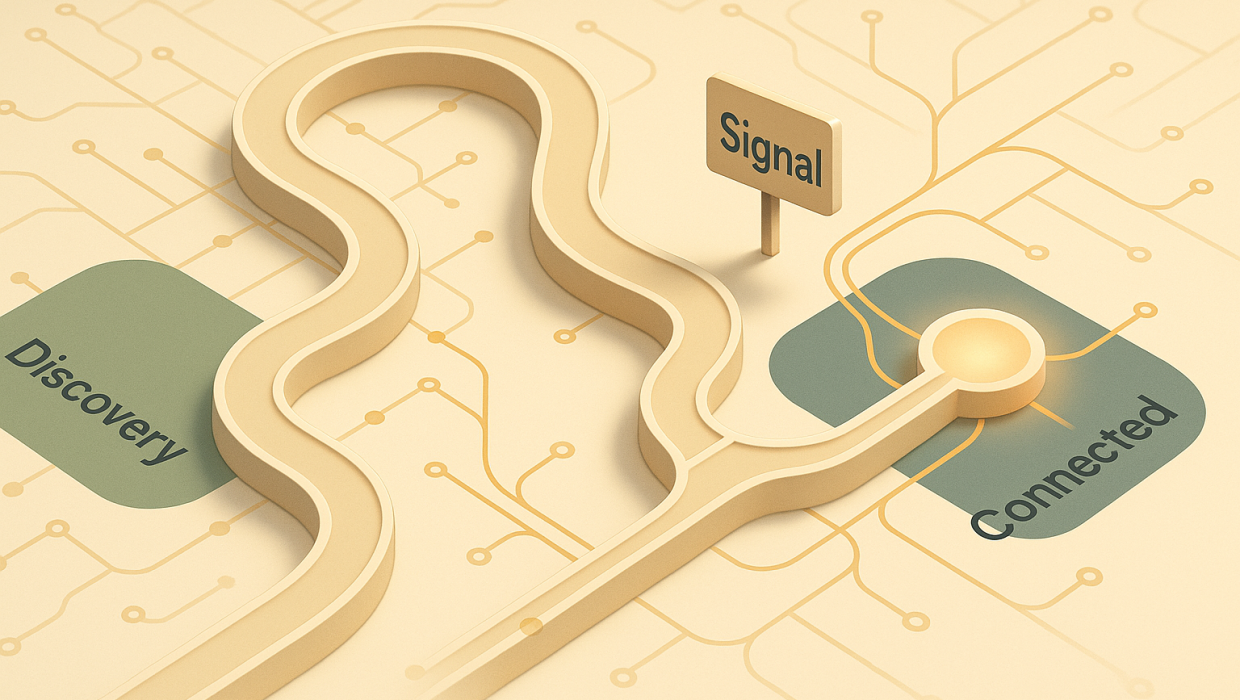
The B2B buying journey today rarely moves in a straight line. A prospect might discover you through a search result, disappear for three weeks, resurface via a LinkedIn ad, download a whitepaper, ghost your sales team, and then convert six months later after a single well-timed email. Multiply that across thousands of accounts, dozens of channels, and thirty or more touchpoints per deal, and the idea that a marketing team can manually track, segment, and respond to each moment becomes fiction.
This is where enterprise automation earns its keep. Not by replacing marketers and sales reps, but by handling the volume and timing problems that human attention simply cannot solve at scale. The enterprises pulling ahead right now aren’t the ones with the biggest teams — they’re the ones whose systems notice a buying signal at 2 a.m. and act on it before a competitor’s rep even wakes up.
What AI-Driven Customer Journey Automation Actually Means
There’s a lot of noise around this phrase, so it’s worth being precise. AI-driven customer journey automation is the use of machine learning models, predictive scoring, and connected workflow logic to guide a customer through personalized, dynamically adjusted interactions — across web, email, ads, CRM, and sales outreach — based on real-time behavior rather than static rules.
That last distinction matters. A traditional automation platform fires a sequence because someone clicked a link three days ago. An AI-driven system reads the full pattern: what they clicked, how long they lingered, what similar accounts did next, and what content or outreach historically moved accounts like this one toward a closed deal. It’s the difference between a flowchart and a nervous system.
Beyond Chatbots and Drip Campaigns
Too many organizations equate “AI in the customer journey” with a chatbot widget or a slightly smarter email sequence. Those are surface-level applications. The real value shows up underneath — in the intelligent systems that connect your CRM, your marketing automation, your product usage data, and your sales pipeline into one continuously learning loop. When that loop is built correctly, it doesn’t just react to the journey. It starts predicting it, flagging accounts likely to churn or convert weeks before a human would catch the signal. Our AI and automation services are built specifically around this kind of connected, predictive infrastructure rather than isolated tools.
The Diagnosis-Before-Build Difference
Here’s where most AI initiatives quietly fail: they start with a tool instead of a diagnosis. A CTO reads about a new AI platform, a marketing director sees a competitor using predictive lead scoring, and suddenly there’s a mandate to “add AI” to the customer journey — without anyone first mapping what that journey actually looks like, where it breaks down, and what data even exists to train a model on.
Diagnosis-before-build means reversing that order. Before any workflow gets automated or any model gets trained, the real work is understanding the current state: Where do leads actually drop off? Which handoffs between marketing and sales lose momentum? What data is trustworthy, and what’s been rotting in a CRM field nobody’s touched since 2021? Enterprises that skip this step end up automating dysfunction — making a broken process faster instead of fixing it.
This diagnostic discipline is also why AI integration projects so often stall in enterprise environments. The technology isn’t the bottleneck. The absence of a clear map of the journey — and the courage to fix what the map reveals — is.
Where Enterprises Get Stuck
Fragmented Systems, Fragmented Journeys
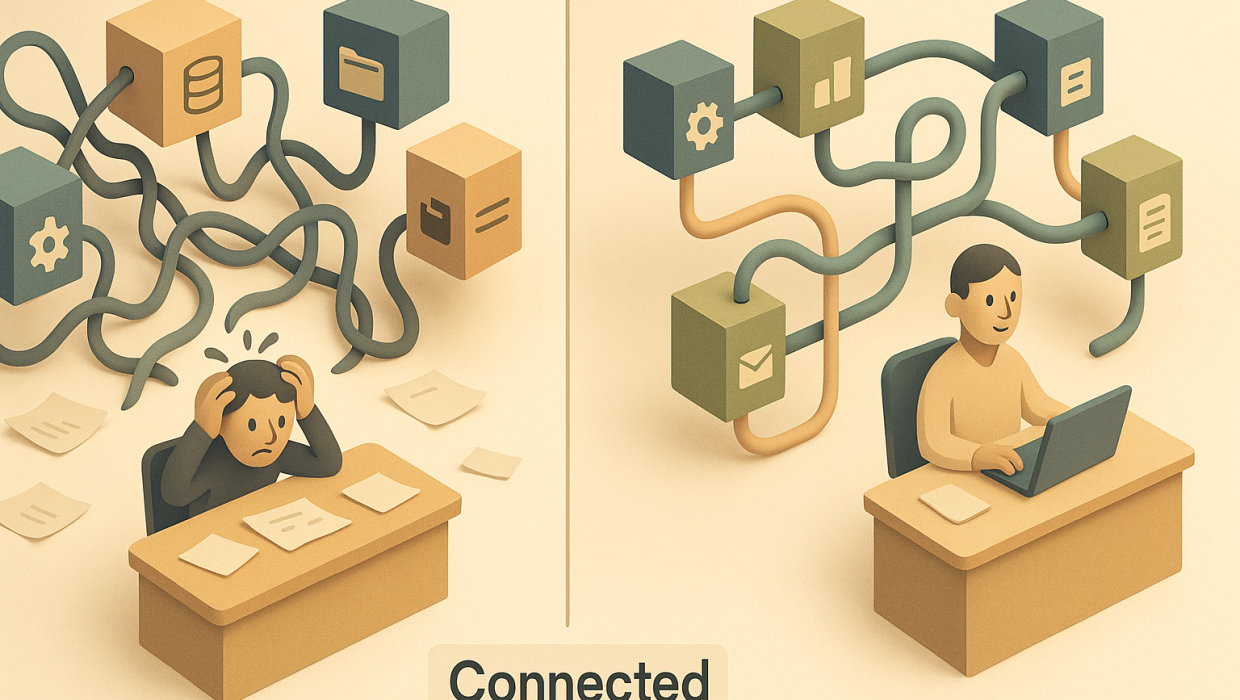
The single most common obstacle we see isn’t a lack of appetite for AI. It’s fragmentation. Marketing runs on one platform, sales lives in another CRM, product usage data sits in a data warehouse nobody in marketing has access to, and customer support tickets are logged in a fourth system that talks to none of the others. You cannot automate a journey that your own systems can’t see end-to-end.
This is the core insight enterprises need to internalize: AI-driven customer journey automation is only as intelligent as the data infrastructure underneath it — and most enterprises haven’t unified that infrastructure enough to make the AI layer worth the investment. Pouring predictive models on top of siloed data doesn’t create intelligence. It creates confident-sounding guesses.
This is the core insight enterprises need to internalize: AI-driven customer journey automation is only as intelligent as the data infrastructure underneath it — and most enterprises haven’t unified that infrastructure enough to make the AI layer worth the investment.
Fixing this often means investment beyond the marketing stack — custom integrations, API work, and sometimes rebuilding core systems so they actually talk to each other. That’s less glamorous than a shiny AI dashboard, but it’s the difference between automation that compounds in value over time and automation that plateaus after the first quarter. Enterprises evaluating this kind of foundational work often find it overlaps directly with custom software solutions designed to unify data across previously disconnected systems.
Building Intelligent Systems That Augment, Not Replace
There’s a version of AI-driven automation that quietly erodes trust: journeys so heavily automated that customers feel processed rather than understood, and sales reps feel sidelined by a black box making decisions they can’t explain. That’s not the version worth building.
The stronger approach treats intelligent systems as an extension of your team’s judgment, not a substitute for it. A predictive model can flag which accounts are showing buying signals and rank them by likelihood to close — but a human still decides how to approach that account, informed by context the model doesn’t have. Automation can trigger the right email at the right moment — but the message itself should still sound like it came from a person who understands the account, because in the best implementations, it did, with AI simply making sure it arrived at the right time.
This is also where AI-driven automation done well pays dividends beyond the marketing funnel — the same predictive infrastructure that scores leads can flag operational risk, surface upsell opportunities in existing accounts, and reduce the manual triage work that burns out revenue teams. Enterprises that have explored lead generation as a standalone function often find the bigger unlock comes from connecting that pipeline to journey-wide automation rather than optimizing lead gen in isolation.
What This Looks Like in Practice
Consider a mid-market SaaS enterprise with a six-month sales cycle and a marketing team drowning in manual lead qualification. A diagnosis-first engagement typically starts by mapping every touchpoint from first visit to closed deal, auditing what data is actually reliable, and identifying where automation would remove friction versus where it would simply mask a deeper process problem.
From there, the build phase connects CRM, marketing automation, and product usage signals into a single scoring and routing system — one that doesn’t just tell sales “this lead is hot,” but explains why, based on which behaviors and account attributes drove the score. Email sequences, ad retargeting, and sales outreach all pull from the same live picture of the account instead of three disconnected guesses. The result isn’t a fully autonomous funnel — it’s a faster, better-informed team making sharper decisions with far less manual digging.
We’ve documented outcomes like this in more detail in our case studies, where the pattern holds consistently: the enterprises that saw the biggest lift weren’t the ones with the most sophisticated AI model, but the ones who did the unglamorous diagnostic work first.
Is Your Enterprise Ready?
Readiness for AI-driven customer journey automation isn’t about budget size or technical sophistication — it’s about whether your organization is honest about the current state of its systems and data. A few questions worth asking internally: Can you trace a single customer’s path across every system they touched, without stitching together three spreadsheets? Do marketing, sales, and product teams trust the same data, or does each team quietly keep its own version of the truth? If a predictive model flagged an account tomorrow, would anyone know what to do with that flag?
If the honest answer to any of those is “not really,” that’s not a disqualifier — it’s the starting point. The enterprises that get the most out of workflow automation and intelligent systems are rarely the ones who had everything figured out beforehand. They’re the ones willing to diagnose the gap before building on top of it.
If you’re weighing whether your current stack, data, and team structure are ready for this kind of investment, it’s worth a direct conversation before committing to a platform or a build. You can start a conversation with our team to walk through where your journey currently breaks down and what a realistic path to automation looks like for your specific systems.
The Bigger Picture
AI-driven customer journey automation isn’t a feature you install. It’s an operating capability you build — one that depends on clean data, connected systems, and a team willing to let the technology handle volume and pattern recognition while keeping human judgment in the driver’s seat for anything that actually requires it. The enterprises treating it that way are already pulling ahead of competitors still bolting chatbots onto broken funnels and calling it transformation.
RELATED QUESTIONS
What is AI-driven customer journey automation?
It’s the use of machine learning and predictive workflow logic to guide customers through personalized experiences across web, email, ads, and sales touchpoints based on real-time behavior. Instead of relying on static, rule-based sequences, it continuously learns from customer signals to adjust timing, messaging, and channel in real time. The goal is a connected, responsive journey rather than isolated automated moments.
Why do enterprise AI automation projects often fail to deliver results?
Most failures trace back to skipping diagnosis before building — enterprises automate a broken or fragmented process instead of fixing it first. When data lives in disconnected systems across marketing, sales, and product teams, even sophisticated predictive models produce unreliable outputs. The fix requires unifying data infrastructure before layering AI on top, not after.
Does AI-driven automation replace marketing and sales teams?
No — the strongest implementations use AI to handle volume, pattern recognition, and timing, while humans retain judgment over strategy, messaging tone, and relationship context. AI can flag which accounts show buying signals and rank them by priority, but people still decide how to act on that information. Systems built purely to replace human decision-making tend to erode customer trust rather than build it.
What’s the difference between traditional marketing automation and AI-driven journey automation?
Traditional automation fires pre-set sequences based on simple triggers, like a single link click or form submission. AI-driven journey automation analyzes broader behavioral patterns, historical outcomes from similar accounts, and real-time signals to predict what a customer needs next, adjusting dynamically rather than following a fixed flowchart. This makes it more responsive and personalized at scale.
How do I know if my enterprise is ready for AI-driven customer journey automation?
Readiness depends less on budget and more on whether your organization can trace a customer’s full path across systems without manually stitching together spreadsheets, and whether teams trust a shared source of data truth. If those fundamentals are missing, the right first step is a diagnostic assessment of current workflows and data quality before selecting any automation platform. Starting with diagnosis prevents investing in AI that sits on top of unreliable data.
Ready to Map Your Customer Journey for AI Automation?
Start a conversation with Sapiens + Machines to discuss your goals, challenges, and next steps.