Every enterprise sits on more data than it knows what to do with — CRM records, support tickets, campaign analytics, operational logs, years of customer interactions. The question isn’t whether you have enough data to grow. It’s whether you can actually use it. That’s where AI-driven data analysis enters the conversation, not as a buzzword but as a genuine inflection point for organizations trying to move faster than their competitors without moving recklessly.
The honest answer to the question in this article’s title is: sometimes, yes — but only when it’s approached with discipline. AI-driven data analysis isn’t a magic layer you drop on top of your existing systems. It’s a capability you build deliberately, on a foundation of clean data, clear business questions, and realistic expectations about what automation can and cannot do. Get that foundation right, and the growth leap is real. Skip it, and you end up with an expensive dashboard nobody trusts.
The Data Problem Hiding Inside Every Growth Plan
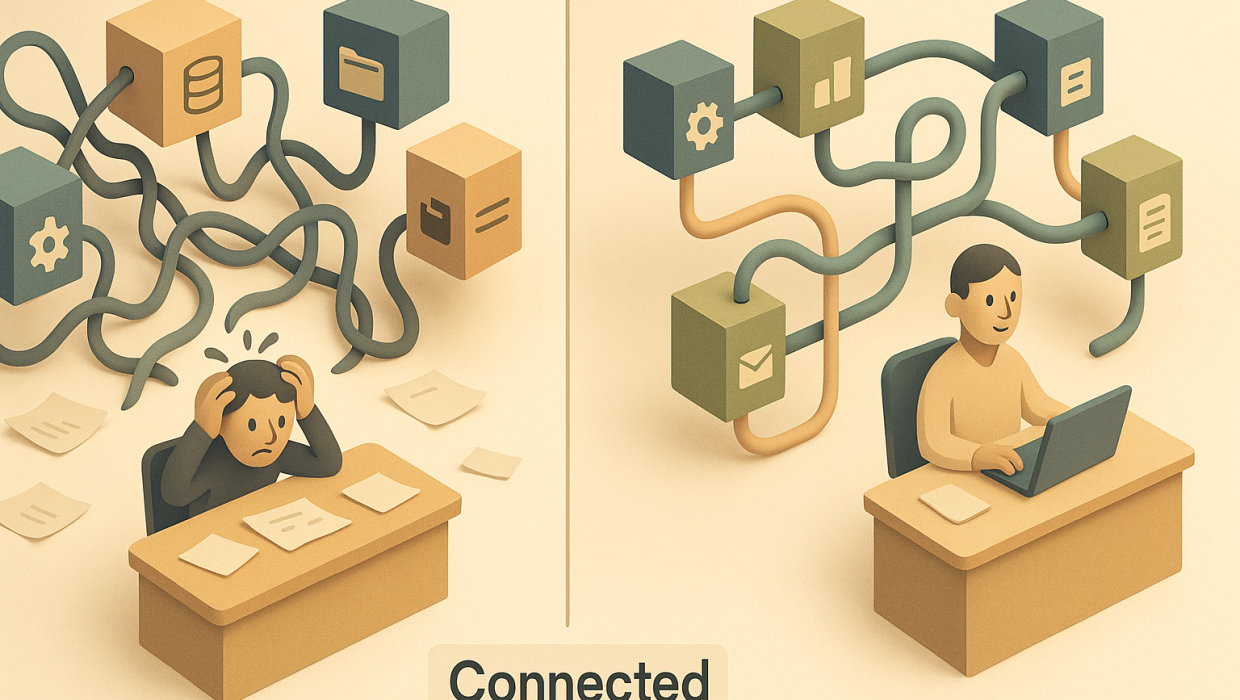
Most enterprise growth plans assume the data problem is already solved. It rarely is. Marketing teams have campaign analytics in one platform, sales has pipeline data in a CRM, operations has performance metrics in a separate system, and none of it talks to the others. Decision-makers end up making strategic calls based on whichever report happened to land on their desk that week, not on a complete picture.
This fragmentation is expensive in ways that are hard to see until you go looking for them: duplicated outreach, missed churn signals, marketing spend directed at the wrong segments, product decisions made on stale assumptions. The irony is that the data to prevent all of this usually already exists inside the organization — it’s just scattered, unstructured, or trapped in formats no one has time to reconcile manually.
This is precisely the gap that AI integration is built to close. Modern machine learning models and workflow automation tools can ingest data from disparate sources, normalize it, and surface patterns that would take a human analyst weeks to find — if they found them at all. But the technology is only half the equation. The other half is knowing which questions are worth asking in the first place.
What AI-Driven Data Analysis Actually Means for a Growing Enterprise
Strip away the jargon, and AI-driven data analysis is simply the use of machine learning and statistical models to detect patterns, predict outcomes, and recommend actions from data at a scale and speed no human team could match unaided. For an enterprise evaluating growth options, that translates into a few concrete capabilities:
Predictive scoring that ranks leads, accounts, or churn risks by likelihood, so your team spends time where it matters instead of working every record equally. Anomaly detection that flags unusual patterns in operations or spend before they become expensive problems. Natural language processing that turns unstructured text — support tickets, reviews, sales call transcripts — into structured signal. And forecasting models that give finance and operations leaders a realistic view of what’s coming, rather than a static quarterly snapshot.
None of these are theoretical. They’re already running inside companies that treat data as an operational asset rather than an IT afterthought. The difference between those companies and the ones still drowning in spreadsheets isn’t the availability of the technology — it’s whether someone took the time to diagnose what the business actually needed before building anything.
Why Diagnosis Has to Come First
We’ve watched enough technology rollouts fail to know that the biggest risk in AI adoption isn’t the algorithm — it’s misalignment between the tool and the actual business problem. A predictive model trained on messy CRM data will confidently produce wrong answers. A workflow automation built around a process no one has questioned in five years just makes a bad process faster.
That’s why any serious AI initiative should start with diagnosis, not deployment. Before a single model gets trained, the right questions are: What decision are we trying to improve? What data do we actually have, and how trustworthy is it? Who will act on these insights, and do they trust the system enough to change behavior based on it? Skipping this step is how companies end up with impressive-looking dashboards that nobody actually uses to make decisions.
From Insight to Action: What Intelligent Systems Look Like in Practice
The real value of AI-driven data analysis isn’t the insight itself — it’s what happens next. An intelligent system that identifies a churn risk but doesn’t route that signal to the account manager, or a model that predicts demand but doesn’t feed that forecast into procurement planning, is analysis for analysis’s sake.
This is where AI integration and workflow automation have to work together. Consider a mid-market B2B services firm that came to us with a familiar complaint: their sales team was buried in leads, but conversion rates were flat. The diagnosis revealed the real issue wasn’t lead volume — it was that every lead was treated identically, regardless of fit or intent. We built a predictive scoring model that pulled signal from CRM history, website behavior, and firmographic data, then wired it directly into their existing sales workflow so reps saw a prioritized queue automatically, not a report they had to remember to check. Within two quarters, close rates on top-tier leads nearly doubled, and the sales team stopped wasting cycles on accounts that were never going to convert. You can see how this kind of work plays out across industries in our case studies.
The pattern holds across functions. In finance, intelligent systems can flag invoice anomalies before they become audit headaches. In operations, they can predict maintenance needs before equipment fails. In marketing, they can connect campaign analytics directly to pipeline outcomes instead of vanity metrics. The common thread is that the insight is embedded into a workflow someone already relies on — not delivered as a standalone report competing for attention.
The Risks of Rushing Enterprise Growth Through AI
It’s worth being direct about where this goes wrong, because it goes wrong often. Enterprises under pressure to “do something with AI” frequently buy a platform, connect it to whatever data is easiest to access, and declare victory. The result is usually a system that produces outputs no one trusts, because the underlying data was never audited for quality, or because the model was trained on historical patterns that no longer reflect current market conditions.
There’s also a governance risk that gets underweighted in the rush to adopt. Predictive models can encode bias baked into historical data — favoring certain account types, geographies, or customer segments in ways that weren’t intentional but are still consequential. Enterprises serious about scaling AI-driven data analysis need a review process, not just a deployment plan. This is a core part of how we approach every engagement, and it’s discussed in more depth on our AI and automation services page.
None of this is an argument against moving forward — it’s an argument for moving forward correctly. The enterprises that get real growth out of AI are rarely the ones who moved fastest. They’re the ones who moved with a clear map of what they were trying to fix.
The enterprises that get real growth out of AI are rarely the ones who moved fastest. They’re the ones who moved with a clear map of what they were trying to fix.
Building Intelligent Systems That Compound Over Time
The most durable advantage AI-driven data analysis creates isn’t a single insight — it’s a system that keeps getting smarter as more data flows through it. That compounding effect is what separates a one-off dashboard project from genuine enterprise transformation. A well-built intelligent system improves its predictions as it sees more outcomes, surfaces new patterns as market conditions shift, and becomes a foundation other tools and teams can build on.
This is why the technical architecture matters as much as the model itself. Systems need to be built with clean custom software integrations between data sources, clear ownership of data quality, and interfaces that fit into how people already work rather than demanding they learn a new tool. It’s also why enterprise leaders evaluating vendors should look closely at the underlying technology stack being proposed, not just the pitch deck. A model that can’t scale past a proof of concept isn’t a growth strategy — it’s a demo.
Where to Start If You’re Evaluating This for Your Organization
If you’re a CTO, marketing director, or agency owner weighing whether AI-driven data analysis belongs in your next growth plan, the honest starting point isn’t a vendor demo — it’s an internal audit. Where does your organization already have data that isn’t being used? Where are decisions being made on gut instinct that could be made on pattern? Where is your team spending hours on manual analysis that a well-trained model could do in minutes?
Answering those questions honestly is uncomfortable, because it usually surfaces gaps in data quality or process maturity that predate any AI conversation. But it’s also the fastest route to a growth initiative that actually works, rather than one that looks good in a boardroom slide and quietly fails six months later.
We built our practice around exactly this kind of diagnosis-first thinking, because we’ve seen too many enterprises buy technology before understanding the problem it’s meant to solve. If you’re weighing whether AI-driven data analysis is the right next move for your organization, we’re glad to talk through where your data stands today and what a realistic path forward looks like — you can start a conversation with us whenever you’re ready. And if you want to see what a properly diagnosed, properly integrated system actually looks like in operation, our AI and automation work is a good place to look next.
Enterprise growth has always depended on making better decisions faster than the competition. AI-driven data analysis doesn’t change that fundamental truth — it just raises the ceiling on how good those decisions can be, provided the foundation underneath them is sound.
RELATED QUESTIONS
What is AI-driven data analysis in simple terms?
AI-driven data analysis is the use of machine learning and statistical models to find patterns, predict outcomes, and recommend actions from business data at a speed and scale humans can’t match alone. Instead of manually building reports, algorithms process large volumes of information — like CRM records, support tickets, or transaction histories — and surface insights someone can act on immediately.
How does AI-driven data analysis actually help enterprise growth?
It helps by turning scattered, underused data into decisions that improve conversion rates, reduce churn, and cut wasted effort across sales, marketing, and operations. For example, predictive scoring can help sales teams prioritize the leads most likely to close, while anomaly detection can catch operational problems before they become costly. The growth comes from better decisions made faster, not from the technology itself.
Why do so many enterprise AI projects fail to deliver results?
Most AI projects fail because they skip diagnosis and jump straight to deployment, connecting a model to whatever data is convenient rather than data that’s clean and relevant. Without first identifying the actual business problem, the resulting system produces outputs that look sophisticated but that no one trusts or acts on. A diagnosis-first approach that audits data quality and defines the decision being improved is what separates successful rollouts from expensive failures.
What should a company do before investing in AI-driven data analysis?
Before investing, a company should audit where it already has unused data, identify which decisions are currently being made on instinct rather than pattern, and assess how clean and reliable its existing data actually is. This internal audit usually reveals gaps in data quality or process maturity that need to be addressed before any model can produce trustworthy results. Skipping this step is the most common reason AI initiatives underdeliver.
Is AI-driven data analysis only useful for large enterprises with big data teams?
No — mid-market companies often see faster, more visible returns because their data environments are simpler to diagnose and integrate. The key factor isn’t company size, it’s whether the organization is willing to properly diagnose its data and workflows before building an automated system. A well-scoped project for a mid-sized firm can deliver meaningful results in a single quarter.
Ready to Turn Your Data Into a Growth Engine?
Start a conversation with Sapiens + Machines to discuss your goals, challenges, and next steps.