Somewhere inside your enterprise right now, a talented employee is doing something a machine could do better — copying data between systems, chasing approvals over email, or manually reconciling reports that should reconcile themselves. This isn’t a hypothetical. It’s the daily reality inside most mid-size and large organizations, and it’s exactly the gap that AI-enhanced process automation was built to close. The question isn’t whether automation belongs in your operation. It’s whether you’re deploying it with enough precision to actually gain ground on competitors who already are.
The Automation Gap Nobody Talks About
Most enterprises have some automation in place. Scheduled reports, basic triggers, maybe a handful of Zapier-style integrations stitched together by whoever had the time. What’s missing isn’t automation itself — it’s intelligence layered on top of it. Traditional automation follows fixed rules: if this happens, do that. AI-enhanced automation adds judgment to the equation, recognizing patterns, prioritizing exceptions, and adapting to conditions that a static rule set was never built to handle.
That distinction matters more than it sounds. A rules-based system can route an invoice. An AI-enhanced system can flag that the invoice looks anomalous compared to twelve months of vendor history, route it to the right approver based on dollar thresholds and risk, and learn from what happens next. One is automation. The other is a system that actually gets smarter over time — which is the real competitive edge, and the reason AI-enhanced process automation has become the flagship discipline inside forward-looking technology strategy.
What AI-Enhanced Process Automation Actually Means
Strip away the buzzwords and the concept is straightforward: it’s the combination of workflow automation (the mechanics of moving work through a system) with AI integration (the judgment layer that decides what to do, when, and for whom). Together, they turn static processes into adaptive ones.
Beyond RPA: Where Intelligence Enters the Workflow
Robotic process automation earned its reputation by handling repetitive, rules-based tasks — data entry, form population, simple transfers between systems. It’s useful, but it’s brittle. Change the input format slightly and the whole thing breaks. AI-enhanced automation solves this by adding a reasoning layer: natural language processing that can read unstructured documents, machine learning models that can score leads or flag risk, and decision engines that route work based on context rather than a rigid if/then tree.
In practice, this looks like a claims process that reads incoming documentation, extracts the relevant fields regardless of formatting, cross-references historical data, and only escalates to a human when the confidence score dips below a set threshold. That’s not a faster version of the old process. It’s a fundamentally different one — and it’s the kind of enterprise automation that compounds in value the longer it runs.
The Competitive Edge Is Already Being Built by Others
Here’s the uncomfortable part: while some organizations are still debating pilot programs, competitors are already several iterations deep. They’ve moved past proof-of-concept and into production, refining models against real operational data, and using the time savings to reinvest in strategy, customer experience, and market expansion. Every quarter an enterprise spends deliberating is a quarter a competitor spends compounding.
This isn’t a call to panic-buy AI tools. It’s a call to recognize that workflow efficiency has become a strategic lever, not just an operations line item. Marketing directors feel it in campaign turnaround times. CTOs feel it in the backlog of manual integrations their teams never have bandwidth to fix. Agency owners feel it in margin — every hour spent on manual reconciliation is an hour not spent on billable strategic work. The organizations closing this gap fastest are treating automation as infrastructure, not experimentation, and they’re building it on systems reviewed at the technology layer, not just the workflow layer.
Diagnosis Before Build: Why Most Automation Projects Fail
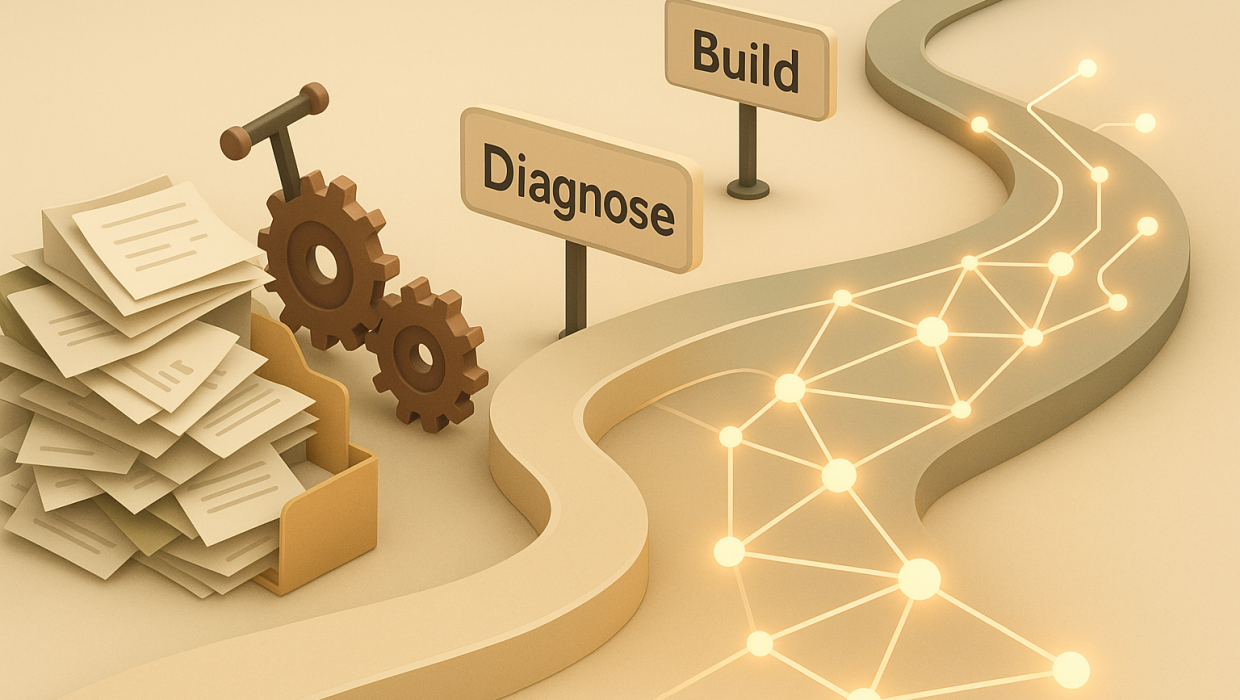
The most common failure mode in enterprise automation isn’t technical. It’s sequencing. Organizations buy a platform, hand it to IT, and ask them to “automate the process” — without first establishing what the process actually is, where it breaks down, and which parts genuinely benefit from intelligence versus simple rules.
The companies pulling ahead aren’t the ones with the most AI — they’re the ones who diagnosed their workflows before automating them.
The companies pulling ahead aren’t the ones with the most AI — they’re the ones who diagnosed their workflows before automating them.
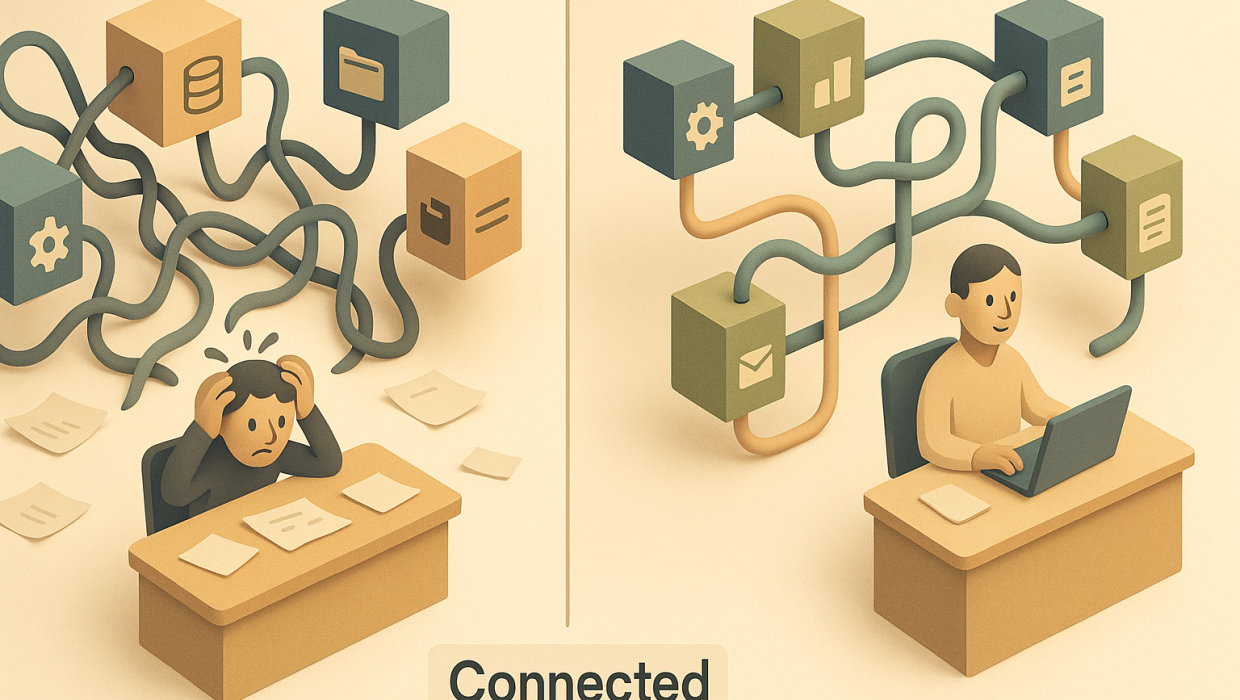
That diagnosis step is unglamorous and frequently skipped, which is precisely why it’s valuable. It means mapping the current-state process end to end, interviewing the people who actually do the work, and identifying where the real bottleneck lives — because it’s rarely where leadership assumes it is. Sometimes the constraint is a data silo. Sometimes it’s an approval chain with too many stakeholders. Sometimes it’s a legacy system that can’t talk to anything else without custom middleware, which is where custom software solutions become necessary rather than optional.
Enterprise Automation Requires Enterprise-Grade Discipline
Enterprise environments carry constraints smaller organizations don’t: legacy infrastructure, compliance requirements, multiple departments with competing priorities, and change-management politics that can stall even a technically sound rollout. This is why a diagnosis-before-build approach isn’t a nice-to-have philosophy — it’s a practical necessity at scale. You cannot automate your way around a broken process; you can only make the breakage move faster. Real workflow efficiency comes from understanding the process deeply enough to know exactly where automation adds leverage and where it would simply industrialize dysfunction.
This is also where AI integration done right pays for itself. When the diagnosis is solid, even a modest automation build can eliminate hours of manual work per week, per team, per quarter — and those hours compound across an organization far faster than most finance teams initially model.
Where to Start: Three Questions Every CTO Should Ask
Before evaluating vendors or platforms, three questions tend to separate successful automation initiatives from expensive shelfware:
Where does human judgment actually add value, and where is it just filling a gap technology should be filling? Not every task benefits from automation — the goal is augmenting expertise, not replacing the people who bring context and accountability to a decision.
What does the data infrastructure look like underneath the process? AI models are only as good as the data feeding them. If your CRM, ERP, and operational systems don’t talk to each other cleanly, that’s the first problem to solve — often through deliberate IT infrastructure work before any automation layer is introduced.
What does success look like in measurable terms, ninety days in? Automation initiatives without a defined efficiency or accuracy benchmark tend to drift indefinitely in “pilot” status. Set the number before you build, not after.
The Cost of Waiting
There’s a version of this conversation where automation feels optional — a future initiative, once budgets loosen or the “right time” arrives. But the cost of waiting isn’t neutral. Manual processes don’t just cost time; they cost accuracy, employee retention (skilled people don’t stay long in roles that are mostly data entry), and responsiveness to customers who increasingly expect real-time answers. Organizations that have already made this shift can be seen in the case studies of enterprises that moved from manual reconciliation to intelligent, self-correcting workflows — often recovering the investment within a single fiscal year through labor reallocation alone.
Every quarter without a clear automation roadmap is a quarter of accumulating technical and operational debt that eventually costs more to unwind than it would have cost to prevent.
Making It Happen
AI-enhanced process automation isn’t a single tool or a vendor decision — it’s a discipline that starts with an honest look at how work actually moves through your organization today. The enterprises gaining real competitive edge right now aren’t the ones with the flashiest AI demo. They’re the ones who did the unglamorous diagnostic work first, built automation on top of a process that made sense, and treated the technology as an amplifier of their team’s expertise rather than a replacement for it.
If your organization is somewhere between “we know we need this” and “we don’t know where to start,” that’s exactly the right moment to bring in a partner who can map the process before recommending the platform. It’s worth a conversation before it becomes a bigger problem than it needs to be — you can start that conversation here and see where the actual leverage points are in your workflows.
The competitive edge in enterprise automation doesn’t belong to whoever adopts AI first. It belongs to whoever integrates it with the most precision.
RELATED QUESTIONS
What is AI-enhanced process automation?
AI-enhanced process automation combines traditional workflow automation with artificial intelligence capabilities like machine learning and natural language processing, allowing systems to make context-aware decisions rather than simply following fixed rules. Instead of just moving data between systems, it can evaluate anomalies, prioritize exceptions, and improve its own accuracy over time as it processes more data.
How is AI-enhanced automation different from traditional RPA?
Traditional RPA (robotic process automation) follows rigid, rules-based logic and tends to break when inputs change format or structure. AI-enhanced automation adds a reasoning layer that can interpret unstructured data, assess confidence levels, and adapt to new conditions, making it far more resilient and valuable in real-world enterprise environments.
Why do enterprise automation projects often fail?
Most enterprise automation projects fail because organizations automate a process before properly diagnosing where its actual bottlenecks lie, often assuming the wrong step is the problem. Without mapping the current-state workflow and identifying where human judgment versus technology genuinely adds value, automation simply speeds up dysfunction instead of removing it.
How long does it take to see ROI from AI-enhanced automation?
Many enterprises see measurable efficiency gains within 90 days when the automation is built on a proper process diagnosis, and full return on investment within a single fiscal year through labor reallocation and error reduction. Timelines vary based on process complexity and existing data infrastructure, but poorly diagnosed projects often stall in pilot status indefinitely.
Should every business process be automated with AI?
No — not every task benefits from AI-enhanced automation, and forcing it onto processes that rely on nuanced human judgment can backfire. The goal is augmenting the expertise of skilled employees, not replacing decision-making entirely, so the right approach identifies which specific parts of a workflow genuinely benefit from intelligence and automates only those.
Ready to Diagnose Where Automation Actually Belongs in Your Workflow?
Start a conversation with Sapiens + Machines to discuss your goals, challenges, and next steps.