Every enterprise technology leader has sat through the same pitch by now: adopt AI, automate everything, watch productivity soar. Reality is messier. AI-powered workflow augmentation — the practice of using intelligent systems to extend human capability rather than replace it — has produced real, measurable gains for some organizations and expensive, half-adopted tooling for others. The difference rarely comes down to the technology itself. It comes down to whether the organization understood its own workflows well enough to know where AI actually belonged.
This is the question worth sitting with before any procurement conversation: not “which AI tool should we buy,” but “should our enterprise embrace AI-powered workflow augmentation at all, and if so, where?” The answer is almost always yes — but the “where” matters more than most vendors want to admit.
What AI-Powered Workflow Augmentation Actually Means
Augmentation is a specific philosophy, distinct from wholesale automation. Automation aims to remove humans from a process entirely. Augmentation aims to make the humans in that process faster, better-informed, and less burdened by repetitive cognitive work — while keeping them firmly in control of judgment calls, exceptions, and anything with real stakes attached.
In practice, this looks like: a sales team using AI to summarize call transcripts and surface objection patterns, rather than letting AI decide which leads to pursue. A legal team using AI to flag contract clauses that deviate from standard language, rather than letting AI approve contracts. A support team using intelligent systems to draft responses that a human reviews and sends, rather than fully autonomous chatbots handling every ticket. The technology does the heavy lifting on volume and pattern recognition; the human retains ownership of the decision.
This distinction matters because it changes how you evaluate success. Full automation is judged on cost reduction and headcount. Augmentation is judged on decision quality, speed to insight, and whether your best people are spending their time on the work that actually requires them.
The Case for Augmentation Over Automation-for-Its-Own-Sake
There’s a reason so many “AI transformation” initiatives stall after the pilot phase: they were built around automating a task rather than augmenting a workflow. Tasks are easy to identify and hard to fully automate reliably — especially in enterprise environments where edge cases, compliance requirements, and institutional knowledge complicate anything that looks simple on a flowchart. Workflows are harder to map but far more forgiving of imperfect AI, because a human is still there to catch what the model misses.
Enterprises that treat AI integration as a workflow-level exercise rather than a task-replacement exercise tend to see faster time-to-value and far less internal resistance. Employees are not being asked to trust a black box with their job; they’re being handed a tool that removes the parts of their job they never wanted anyway — the manual data entry, the first-draft grunt work, the endless status-checking across disconnected systems.
Should Your Enterprise Embrace AI-Powered Workflow Augmentation? Signs You’re Ready
Not every organization is positioned to benefit immediately, and that’s not a failure — it’s information. A few honest signals worth checking before you commit budget:
Your workflows are documented, even informally. If nobody can describe how a process actually runs today — not the org chart version, the real version with all its workarounds — augmentation has nothing solid to attach to. AI amplifies whatever process you feed it, including a broken one.
You have a genuine volume or complexity problem. Augmentation earns its keep in workflows with real throughput: high ticket volume, large document sets, repetitive research tasks, or data synthesis across multiple systems. If a process runs twice a month and takes an hour, the juice usually isn’t worth the squeeze.
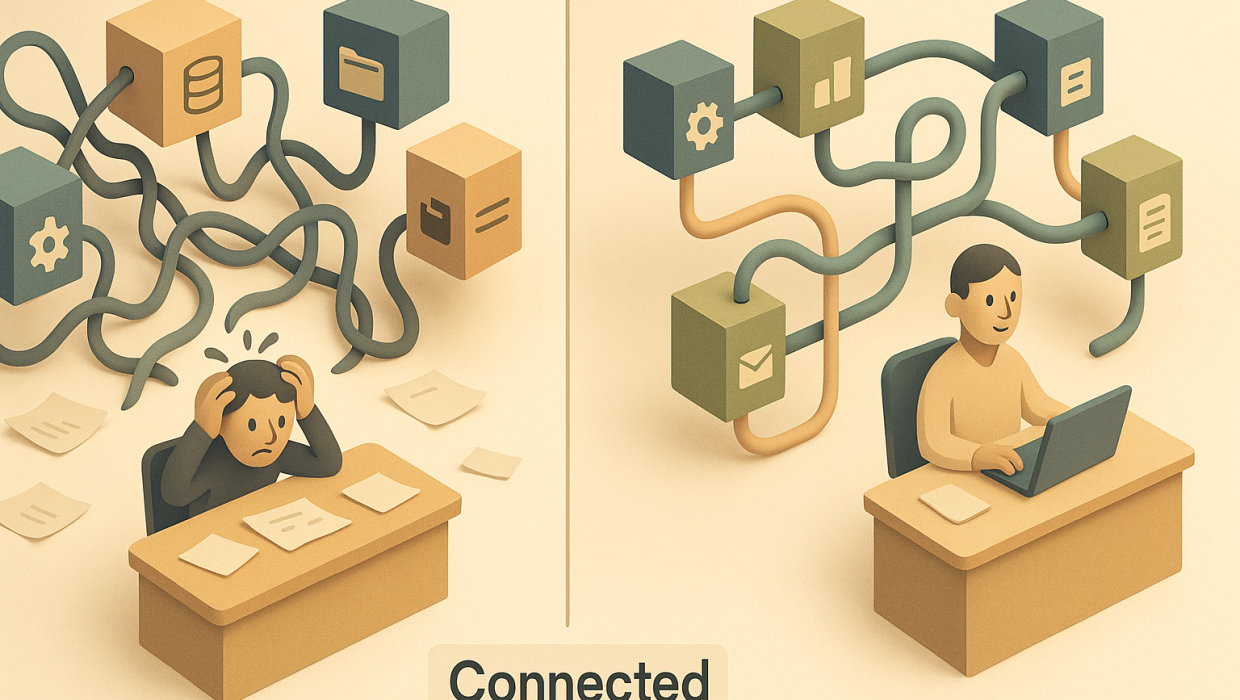
Your systems can actually talk to each other. AI augmentation depends on data flowing between the tools your team already uses — your CRM, your document management system, your internal databases. Enterprises with siloed, disconnected tech stacks often need systems integration work before any AI layer will function as intended.
Leadership is prepared to change how success is measured. Augmentation shifts KPIs from raw output to decision quality and cycle time. Organizations still measuring everything by headcount reduction will misjudge augmentation as underperforming, when it’s actually working exactly as designed.
How Diagnosis-Before-Build Changes the Equation
The single most common mistake enterprises make with AI-powered workflow augmentation is buying the tool before understanding the workflow. A platform gets selected because a competitor uses it, or because a vendor demo looked impressive, and only afterward does anyone ask which specific bottleneck it’s supposed to solve. This backwards sequence is why so much enterprise AI spend produces underwhelming results — not because the models are weak, but because they were pointed at the wrong problem from the start.
A diagnosis-first approach flips the order. Before any tooling decision, the real questions are: Where does work actually slow down? Where do your best people spend time on tasks that don’t require their judgment? Where does information get lost between systems, forcing someone to manually reconcile it? Where is your team making decisions with less context than they should have, simply because pulling that context together takes too long?
Answering those questions honestly — sometimes through structured workflow audits, sometimes through direct observation of how teams actually work day-to-day — produces a map of where enterprise automation will generate real leverage versus where it will just add another dashboard nobody checks. This is the same discipline behind good software architecture and good marketing strategy: understand the system before you touch it. It’s why we treat diagnosis as a prerequisite, not a formality, on every workflow augmentation engagement.
Where It Tends to Go Wrong
Even well-intentioned augmentation efforts fail in predictable ways. The most common is scope creep disguised as ambition — starting with “let’s augment our customer onboarding workflow” and ending up trying to overhaul five departments simultaneously, with no clear owner for any of them. Augmentation works best when it’s scoped tightly around a single measurable workflow, proven there, and then extended.
The second failure mode is treating intelligent systems as static once deployed. AI models and the workflows they support both drift over time — customer behavior changes, product lines shift, compliance rules update. An augmentation layer that isn’t monitored and retrained becomes a liability rather than an asset, quietly making recommendations based on outdated patterns. Enterprises that see lasting results tend to have someone accountable for watching this drift, whether that’s an internal team or a technology partner maintaining the system as part of ongoing IT infrastructure support.
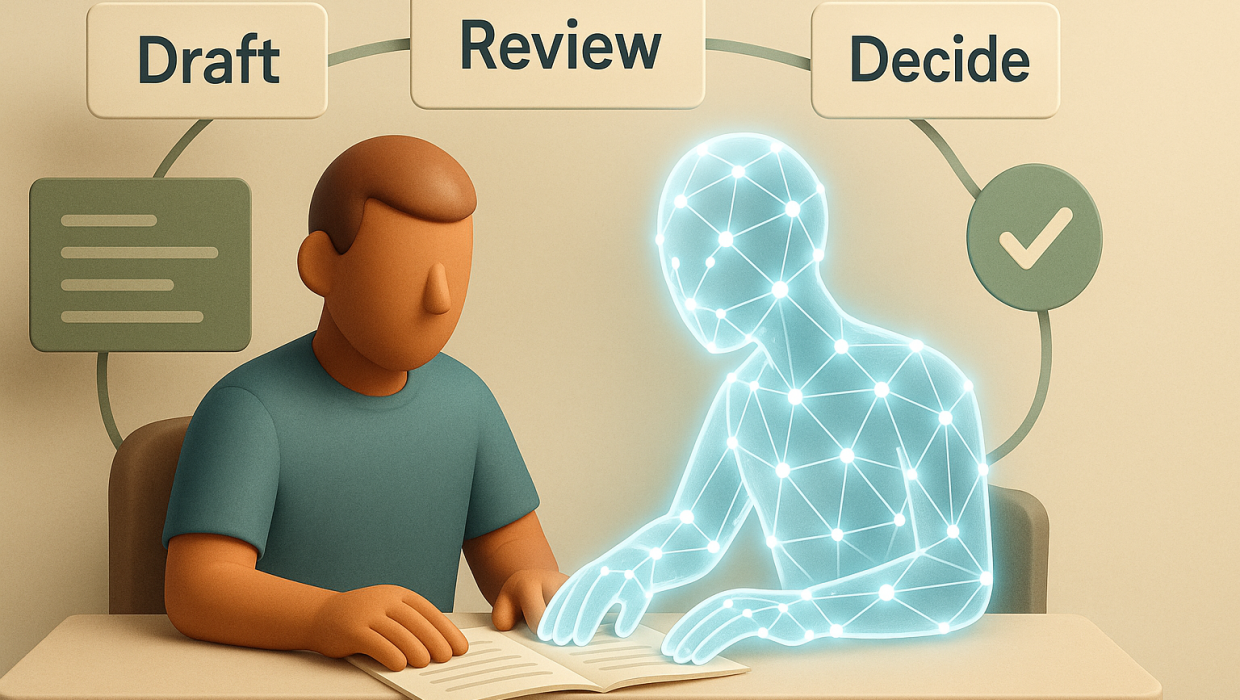
The third, and most consequential, is misplacing trust. Augmentation fails the moment an organization starts treating AI output as a final answer rather than an accelerated first draft. The right question isn’t whether AI can do the work — it’s whether AI should be trusted with the judgment call at the end of it. Enterprises that keep humans firmly in that final seat see augmentation compound in value over time. Enterprises that quietly let the AI take over the decision, without deciding to, tend to discover the cost of that drift only after something goes wrong.
The right question isn’t whether AI can do the work — it’s whether AI should be trusted with the judgment call at the end of it.
What Getting It Right Looks Like
Done well, AI-powered workflow augmentation is almost unglamorous in its steadiness. Response times drop because drafts arrive pre-written and only need review. Research that used to consume a day gets synthesized in minutes, freeing analysts to focus on interpretation rather than collection. Onboarding new employees takes less time because institutional knowledge is captured and surfaced by intelligent systems rather than living only in a few people’s heads. None of this requires replacing your team — it requires giving them better tools and removing the friction between their expertise and the information they need to apply it.
We’ve seen this play out concretely across client engagements — the specifics vary by industry, but the pattern of diagnosis, targeted augmentation, and measured expansion holds consistently, and it’s documented in more detail across our case studies.
Making the Decision
If your enterprise is weighing whether to embrace AI-powered workflow augmentation, the honest answer is that the technology is ready — the more important question is whether your organization has done the groundwork to deploy it well. That groundwork isn’t glamorous: mapping real workflows, being honest about where systems don’t talk to each other, and deciding in advance what decision-making authority stays human no matter how capable the model becomes.
Enterprises that skip this groundwork often end up with expensive pilots that never scale. Enterprises that do it well end up with workflows that get measurably faster and teams that trust the tools they’ve been handed, because those tools were built around how they actually work rather than how a vendor imagined they should.
If you’re trying to figure out where augmentation would create the most leverage in your organization — and where it definitely shouldn’t touch — that’s exactly the kind of conversation worth having before any tooling decision gets made. You can start that conversation here, and we’ll help you map it out honestly, whether or not it leads anywhere near a build.
RELATED QUESTIONS
What is AI-powered workflow augmentation?
AI-powered workflow augmentation is the practice of using AI and intelligent systems to extend human capability within a workflow rather than replace human decision-making entirely. AI handles repetitive tasks like drafting, summarizing, and pattern recognition, while humans retain control over judgment calls, exceptions, and final decisions.
How is workflow augmentation different from full automation?
Full automation aims to remove humans from a process entirely, while augmentation aims to make the humans involved faster and better-informed without taking away their control. Automation is typically judged on cost and headcount reduction, whereas augmentation is judged on decision quality, speed to insight, and how effectively skilled employees are freed up for higher-value work.
How do I know if my enterprise is ready for AI workflow augmentation?
Readiness signals include having workflows that are at least informally documented, dealing with real volume or complexity (not occasional low-stakes tasks), having systems that can actually share data with each other, and leadership willing to measure success by decision quality rather than headcount alone. Without these in place, AI tools tend to amplify existing dysfunction rather than fix it.
Why do so many enterprise AI initiatives fail or stall after a pilot?
Most stalled AI initiatives were built around automating an isolated task rather than augmenting a broader workflow, or the tool was selected before anyone diagnosed which bottleneck it was meant to solve. This backwards sequence — buying technology first and figuring out the use case afterward — is the leading cause of underwhelming enterprise AI results.
Should AI be allowed to make final business decisions in an enterprise workflow?
In most enterprise contexts, no — AI output should be treated as an accelerated first draft or recommendation, not a final answer, especially for decisions with real financial, legal, or customer impact. The organizations that see the most durable results keep a human accountable for the final judgment call, using AI to inform that decision rather than replace it.
Ready to Diagnose Where AI Augmentation Fits in Your Workflows?
Start a conversation with Sapiens + Machines to discuss your goals, challenges, and next steps.