For most B2B companies, the website is still built like a brochure — one static experience, handed to every visitor regardless of who they are, what they need, or why they showed up. That approach is quietly costing you engagement, and dynamic content personalization is how the best-performing B2B sites are fixing it.
The Cost of a Generic Website Experience
Think about the range of people who land on a typical B2B homepage in a single week: a CTO evaluating vendors for a Q3 infrastructure overhaul, a marketing director doing early-stage research, a current client checking a resource page, and a competitor scoping your positioning. A static site shows all four of them the exact same hero banner, the exact same case study, the exact same call to action.
That’s not a design failure — it’s an architecture failure. Traditional websites were built as digital brochures, optimized for a single narrative rather than a spectrum of intents. The result is bounce rates that look fine on paper but hide a deeper problem: visitors who never see the content most relevant to their actual situation, and therefore never convert.
What Dynamic Content Personalization Actually Means
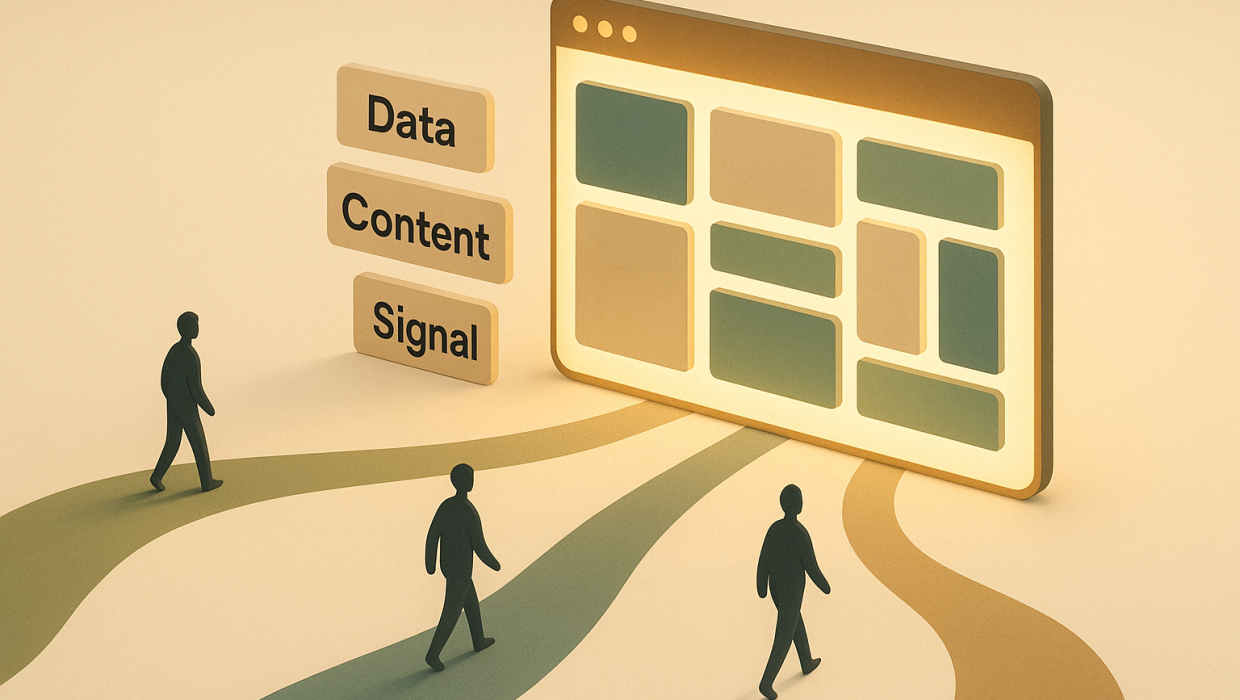
Dynamic content personalization is the practice of adjusting what a website shows — copy, imagery, case studies, calls to action, even navigation — based on real signals about the visitor: their industry, company size, referral source, past behavior, stage in the buying journey, or explicit preferences they’ve shared. Instead of one page trying to serve everyone, the page reconfigures itself to serve the person in front of it.
This isn’t the same as basic A/B testing, and it’s not the same as slapping a first-name merge tag into an email. True personalization operates at the structural level of the site — driven by data pipelines, decision logic, and content architecture designed from the start to flex. That’s why it belongs in the same conversation as core web development strategy, not treated as a marketing add-on bolted on after launch.
Beyond Basic Segmentation
Many teams believe they’re already personalizing because they’ve segmented an email list or built a handful of landing page variants. That’s a start, but it’s not dynamic. Segmentation is static — a visitor gets sorted into a bucket once and stays there. Dynamic personalization is continuous: it reads new signals as they arrive and adjusts in real time, so a returning visitor who’s now read three pricing pages sees a fundamentally different experience than they did on their first visit.
Why Website Engagement Depends on a Personalized User Experience
Engagement isn’t a vanity metric — it’s a proxy for relevance. When a visitor spends longer on a page, clicks deeper into a site, or returns a second time, they’re telling you the content matched their intent. A personalized user experience compounds this: the more relevant the first interaction, the more likely a second one happens, and the shorter the path to a qualified conversation.
Consider the mechanics. A visitor arriving from a paid search ad about supply chain automation shouldn’t land on a generic homepage — they should see content that picks up exactly where the ad left off. A returning visitor who downloaded a whitepaper on API integration should see next-step content related to implementation, not another introductory piece. This kind of continuity is what separates websites that convert from websites that merely exist. It’s also where personalization intersects directly with lead generation strategy — the site itself becomes part of the funnel logic, not just a landing zone at the end of it.
The B2B Case for Personalization
There’s a persistent myth that personalization is a B2C tactic — useful for retail sites recommending products, less relevant for B2B companies selling considered, high-value services. The opposite is true. B2B buying committees are larger, sales cycles are longer, and the cost of losing a visitor’s attention is higher because there are fewer visitors to begin with. Every session matters more.
In B2B web development, personalization also solves a structural problem: B2B companies frequently sell to multiple, distinct buyer types — a technical evaluator, a budget holder, an end user — often through the same site. Static pages force these audiences to dig for relevance. Dynamic personalization lets the site present the technical depth a CTO wants and the business case a CFO wants, without maintaining two separate websites or forcing visitors to self-select through a maze of navigation.
How to Build It Right: Diagnosis Before Build
The most common reason personalization initiatives underperform isn’t the technology — it’s the sequencing. Teams buy a personalization platform, bolt it onto an existing site, and wonder why the results are underwhelming. Personalization only works when the underlying site is architected to support it, which is why our process always starts with diagnosis, not tooling.
Data Foundations
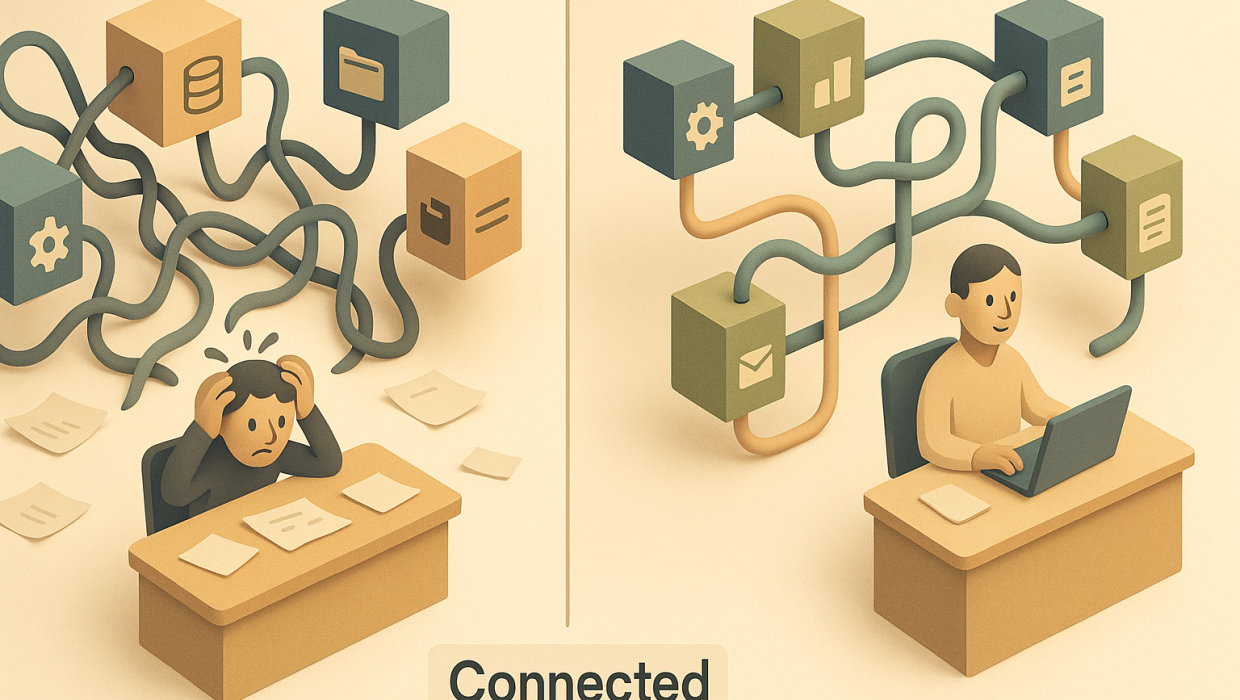
Personalization is only as good as the signals feeding it. Before any dynamic content goes live, you need clarity on what data you actually have access to — CRM records, behavioral analytics, firmographic enrichment, intent signals — and how reliably that data flows into the systems making real-time decisions. This is frequently where automation and intelligent workflows come in, since manually triggering content changes based on visitor behavior simply doesn’t scale past a handful of rules.
Content Architecture
Once the data foundation is solid, the site itself needs to be built — or rebuilt — with modular content blocks that can be swapped, reordered, or hidden based on visitor context. This is deep, structural work. It touches your CMS, your component library, your tagging taxonomy, and your team’s internal workflows for producing content that’s built to be recombined rather than published as a single fixed page. It’s a core part of what modern custom website solutions should include from day one, rather than being retrofitted after the fact.
Testing and Iteration
Personalization is never “done” — it’s a living system that improves as you learn which signals actually predict engagement and which don’t. Successful teams treat it the way they’d treat any product: with hypotheses, controlled experiments, and a willingness to retire personalization rules that aren’t earning their keep.
Common Pitfalls Worth Naming
A few patterns show up repeatedly in personalization efforts that stall:
Over-personalizing too early. Teams try to build twenty visitor segments before they’ve validated that even three segments behave meaningfully differently. Start narrow, prove the lift, then expand.
Treating personalization as purely a marketing project. Because the underlying logic often depends on real-time data processing and system integrations, this is genuinely cross-functional work spanning marketing, engineering, and sometimes IT infrastructure. Leaving any one of those groups out tends to produce brittle systems that break the first time a data source changes.
No fallback experience. Every dynamic rule needs a sensible default for visitors who don’t match any known segment — otherwise your “personalized” site quietly fails for a meaningful share of traffic.
Personalizing content but not measuring it. Without clear before-and-after engagement benchmarks, it’s impossible to know whether the investment is paying off. Tie every personalization initiative to specific engagement and conversion metrics from the outset.
Real-World Impact
Personalization isn’t about generating more content — it’s about giving the right person the right piece of it at the right moment. We’ve seen this play out across client engagements where a targeted rebuild of a site’s content logic — not a full redesign — produced measurable lifts in time-on-site, return visits, and form completions within weeks. The technical lift was often smaller than clients expected, because the real unlock was in how content was structured and triggered, not in adding new pages. You can see how this diagnosis-first approach plays out across different industries in our case studies, where the common thread isn’t the specific technology stack but the discipline of understanding the problem before proposing a build.
Personalization isn’t about generating more content — it’s about giving the right person the right piece of it at the right moment.
Getting Started Without Overhauling Everything
You don’t need to rebuild your entire site to begin. Most successful personalization programs start with a single high-traffic page — often the homepage or a primary landing page — and a small number of well-defined visitor segments based on data you already have. From there, the system expands as confidence and data quality grow.
What matters most is treating this as an architectural decision, not a marketing tactic layered on top of an unchanged site. The companies seeing real engagement gains from personalization are the ones who evaluated their site’s underlying structure first, then made deliberate technology choices to support it — the same philosophy that underpins how we think about technology decisions more broadly.
If your website is still showing every visitor the same static experience, the gap between where you are and where your competitors are heading is widening every quarter. The good news is that closing it doesn’t require starting from scratch — it requires an honest look at what your site currently knows about its visitors, and what it could be doing with that information. That’s a conversation worth having before you commit budget to any platform or rebuild — and it’s exactly the kind of conversation we start every engagement with, so if you’re weighing your options, let’s talk about where your site stands today.
RELATED QUESTIONS
What is dynamic content personalization on a website?
Dynamic content personalization is the practice of automatically changing a website’s content — such as copy, images, case studies, or calls to action — based on real-time signals about who the visitor is, like their industry, behavior, or referral source. Unlike static pages that show the same content to everyone, personalized pages adapt continuously as new data about the visitor comes in.
Does content personalization work for B2B websites, not just B2C?
Yes, and arguably it matters more for B2B. B2B buying committees are larger, sales cycles are longer, and traffic volumes are lower, so each visitor session carries more weight. Personalization helps B2B sites serve multiple distinct buyer types — technical evaluators, budget holders, end users — through one site without forcing everyone through the same generic path.
How is dynamic personalization different from basic website segmentation?
Segmentation typically sorts a visitor into a fixed bucket once, often based on an email list or a single landing page variant, and that assignment rarely changes. Dynamic personalization is continuous — it reads new behavioral and contextual signals in real time and adjusts the experience on an ongoing basis, so a visitor’s fifth session can look very different from their first.
What’s needed before a company can start personalizing its website content?
The foundation is reliable data — knowing what visitor signals you actually have access to (CRM data, behavioral analytics, firmographic information) and confirming those signals flow accurately into your site in real time. Just as important is a modular content architecture, since a site built as fixed, one-piece pages can’t easily swap content based on visitor context without a deeper rebuild.
How long does it take to see results from website personalization?
Many teams see measurable engagement lifts — such as longer time-on-site, more return visits, or higher form completion rates — within weeks of launching a focused personalization initiative on a single high-traffic page. Results scale further over subsequent months as more visitor segments and data signals are added to the system.
Ready to Build a Website That Adapts to Every Visitor?
Start a conversation with Sapiens + Machines to discuss your goals, challenges, and next steps.