Every enterprise leadership team has sat through the same slide deck: AI will cut costs, accelerate output, and free up your best people for higher-value work. Most have already spent real budget chasing that promise. And yet, when you ask CTOs and marketing directors how much of their organization’s AI automation potential has actually been realized, the honest answer is usually somewhere between “a little” and “not much.” The tools got bought. The pilots got launched. The transformation didn’t arrive.
This isn’t a technology problem. It’s a diagnosis problem.
The Real Reason AI Automation Potential Goes Untapped
Enterprises tend to approach AI the way they approach most software purchases: identify a category, pick a vendor, deploy the tool, measure adoption. That model works reasonably well for point solutions — a new CRM field, a new dashboard. It fails almost every time with AI, because AI doesn’t operate on top of your business the way traditional software does. It operates inside your workflows, your data structures, and your decision points. If those are unclear, undocumented, or quietly broken, the AI doesn’t fix them. It automates them — inconsistencies, bottlenecks, and all, just faster.
We see this constantly in enterprise AI integration engagements that come to us after a first attempt has stalled. The pattern is almost always the same: a team implemented a chatbot, a scoring model, or a document-processing tool in isolation, without first mapping how information actually moves between departments. The tool performs fine in a vacuum. It underperforms — or actively creates friction — the moment it has to interact with legacy CRM data, inconsistent naming conventions, or a sales process that lives half in a system and half in someone’s head.
The uncomfortable truth is that most organizations don’t have an AI problem. They have a process visibility problem that AI has simply made impossible to ignore.
Diagnosis Before Build: Why Most Enterprises Skip This Step
There’s a reason vendors rarely lead with diagnosis: it’s slower, less flashy, and doesn’t demo well. It’s far easier to sell a platform than to sell a two-week discovery sprint mapping how your finance team actually reconciles vendor invoices, or how your support team actually triages tickets before they escalate.
But skipping diagnosis is precisely why so much enterprise AI spend underdelivers. A workflow that looks simple on an org chart — “lead comes in, sales follows up” — is rarely simple in practice. There are exceptions, workarounds, undocumented judgment calls, and tribal knowledge that lives in the heads of your most experienced people. Any automation layered on top of that without first surfacing it will break in ways that are expensive to unwind later, and worse, will erode trust in AI initiatives across the organization.
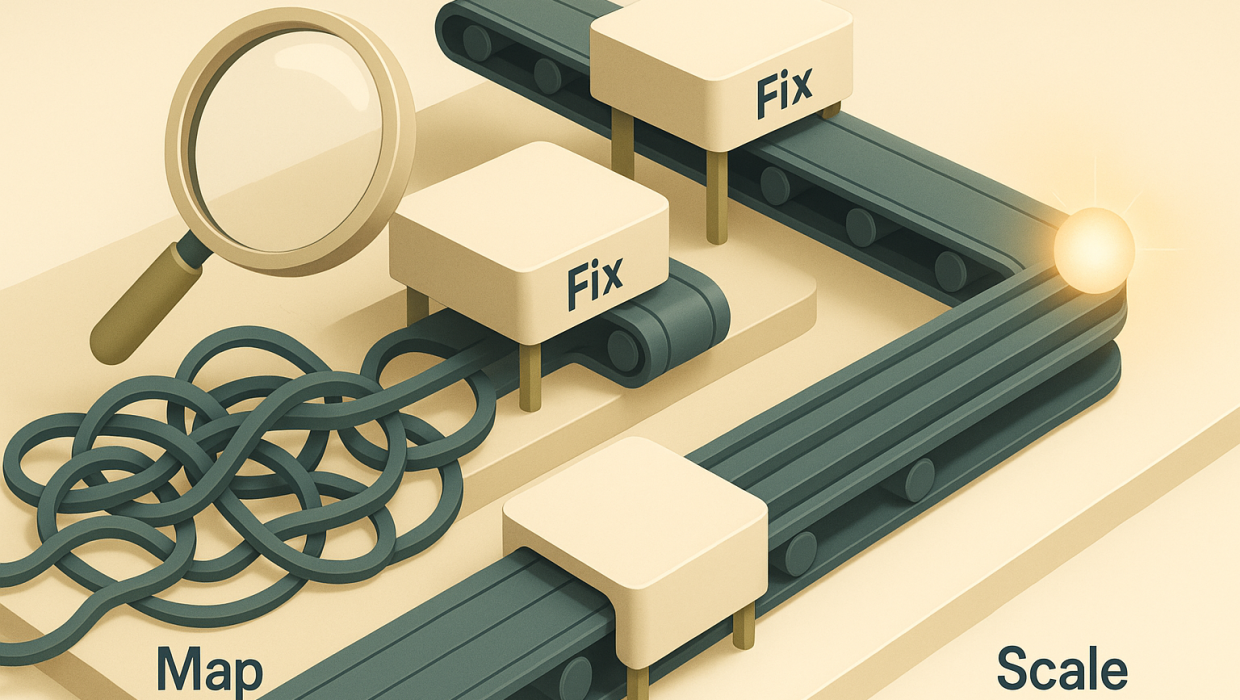
A diagnosis-first approach means walking the actual workflow — not the org chart version of it — before writing a line of code or configuring a model. It means asking where humans are making judgment calls that a model could support (not replace), where data is duplicated or contradictory across systems, and where the real bottleneck is a decision point rather than a data-processing step. Only once that map exists does it make sense to talk about which parts of the process should become AI-driven processes and which should remain firmly in human hands. Automation without diagnosis just makes the wrong process faster.
Automation without diagnosis just makes the wrong process faster.
What Workflow Intelligence Actually Looks Like in Practice
“Workflow intelligence” gets thrown around loosely, so it’s worth being precise about what it actually means in an enterprise context. It’s not a single tool or model. It’s the combination of three things working together: accurate visibility into how work currently moves through your organization, a clear model of where human judgment adds irreplaceable value, and technology deployed specifically at the points where pattern recognition, data synthesis, or repetitive decisioning is the actual bottleneck.
Consider a mid-market B2B company struggling with lead qualification. The instinct is to buy a predictive scoring tool and point it at the CRM. But if the underlying CRM data is inconsistent — different reps logging deal stages differently, no standard definition of a “qualified” lead — the model will learn and amplify that inconsistency. The higher-leverage move is often smaller and less exciting: standardize the data model first, clarify what qualification actually means across the sales team, and only then introduce a scoring layer. The AI becomes a force multiplier on a process that already makes sense, rather than a patch over one that doesn’t.
This is also where the augmentation-over-replacement principle earns its keep. The goal isn’t to remove the sales rep’s judgment from the qualification process — it’s to hand them a system that surfaces the right signals faster, so their judgment gets applied to the accounts that actually deserve it. The same logic extends to document-heavy operations, customer support triage, and internal reporting: the highest-value automation targets the grunt work around a decision, not the decision itself.
The Integration Problem Nobody Talks About
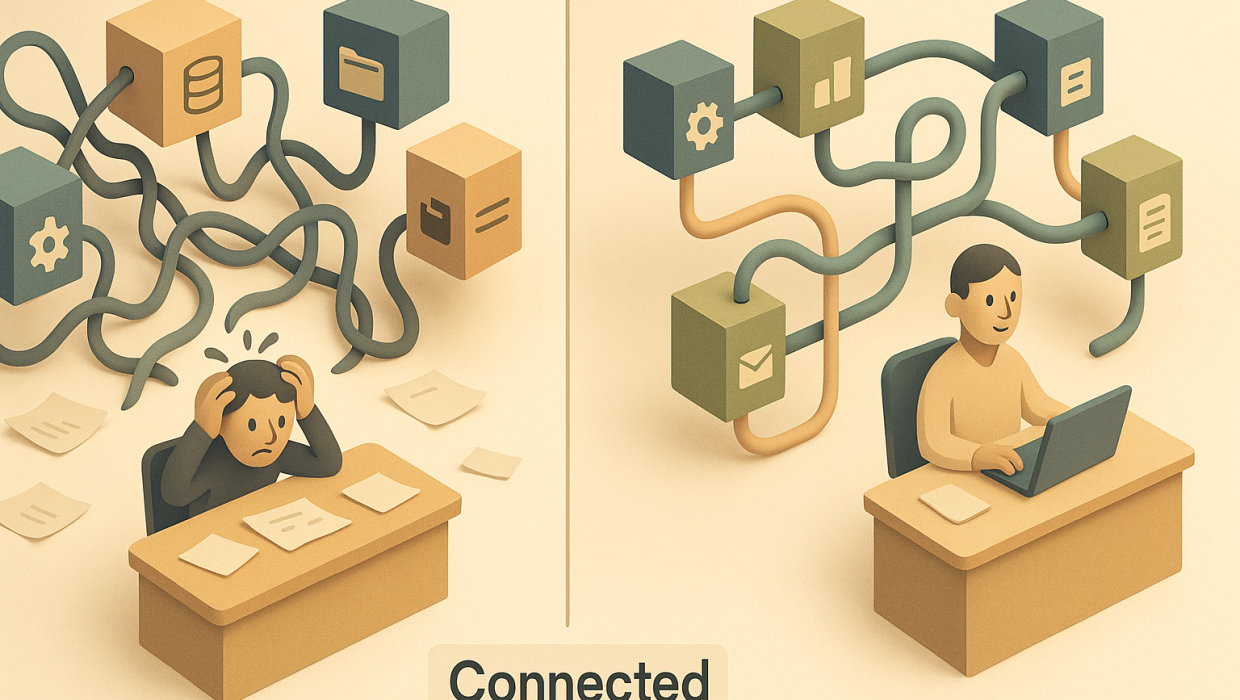
Even organizations that get the diagnosis right often stumble at integration. AI tools rarely operate as standalone systems in a mature enterprise — they need to talk to your CRM, your ERP, your internal tools, and often several legacy systems that were never designed to expose their data cleanly. This is where a lot of otherwise well-scoped AI initiatives quietly die: not in the model design, but in the API work, the data mapping, and the systems integration required to make the automation actually load-bearing in daily operations.
This is precisely why AI initiatives can’t be treated as a marketing team side project or an isolated IT experiment. They require the same rigor as any serious custom software investment — careful architecture, realistic timelines, and a clear owner accountable for the integration, not just the model’s accuracy. Enterprises that treat their AI automation potential as an IT infrastructure question, not just a tools question, are the ones who see initiatives survive past the pilot stage.
It’s also worth noting that automation and IT resilience are linked in ways many teams underestimate. An AI-driven process that automates approvals or customer communication is now a critical business system — which means it inherits all the same requirements around uptime, backup, and continuity planning that any other managed IT infrastructure demands. Treating an automation pilot as disposable experimentation, rather than production infrastructure, is one of the fastest ways to end up with a brittle system nobody trusts.
Building AI-Driven Processes That Compound
The enterprises that get real, compounding value from AI share a common trait: they don’t treat each automation as a one-off project. They treat their first successful diagnosis-and-build cycle as a template, then apply the same rigor to the next workflow, and the next. Over time, this builds what’s best described as institutional workflow intelligence — a shared understanding across the organization of where technology should carry weight and where human expertise should stay firmly in control.
This compounding effect is visible in our own client work. Teams who started with a single, well-diagnosed automation — often something modest, like standardizing intake and triage for inbound requests — consistently come back for a second and third phase, because the first phase actually held up under real operating conditions. You can see the pattern across several of our case studies, where the initial engagement was deliberately narrow, and the value expanded once the underlying data and process were trustworthy.
The opposite pattern is just as visible in the market: organizations that bought broad, ambitious AI platforms up front, without diagnosis, and are now sitting on expensive tools with low adoption and skeptical stakeholders. Rebuilding trust after that experience takes longer than getting the sequencing right the first time.
Where to Start
If your organization is evaluating its next move on AI, the most useful question isn’t “which tool should we buy?” It’s “where in our operation is human judgment currently being wasted on work that doesn’t require it?” That question, answered honestly, will usually point you toward the two or three processes where automation will produce a measurable, defensible return — rather than a hundred places where it might theoretically help.
This is also where a lot of decision-makers benefit from an outside perspective. It’s genuinely difficult to diagnose your own organization’s workflow blind spots when you’re the one who built them. An honest evaluation of your current systems, data quality, and process maturity — before any commitment to a specific platform — is the single highest-leverage step available to a CTO or marketing director trying to move past pilot purgatory. If you want that conversation, it’s worth starting one with a partner who will map the problem before proposing the fix — that’s exactly the kind of discussion we have when a company decides to start a conversation with us.
The Bottom Line
The enterprises capturing real value from AI aren’t necessarily the ones with the biggest budgets or the most advanced models. They’re the ones willing to slow down at the start — to diagnose before they build — so that the automation they eventually deploy is solving the actual problem, not just a faster version of the wrong one. Full AI automation potential isn’t unlocked by a tool. It’s unlocked by clarity, sequencing, and a willingness to let human judgment and machine capability do the parts they’re each actually good at.
RELATED QUESTIONS
Why isn’t my company seeing results from our AI investments?
Most AI initiatives underdeliver because they automate a process that was never clearly mapped or diagnosed first. If the underlying workflow has inconsistent data, undocumented exceptions, or unclear decision points, AI will amplify those problems rather than solve them. The fix is to diagnose the actual workflow before deploying any tool, so the automation targets a real bottleneck rather than a symptom.
What does “diagnosis before build” mean in AI automation?
Diagnosis before build means mapping how a workflow actually operates — including exceptions, workarounds, and human judgment calls — before designing or deploying any automation or AI model. It replaces the common approach of buying a tool first and hoping it fits, with a process of understanding the real bottleneck and only then choosing the right technology to address it. This sequencing dramatically improves adoption and long-term reliability.
Should AI replace human decision-making in enterprise workflows?
No — the most effective enterprise AI deployments augment human judgment rather than replace it, using automation to handle repetitive data synthesis and pattern recognition so people can focus their expertise on the decisions that actually require it. Removing human judgment entirely from complex processes tends to create brittle systems that break down under edge cases. The strongest results come from combining machine consistency with human context.
What’s the biggest hidden obstacle to enterprise AI integration?
Integration, not model accuracy, is usually where AI initiatives stall. AI tools need to connect cleanly with CRMs, ERPs, and legacy systems that were never designed for easy data exchange, and that systems integration work is often underestimated in both scope and cost. Treating AI deployment with the same architectural rigor as any major software investment is essential to making automation reliable in daily operations.
How should a company decide which process to automate first with AI?
Start by identifying where human judgment is currently being spent on repetitive, low-value work rather than genuinely difficult decisions — that gap usually points to the highest-return automation opportunity. It’s more effective to pick two or three well-diagnosed processes than to attempt a broad, unfocused automation rollout across the whole organization. A narrow, well-executed first phase also builds internal trust that makes future automation initiatives easier to fund and adopt.
Ready to Find Where Your Automation Potential Is Hiding?
Start a conversation with Sapiens + Machines to discuss your goals, challenges, and next steps.