Every enterprise leadership team has now sat through the same slide deck: AI is transforming operations, competitors are moving fast, and the window to act is closing. What that slide deck rarely explains is why so many companies still feel like they’re standing still. They’ve bought the tools. They’ve run the pilots. And yet the promised AI-driven workflow transformation hasn’t materialized into anything that changes how the business actually runs day to day.
This isn’t a technology problem. It’s a diagnosis problem. The organizations riding the current wave of AI integration aren’t the ones with the most licenses or the flashiest chatbot — they’re the ones who correctly identified which workflows were worth touching in the first place, and which weren’t.
The Surge Is Real — But It’s Not Where Most Companies Are Looking
There’s a meaningful difference between “using AI” and experiencing an AI-driven workflow surge. Using AI means someone in marketing has ChatGPT open in a browser tab. A workflow surge means the handoffs between systems, teams, and decisions have been redesigned so that information moves faster, errors drop, and human attention gets redirected toward the judgment calls that actually require it.
Most enterprise operations are still optimizing at the task level — a smarter email draft here, an automated report there — while the structural bottlenecks that actually slow the business down go untouched. Lead data still sits in a CRM that doesn’t talk to the fulfillment system. Contracts still get manually re-keyed between platforms. Customer service escalations still bounce between three tools before a human ever sees the full picture. These are the places where a real surge happens, and they’re almost never the places companies start.
What an AI-Driven Workflow Surge Actually Looks Like
A genuine surge shows up as compounding efficiency, not isolated wins. A single automated task might save an employee twenty minutes a day. A redesigned workflow — where AI handles intake, triage, and first-pass analysis while a human makes the final call — can compress a five-day process into same-day turnaround, free up senior staff for higher-value work, and produce cleaner data that improves every downstream decision.
A genuine surge shows up as compounding efficiency, not isolated wins.
The companies capturing this right now share a pattern: they treat AI integration as an operations redesign project, not a software purchase. They ask which decisions are being made too slowly, with too little information, or by the wrong person — and then they build the system that fixes that specific problem. That’s a fundamentally different starting point than “which AI tool should we buy,” and it’s the difference between a pilot that stalls and a workflow that scales.
Why Enterprise Operations Stall Before They Scale
If the opportunity is this visible, why do so many enterprise teams stall out? In our work diagnosing operations across B2B companies, the same two gaps show up again and again.
The Integration Gap
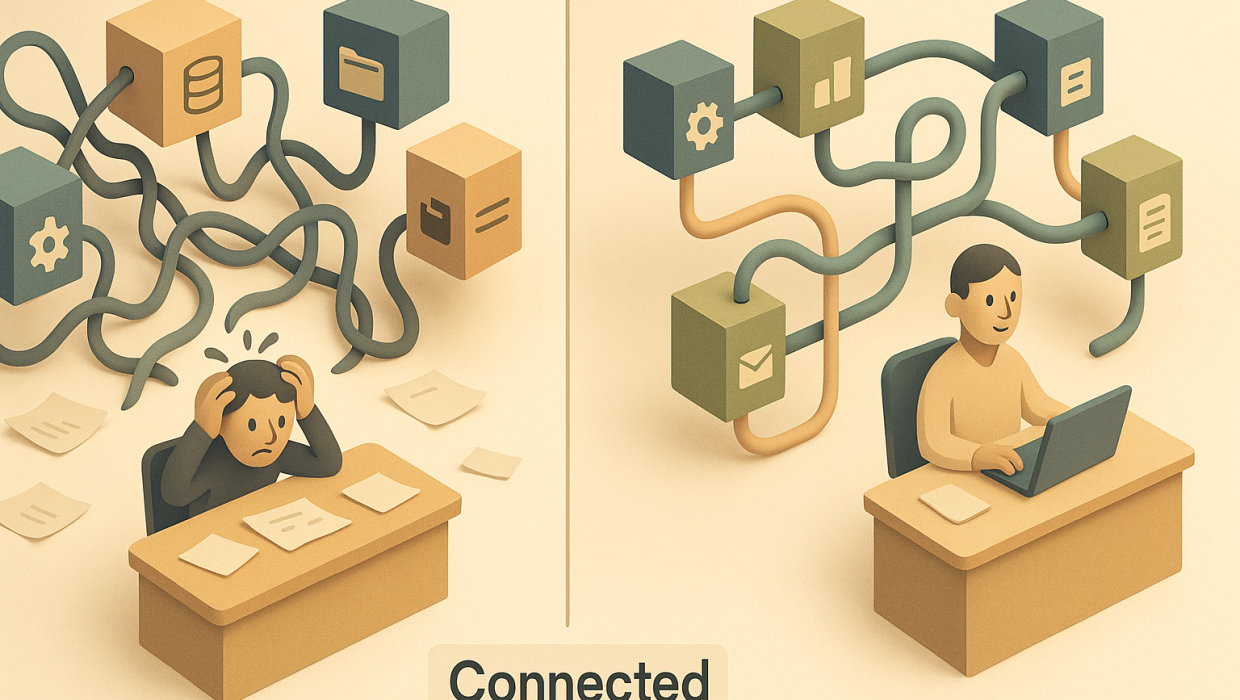
Most enterprises have accumulated a patchwork of systems — a CRM here, a project management tool there, a homegrown spreadsheet process holding it all together somewhere in the middle. AI tools bolted onto a fragmented stack just add another disconnected layer. Real workflow automation requires the underlying systems to actually talk to each other, which means integration work is usually the unglamorous prerequisite that has to happen before any AI layer can deliver value. Skipping this step is the single most common reason pilots don’t scale — the AI works fine in isolation, but the data it needs is scattered across five places that were never designed to connect.
The Judgment Gap
The second stall point is philosophical, not technical. Teams either try to automate everything, stripping out the human judgment that made the process reliable in the first place, or they resist automation entirely out of fear that it will. Neither extreme works. The workflows that hold up under real operating pressure are the ones where automation handles volume, consistency, and pattern-matching, while people retain control over exceptions, relationships, and anything with real ambiguity. Getting that balance right requires actually understanding the workflow before touching it — which is exactly the diagnostic step most vendors skip because it doesn’t look like a deliverable.
Diagnosis Before Build: The Right Way to Approach AI Integration
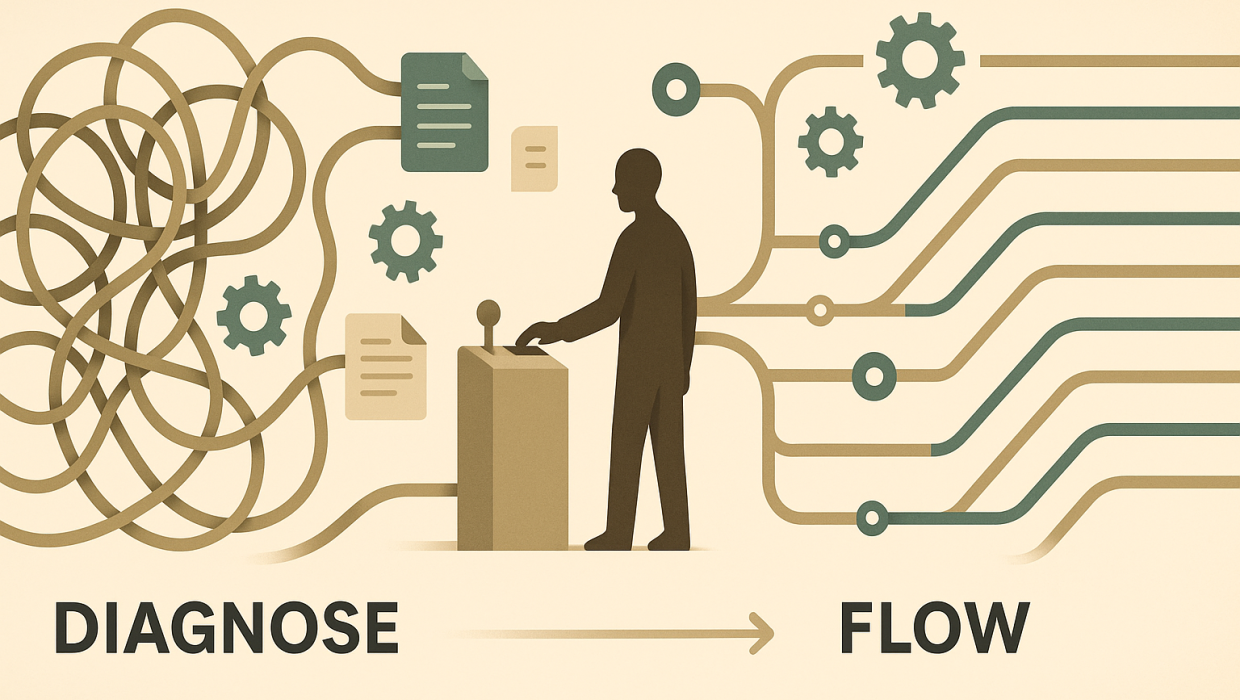
A workflow surge doesn’t start with a tool. It starts with a map. Before any automation gets built, the questions worth answering are: Where does information currently get stuck? Where do humans re-enter data that already exists somewhere else? Where are decisions being delayed by lack of visibility rather than lack of intelligence? Where does the current process actually break under volume?
This is the foundation of a diagnosis-before-build methodology, and it’s the reason our AI integration and automation work always begins with mapping the operation before writing a line of code or configuring a single workflow. Enterprises that skip this step tend to automate the wrong thing beautifully — a perfectly efficient process that nobody needed in the first place, while the actual bottleneck sits untouched three steps downstream.
The diagnostic phase also surfaces something enterprises rarely expect: a meaningful share of “AI opportunities” turn out to be integration problems in disguise. A sales team that wants an AI lead-scoring model often actually needs their CRM data cleaned and connected to marketing and fulfillment systems first — otherwise the model is making smart predictions on unreliable inputs. Solving that root issue is closer to custom software and systems integration work than it is to AI in the narrow sense, and it’s exactly the kind of finding that a proper diagnosis catches before budget gets spent on the wrong layer of the stack.
What Good Workflow Automation Looks Like in Practice
Concrete examples make this less abstract. A B2B services firm drowning in inbound RFPs doesn’t need a general-purpose AI assistant — it needs a workflow where incoming documents are automatically parsed, matched against past proposals, scored for fit, and routed to the right specialist with relevant context pre-attached, so the human review step takes minutes instead of hours. A marketing operations team juggling campaign data across four platforms doesn’t need another dashboard — it needs the platforms integrated so performance data flows into one place automatically, freeing analysts to interpret results instead of assembling them.
In both cases, the technology is almost secondary to the diagnostic work of understanding exactly where time and accuracy are being lost. This is where enterprise operations and AI integration genuinely meet: not in a demo, but in a redesigned handoff that a team actually uses six months later without a consultant standing over their shoulder. It’s worth browsing real examples of this kind of work in our case studies, where the pattern holds across industries — the win is rarely “we added AI,” it’s “we fixed the process AI now runs inside of.”
None of this happens without the right underlying technology choices, either. An AI-driven workflow is only as reliable as the infrastructure it runs on, which is why decisions about platforms, data architecture, and system compatibility deserve real scrutiny — something we go deeper on in our overview of the technology considerations that determine whether an automation initiative actually holds up under production load.
The Cost of Waiting
There’s a temptation to treat this as a someday project — worth doing, but not urgent. That calculus is shifting fast. As more competitors redesign their operations around AI-assisted workflows, the gap isn’t just about efficiency anymore; it’s about response time, data quality, and the ability to make decisions with current information instead of last week’s. An enterprise still manually reconciling data between systems isn’t just slower — it’s making decisions on staler, messier inputs than a competitor whose workflows surface clean, current data automatically.
This is also where the compounding nature of workflow surges becomes a competitive risk rather than just an opportunity. Every quarter an operation runs on disconnected systems is another quarter of data debt, manual error, and missed pattern recognition — problems that get more expensive to unwind the longer they sit. The organizations that treat this as a genuine strategic priority now, rather than a future initiative, are the ones setting the operating baseline everyone else eventually has to catch up to.
Getting Started Without Betting the Business
The good news is that none of this requires a company-wide overhaul on day one. The right entry point is almost always a focused diagnosis of one operational area — the one causing the most visible pain, whether that’s sales handoffs, customer onboarding, or internal reporting — followed by a scoped build that proves the model before it scales further. This is precisely what workflow automation done properly looks like: small enough to move quickly, substantial enough to show real operational change, and built on an honest read of what the business actually needs rather than what’s trending.
If your team has been circling this decision — aware that competitors are moving, unsure exactly where to start, wary of another tool that doesn’t stick — that uncertainty is usually a sign the diagnostic step hasn’t happened yet, not a sign the opportunity isn’t real. The conversation worth having isn’t “which AI should we buy,” it’s “where is our operation actually losing time, accuracy, or opportunity right now.” That’s a conversation we’re glad to have — you can start one here whenever you’re ready to look at your operations honestly.
Let’s make it happen — starting with an honest look at where your workflows actually stand today.
RELATED QUESTIONS
What does an AI-driven workflow actually mean for a business?
An AI-driven workflow is a business process where artificial intelligence handles repetitive tasks like data intake, sorting, and first-pass analysis, while humans retain control over exceptions, judgment calls, and final decisions. It’s different from simply “using AI tools” because it involves redesigning how information and decisions move through an entire process, not just adding a smart feature to one step.
Why do so many enterprise AI automation projects fail to scale past the pilot stage?
Most AI automation pilots stall because they’re built on top of fragmented systems that were never designed to share data, so the AI performs well in isolation but can’t access reliable, connected information at scale. The fix is addressing integration and data quality issues first, before layering AI on top of a broken or disconnected process.
What is a diagnosis-before-build approach to AI integration?
Diagnosis-before-build means mapping exactly where a business process breaks down, where decisions get delayed, and where data quality suffers before designing or building any automation. This prevents companies from automating the wrong task efficiently while the actual operational bottleneck goes untouched.
How is workflow automation different from replacing employees with AI?
Effective workflow automation is designed to handle high-volume, repetitive, and pattern-based tasks so that employees can focus on judgment, relationships, and exceptions that require human expertise. The goal is augmenting decision-making speed and accuracy, not eliminating the people who make the final calls.
Where should an enterprise start if it wants to build an AI-driven workflow but doesn’t know where to begin?
The best starting point is a focused diagnosis of a single high-pain operational area, such as sales handoffs, customer onboarding, or internal reporting, rather than attempting a company-wide overhaul. A scoped pilot in one area proves the approach works and builds a foundation before expanding automation to other parts of the business.
Ready to Diagnose Your Operations for the Next Workflow Surge?
Start a conversation with Sapiens + Machines to discuss your goals, challenges, and next steps.