There’s a specific moment every operations leader eventually hits: a report takes three days to compile that should take three hours, a lead sits untouched in a queue for a week, or two departments discover they’ve been maintaining separate versions of the same customer record. None of these are dramatic failures. They’re symptoms of a much quieter problem — the absence of AI-driven workflow intelligence in an organization that has simply outgrown its manual processes.
Enterprises rarely overlook automation because they don’t believe in it. They overlook it because the cost of inaction is invisible until it isn’t. Nobody gets fired for the ten minutes lost per employee per day reconciling spreadsheets. But multiply that across a workforce, a fiscal year, and a competitor who solved the problem eighteen months ago, and the invisible cost becomes an existential one.
The Hidden Cost of Standing Still
Workflow intelligence isn’t a buzzword for “more software.” It refers to systems that observe how work actually moves through an organization — where decisions get made, where data originates, where approvals stall — and then apply automation and machine judgment to the parts of that flow that don’t require a human’s full attention. When that layer is missing, the cost shows up in three predictable places: time, accuracy, and opportunity.
Time gets lost to manual handoffs. Accuracy erodes every time a human retypes data that already existed somewhere else. And opportunity — the hardest cost to quantify, but the most expensive — disappears when your team is too buried in operational maintenance to notice a market shift, a churn signal, or a process that’s ready to scale.
None of this requires a catastrophic failure to matter. It requires only that a competitor solves it first.
Where the Gaps Show Up First
Manual Handoffs That Should Be Invisible
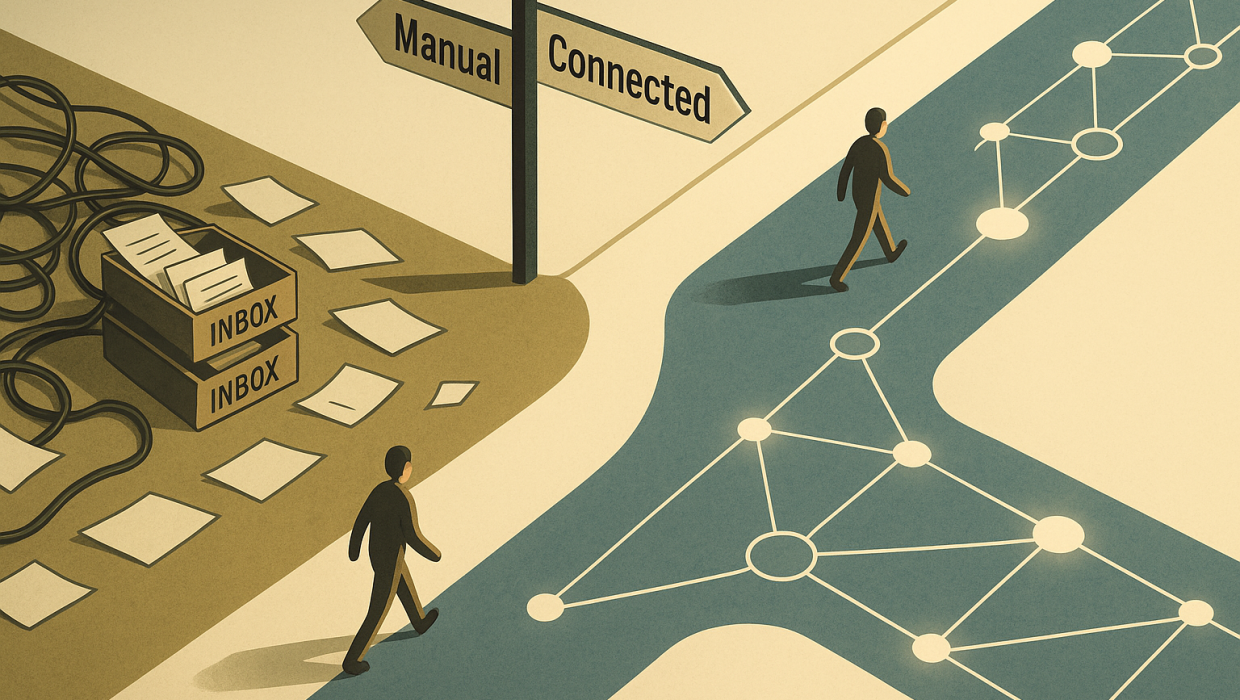
The clearest early warning sign is friction at the seams — the points where one system, team, or tool has to pass information to another. A sales team closes a deal in the CRM, but finance still receives the contract details by email. A support ticket gets resolved, but the knowledge base isn’t updated unless someone remembers to do it manually. These handoffs feel like normal operations because they’ve always existed. But each one is a place where AI integration could eliminate the lag entirely, and each one that persists is a small, recurring tax on enterprise efficiency.
Data That Never Talks to Itself
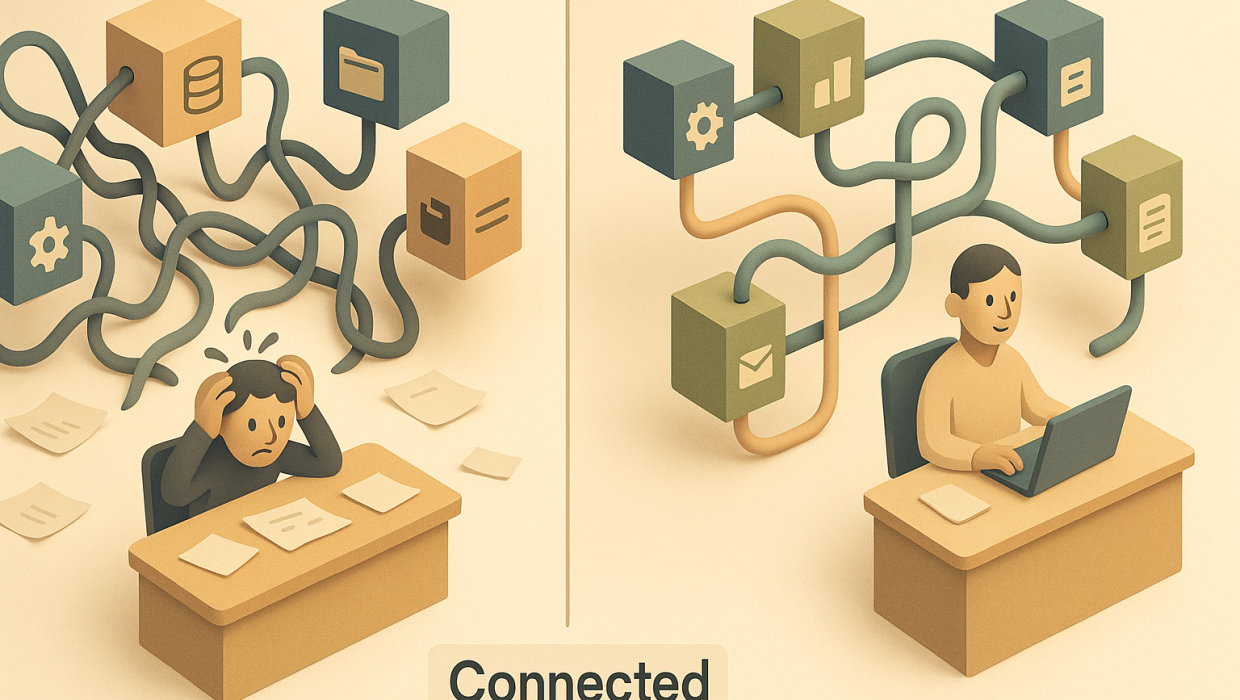
The second gap is subtler: disconnected data. Most enterprises don’t lack data — they lack a system that lets their data reason across silos. Marketing knows engagement history. Sales knows deal history. Support knows complaint history. Without a layer of intelligence connecting them, each department is making decisions with a third of the picture. This is precisely the kind of fragmentation that AI-driven workflow intelligence is built to resolve — not by replacing the people making decisions, but by giving them a complete, current picture before they decide.
The Compounding Effect on Enterprise Efficiency
Inefficiency doesn’t scale linearly — it compounds. A manual process that costs an employee twenty minutes a day seems trivial in isolation. Multiplied across a growing headcount, a widening product line, and an increasingly complex customer base, that same process becomes a structural drag on the business. Enterprises that delay automated systems long enough eventually find themselves hiring more people to manage complexity that better systems could have absorbed.
This is the part that catches leadership off guard. The decision to postpone workflow intelligence rarely feels like a decision at all — it feels like focusing on “more urgent” priorities. But every quarter without it means another quarter of paying human salaries to do work that machine judgment, properly supervised, could have handled in seconds. The math doesn’t announce itself. It just quietly gets worse.
What AI-Driven Workflow Intelligence Actually Looks Like
Done well, this isn’t about deploying a chatbot or bolting an AI feature onto an existing tool. It’s about mapping how information and decisions actually move through your organization, identifying where automation can absorb repetitive cognitive load, and building systems that route the right information to the right person at the right moment — before they even have to ask for it.
A well-instrumented workflow might automatically score and route inbound leads based on real engagement signals rather than static form fields, flag anomalies in operational data before they become customer complaints, or generate a first-draft report so an analyst’s time goes toward interpretation rather than assembly. In each case, the technology isn’t making the final call. It’s clearing the runway so a human expert can make a better one, faster.
Diagnosis Before Build
The mistake most enterprises make isn’t underinvesting in AI — it’s overinvesting in the wrong place. They buy a platform because a competitor has one, without first understanding which of their workflows are actually broken. That’s backward. The right sequence starts with diagnosis: mapping current processes, identifying where human judgment is being wasted on repetitive tasks, and only then designing the automation that fits. This is why any credible AI integration engagement should start with an honest audit of what’s actually happening inside the business, not a sales pitch for a specific tool. Skipping that step is how enterprises end up with expensive software that automates the wrong problem.
The Competitive Gap Widens Quietly
Here’s the part most executives underestimate: this gap doesn’t close on its own, and it doesn’t stay static. While one enterprise is still routing approvals through email threads, a competitor down the street has already connected its CRM, support desk, and finance systems into a single intelligent workflow — and is using the time saved to out-position everyone else on price, speed, or service. Custom-built software solutions and integrated systems aren’t a luxury reserved for enterprises with unlimited budgets anymore; they’re increasingly the baseline expectation of a modern buyer.
The businesses that get this right rarely announce it publicly. It shows up instead in response times, in the accuracy of their forecasting, and in how few things fall through the cracks. Enterprises that have gone through this transition often describe it less as “adding AI” and more as finally seeing their own operations clearly for the first time — a pattern documented across several of our own case studies, where the biggest wins came not from flashy technology but from fixing workflows nobody had looked at critically in years.
Building Automated Systems That Support Judgment, Not Replace It
There’s a legitimate fear underlying enterprise hesitation here, and it deserves to be named directly: the worry that automation means replacing skilled people with algorithms. That fear is usually based on a flawed premise. The organizations getting the most value from workflow intelligence aren’t the ones removing humans from decisions — they’re the ones removing humans from tasks that never needed a human in the first place, so that human judgment gets applied where it actually matters: strategy, relationships, and the ambiguous calls no model should be making alone.
Enterprises that treat AI-driven workflow intelligence as optional aren’t avoiding risk — they’re accumulating it, one manual process at a time. That accumulation is silent until the day a competitor’s speed, accuracy, or responsiveness makes it impossible to ignore.
Enterprises that treat AI-driven workflow intelligence as optional aren’t avoiding risk — they’re accumulating it, one manual process at a time.
What to Do Before You Fall Further Behind
The starting point isn’t a massive transformation initiative — it’s a clear-eyed look at where your organization’s time actually goes. Which reports take longer to build than they should? Which teams are re-entering data that already exists elsewhere? Where do customers wait longest for a response that should be instant? Answering those questions honestly, before buying anything, is the difference between automation that sticks and automation that gets quietly abandoned six months later.
For enterprises without the internal bandwidth to run that audit objectively, this is often where an outside diagnostic view proves valuable — someone with no stake in defending the status quo, whose only job is to find where the system is leaking time and judgment. That objectivity, paired with the technical capability to actually build the fix, is where real business optimization starts. If you’re ready to find out where those gaps live in your own operation, this is a good moment to start a conversation before the cost of waiting grows any larger.
The Real Risk Isn’t the Technology
The uncomfortable truth is that most enterprises don’t fall behind because AI is too complicated to adopt. They fall behind because nobody stopped long enough to diagnose what was actually broken before reaching for a tool. Workflow intelligence, done properly, isn’t about chasing the newest capability — it’s about finally seeing your own organization clearly, and building the connective tissue between your teams, your data, and your decisions. The enterprises that treat that as foundational infrastructure, not a future initiative, are the ones still setting the pace a year from now.
RELATED QUESTIONS
What is AI-driven workflow intelligence?
AI-driven workflow intelligence refers to systems that observe how work and data actually move through an organization and apply automation to the repetitive parts of that flow, while routing the right information to the right person at the right time. It’s less about deploying a single AI tool and more about connecting decisions, data, and teams so human judgment isn’t wasted on manual, repetitive tasks.
What happens if a company doesn’t adopt AI-driven workflow automation?
Companies that skip AI-driven workflow automation typically don’t experience a single dramatic failure — instead, they accumulate small, recurring costs like duplicated data entry, slow handoffs between departments, and missed signals in customer or operational data. Over time these costs compound, making the organization measurably slower and less accurate than competitors who’ve already automated those same processes.
How do you know if your enterprise needs workflow automation?
Common warning signs include employees manually re-entering data that already exists in another system, reports or approvals taking days instead of hours, and teams working from outdated or incomplete information because their tools don’t talk to each other. If you can point to a specific handoff between teams or systems that regularly causes delays or errors, that’s usually a strong candidate for automation.
Does AI automation replace human employees?
Not when implemented well. The goal of effective AI integration is to remove humans from repetitive tasks that never required human judgment in the first place, freeing people to focus on strategy, relationships, and decisions that genuinely need expertise. Enterprises that get the most value from automation use it to support and speed up human decision-making, not to eliminate it.
Where should a company start when adopting AI workflow automation?
The right starting point is a diagnostic audit of existing workflows, not a purchase of new software. Companies should first identify exactly where time, accuracy, or opportunity is being lost — such as slow handoffs or disconnected data — before selecting or building any automated system to address it. Skipping this step is the most common reason automation projects fail to deliver lasting value.
Find Out Where Your Workflows Are Leaking Time and Judgment
Start a conversation with Sapiens + Machines to discuss your goals, challenges, and next steps.