Enterprise search optimization used to mean one thing: rank on Google. That definition is now dangerously incomplete. Buyers ask ChatGPT to compare vendors. Procurement teams read AI Overviews instead of clicking through ten blue links. Sales-qualified leads increasingly arrive already convinced, having been “sold” by an answer engine’s summary before a human ever visits your site. For B2B decision-makers, this isn’t a future trend to monitor — it’s the current operating environment.
The Search Landscape Has Fractured
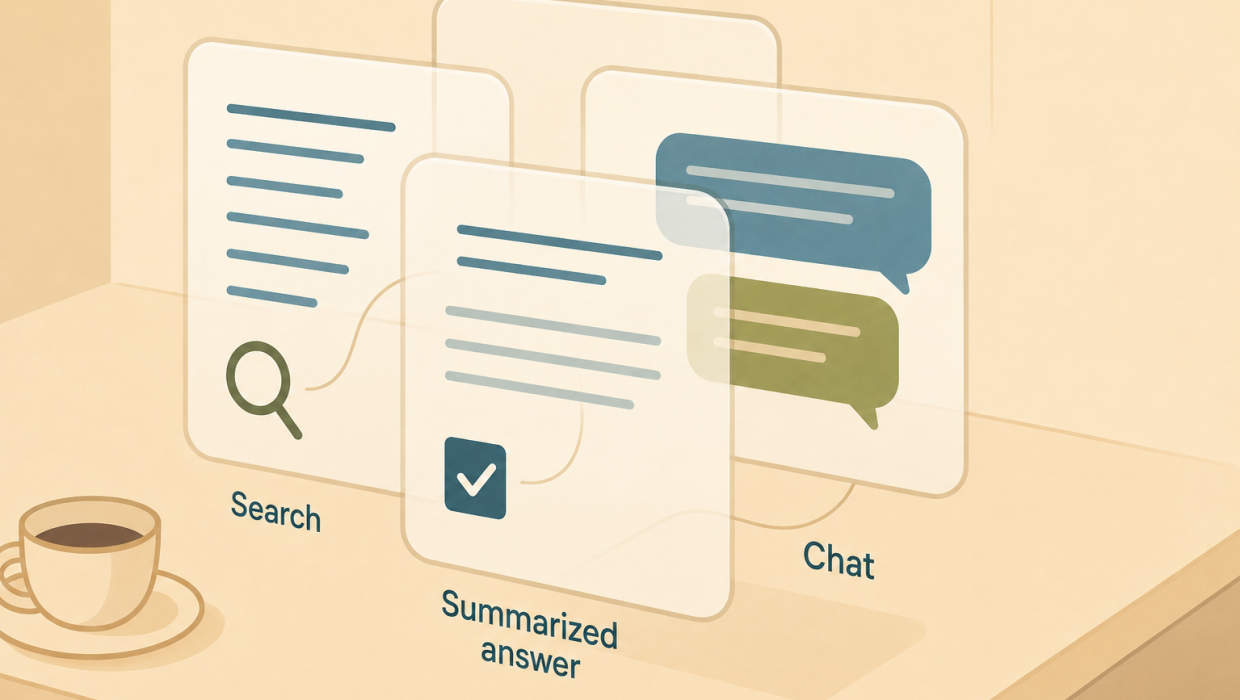
For two decades, search optimization was a single discipline with a single scoreboard: rankings. Today, visibility is distributed across at least three distinct systems, each with its own logic.
Traditional search engines still reward technical health, backlinks, and relevance signals. Answer engines — the AI-generated summaries sitting atop Google and Bing results — reward clarity, structure, and citability. Generative engines like ChatGPT, Perplexity, and Gemini reward something else entirely: being the source that large language models trust enough to synthesize into an answer, often with no click at all.
This fragmentation means a company can rank #1 organically and still be invisible in the answer layer where an increasing share of B2B research now happens. That gap is where most enterprise visibility budgets are quietly being wasted.
What Enterprise Search Optimization Actually Means Now
Enterprise search optimization is no longer a content marketing task bolted onto a website. It’s a cross-functional discipline that sits at the intersection of engineering, content strategy, and brand governance — which is exactly why it belongs on the desks of CTOs and marketing directors simultaneously, not one or the other.
From Keywords to Answers
The old unit of optimization was the keyword. The new unit is the answer. Search and generative systems are no longer matching strings — they’re extracting meaning, comparing claims across sources, and deciding which entity to cite as authoritative. A page stuffed with keyword variants but light on clear, structured claims will lose to a competitor’s tighter, better-labeled content every time.
Generative Engines Change the Unit of Optimization
Generative engine techniques require thinking in terms of extractable facts rather than persuasive prose. Large language models favor content with explicit definitions, comparison structures, numbered steps, and consistent entity naming. If your product, methodology, or category terms are described inconsistently across your site, you’re making it harder for a model to confidently attribute an answer to you — and confidence is the currency of citation.
This is where structured technical work and content strategy have to move in lockstep, which is precisely the kind of cross-disciplinary problem our search, answer, and generative engine optimization service is built to solve — treating schema, site architecture, and narrative clarity as one system rather than three separate line items.
Answer Engine Optimization: The New Front Door
Answer engine optimization (AEO) deserves its own strategic line item, not a footnote in an SEO plan. AEO is about winning the “position zero” moment — the AI-generated summary a user sees before, or instead of, a list of links.
Winning that moment requires a few concrete practices:
Explicit structure. Use headers that phrase real questions the way buyers actually ask them, followed immediately by a direct, complete answer. Ambiguity is punished; directness is rewarded.
Schema markup discipline. FAQ, HowTo, and Organization schema give answer engines machine-readable confirmation of what your content is claiming, reducing the chance a model misattributes your insight to a competitor.
Source consistency. If your pricing, methodology, or case study numbers vary across your site, PR mentions, and directory listings, you erode the trust signals that answer engines use to decide who to cite.
None of this replaces traditional SEO — it extends it. A technically sound, fast, well-linked site is still the foundation everything else is built on, which is why site architecture and page performance remain part of any serious visibility strategy, closely tied to the broader web development work that underpins it.
Building a B2B SEO Strategy That Works Across All Three Layers
A modern B2B SEO strategy has to be judged against three simultaneous questions: Does it rank? Does it get cited in AI Overviews? Does it get referenced by generative models when a prospect asks an open-ended question in a chat interface?
Technical Foundations
Site speed, crawlability, mobile performance, and clean information architecture remain non-negotiable. Generative and answer engines are, at their core, still consuming crawled and indexed content — a slow or poorly structured site limits how much of your expertise ever reaches the model in the first place.
Content Structured for Machines and Humans
The best-performing B2B content today does double duty: it reads naturally for a human decision-maker while being explicit enough for a machine to extract a clean claim. That means fewer clever headlines and more direct ones, fewer buried conclusions and more stated-up-front insights, and a consistent vocabulary for your core concepts across blog posts, service pages, and case studies.
Search Technology Integration: Where CTOs and CMOs Must Align
Search technology integration is the unglamorous but essential layer beneath all of this. It’s the CMS architecture, the API connections between your content platform and your CRM, the analytics pipeline that tells you whether AI-driven traffic is converting differently than organic traffic — and increasingly, the automation that keeps schema and structured data accurate as your site scales.
This is precisely where marketing and engineering priorities collide, and where most organizations stall. A marketing team can write brilliant, well-structured content, but if it’s deployed on a CMS that can’t render schema properly or that strips structured data on publish, none of that work reaches the machines reading it. Conversely, an engineering team can build a technically flawless site that has nothing worth citing. Closing that gap often means pairing search strategy with real automation and AI integration work, so structured data, content updates, and technical health stay synchronized without manual babysitting.
If you’re weighing whether your current stack can even support this kind of integration, that’s a conversation worth having early — our team is happy to start a conversation about where your architecture stands today.
Diagnosis Before Build: Why Most Enterprise Search Efforts Fail
The single most common failure pattern in enterprise search work is skipping straight to tactics. A team decides it needs “more schema” or “an AEO strategy” without first diagnosing where the actual visibility gap lives — technical, structural, or narrative. The result is budget spent on the wrong layer of the problem while the real leak keeps draining trust and traffic.
The result is budget spent on the wrong layer of the problem while the real leak keeps draining trust and traffic.
A rigorous diagnosis looks at crawl logs, existing schema coverage, competitor citation patterns in AI Overviews, and how your brand’s core claims are represented (or misrepresented) across the web before a single new piece of content gets written. Only after that diagnosis is complete does it make sense to build — whether that build involves new content architecture, custom tooling, or deeper software solutions to manage structured data at scale.
This is the same principle behind our broader SEO, AEO, and GEO service: diagnose the actual mechanism of visibility loss first, then build the specific fix — never the reverse. You can see this play out in practice across our case studies, where the sequencing of diagnosis before build consistently separates lasting gains from short-term ranking bumps.
The Path Forward
Enterprise visibility is no longer won or lost on a single search results page. It’s won across a layered system of engines, each with different rules but a shared underlying demand: clarity, structure, and trustworthiness. Organizations that treat traditional SEO, answer engine optimization, and generative engine techniques as one coordinated discipline — backed by the technical infrastructure to support it — will be the ones cited, summarized, and remembered when it matters most.
The organizations that keep treating them as separate initiatives, run by separate teams with separate budgets, will keep losing visibility to competitors who figured out they’re the same problem wearing three different masks.
RELATED QUESTIONS
What is enterprise search optimization?
Enterprise search optimization is the practice of making a company’s content and technical infrastructure visible and citable across traditional search engines, AI-generated answer summaries, and generative AI tools like ChatGPT. It goes beyond keyword ranking to include structured data, content clarity, and technical performance so that machines can confidently surface and cite the information. For large organizations, it also requires coordination between marketing and engineering teams to keep that infrastructure consistent at scale.
How is answer engine optimization different from traditional SEO?
Traditional SEO focuses on ranking web pages in a list of links, while answer engine optimization (AEO) focuses on getting content directly cited or summarized in AI-generated answer boxes above those links. AEO relies heavily on explicit structure, schema markup, and directly-stated answers rather than persuasive or narrative writing. The two disciplines overlap technically but require different content and structuring priorities to win each layer.
Why do generative engines like ChatGPT cite some companies and not others?
Generative engines favor sources with clear, consistent, and well-structured claims because they extract meaning rather than matching keywords. If a company’s core facts, definitions, and terminology are stated consistently and clearly across its site, the model has more confidence attributing an answer to that source. Inconsistent messaging, vague claims, or poor technical structure make it harder for the model to trust and cite that content.
Why is a diagnosis-before-build approach important for search strategy?
A diagnosis-before-build approach ensures that resources are spent fixing the actual cause of a visibility problem rather than applying generic tactics that may not address the real issue. Many organizations jump straight to adding schema or publishing more content without first identifying whether the gap is technical, structural, or narrative. Proper diagnosis — reviewing crawl data, schema coverage, and competitor citation patterns — leads to fixes that produce lasting results rather than short-term ranking bumps.
Who should be responsible for enterprise search optimization within a company?
Enterprise search optimization works best as a shared responsibility between marketing and engineering leadership, since it requires both content clarity and technical infrastructure to succeed. Marketing teams typically own messaging, structure, and content strategy, while engineering or IT teams own the technical foundation like site performance, schema implementation, and CMS architecture. Companies that treat this as a purely marketing or purely technical function tend to see incomplete results.
Ready to Diagnose Your Search Visibility Gaps?
Start a conversation with Sapiens + Machines to discuss your goals, challenges, and next steps.