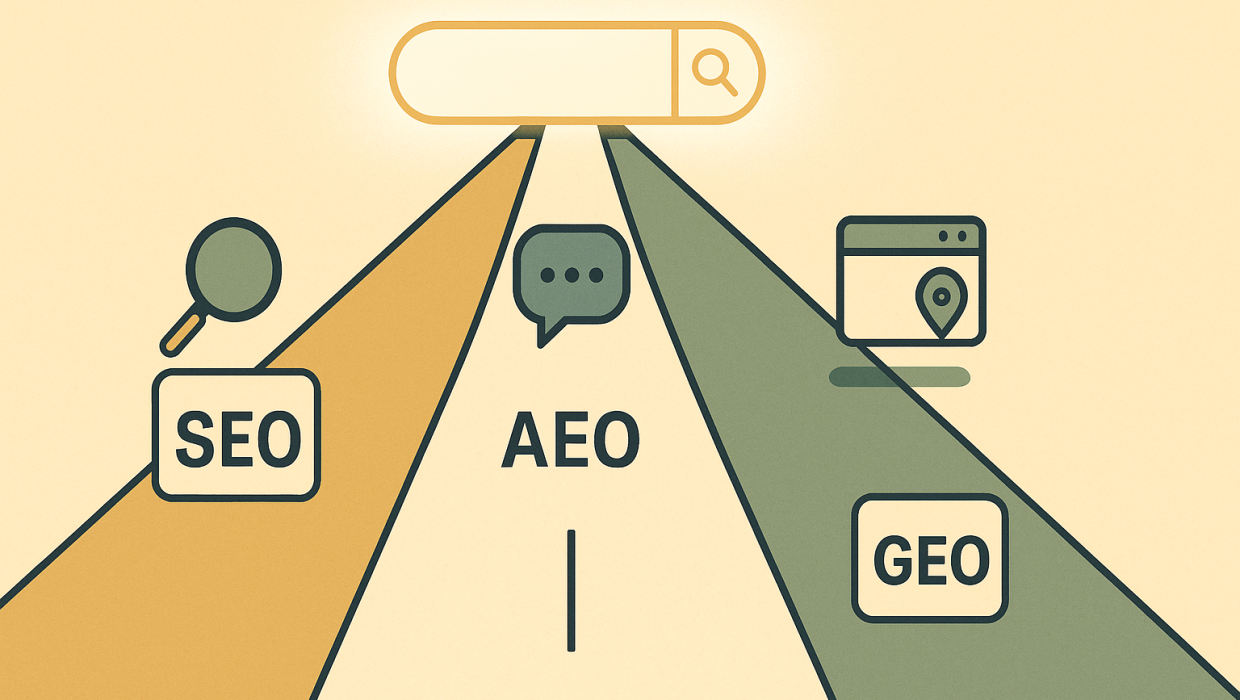
If your enterprise SEO strategy still measures success in blue links and click-through rates, you’re optimizing for a search landscape that’s already halfway extinct. Generative engine optimization — the practice of earning visibility inside AI-generated answers from tools like ChatGPT, Perplexity, and Google’s AI Overviews — has moved from experimental to essential in the span of about eighteen months. The question isn’t whether generative engines will reshape how your buyers find you. It’s whether your team noticed before your competitors did.
The Search Landscape Has Quietly Split in Three
For twenty years, “search optimization” meant one thing: rank higher on a results page built from ten blue links. That world hasn’t disappeared, but it’s no longer the whole picture. Today, discovery happens across three overlapping but distinct systems — traditional search engines, answer engines, and generative engines — and each one rewards a different kind of content, structure, and technical foundation.
Traditional search still governs a huge share of B2B research, especially for bottom-funnel, high-intent queries. Answer engines — think featured snippets, voice assistants, and Google’s “People Also Ask” boxes — reward content structured to deliver a direct answer instantly. Generative engines go a step further: they synthesize information from dozens of sources into a single conversational response, often with no click at all. Your prospect gets their answer, forms an opinion of your company, and may never visit your website in the process.
From SEO to AEO to GEO — What’s Actually Different
SEO optimizes for ranking a page. Answer engine optimization optimizes for being the direct, extractable answer to a specific question. Generative engine optimization optimizes for something harder to control and more valuable to win: being the source a large language model trusts enough to cite, paraphrase, or recommend when a buyer asks it to compare vendors, explain a category, or solve a problem.
That distinction matters enormously for enterprise visibility. A page can rank on page one of Google and still be invisible inside ChatGPT’s answer to “who are the best enterprise software implementation partners.” The ranking systems are different. The trust signals are different. And most enterprise SEO programs weren’t built with any of this in mind.
Why Enterprise SEO Strategy Alone No Longer Covers Enterprise Visibility
Enterprise SEO strategy built around keyword targeting, backlink acquisition, and domain authority still has real value — it’s not being replaced, it’s being surrounded. What’s changed is the buyer journey itself. A growing share of B2B research now starts inside a chat interface rather than a search bar, particularly among technical buyers who are already comfortable treating an LLM as a research assistant. If your content isn’t structured for that assistant to find, understand, and trust, you’re absent from a conversation your competitors may already be winning.
This is precisely the gap our SEO, AEO, and GEO practice was built to close. Enterprise visibility today isn’t a single scoreboard — it’s a set of overlapping scoreboards, and most companies are only tracking one of them.
The Diagnosis Most Companies Skip
Here’s where most agencies go wrong: they jump straight to producing more content, adding more schema, or chasing more backlinks without first understanding where a brand actually stands inside AI-generated answers today. Diagnosis has to come before build. That means auditing how often your brand appears in generative responses to category-relevant queries, identifying which competitors are being cited instead, and understanding why — is it a content structure problem, a technical crawlability problem, or a genuine authority gap that content alone won’t fix?
Without that diagnostic step, you risk investing in tactics that optimize for the wrong engine entirely, or worse, optimizing for a problem you don’t actually have.
What Generative Engine Optimization Actually Requires
Winning visibility inside generative engines depends on a handful of concrete, controllable factors — none of them mysterious, all of them frequently neglected.
Structured Data and Machine-Readable Trust
Generative engines lean heavily on structured data to understand what a page is actually about — not just what it says, but what entity, category, and relationship it represents. Clean schema markup, consistent entity naming, and a well-organized technology foundation make the difference between content an AI system can parse confidently and content it skips because the signal is too noisy. This is technical work as much as it is content work, and it’s why generative engine optimization sits at the intersection of engineering and editorial strategy.
Answer Engine Optimization: Writing for the Citation, Not Just the Click
Answer engine optimization rewards content that leads with a direct, well-formed answer before expanding into depth and nuance. That’s a real shift for teams trained to write SEO content that builds slowly toward a conclusion. The brands winning generative visibility today are not the ones with the most content — they’re the ones with the clearest answers. Every page should be able to stand alone as a citable, self-contained response to the exact question a buyer is asking, whether that buyer is a human or a model summarizing on their behalf.
The brands winning generative visibility today are not the ones with the most content — they’re the ones with the clearest answers.
The Cost of Waiting
The risk here isn’t abstract. When a generative engine answers a category question — “what’s the best CRM integration partner for mid-market manufacturers,” for instance — it’s making a recommendation on your behalf whether you’ve earned that trust or not. If your competitor has invested in structured, citation-ready content and you haven’t, they become the default answer. Not because their product is better, but because their content was legible to the systems doing the recommending.
That erosion happens quietly. There’s no ranking drop to alert your team, no dashboard flashing red — just a slow decline in inbound interest that’s hard to trace back to its actual cause. If you suspect this is already happening inside your funnel, it’s worth a direct conversation before the gap widens further — you can start a conversation with us to find out exactly where you stand.
A Practical Path Forward
The good news is that none of this requires starting over. It requires sequencing the work correctly.
Start with a visibility audit: query the major generative engines with the questions your real buyers ask, and document where your brand appears, where it’s absent, and who’s showing up instead. Next, fix the technical foundation — crawlability for AI bots, schema markup, clean site architecture — before touching content, since no amount of great writing overcomes a page a model can’t parse. From there, restructure your highest-value pages around direct, extractable answers, and build the authority signals — citations, mentions, structured data, consistent entity presence — that generative engines use as trust proxies.
For many enterprises, this work also intersects with broader AI automation initiatives already underway internally, which makes it worth coordinating rather than running as an isolated marketing project. Our SEO, AEO, and GEO service was designed around exactly this kind of sequencing — diagnose first, prioritize the highest-impact fixes, then build with intention rather than guesswork. You can see how this plays out in practice across our case studies, where the pattern holds regardless of industry: visibility follows structure, not volume.
Where This Leaves B2B Marketing Leaders
CTOs, marketing directors, and agency owners evaluating partners in this space should ask a pointed question: does this partner understand the difference between ranking and being cited? Enterprise SEO strategy, answer engine optimization, and generative engine optimization are related disciplines, not interchangeable ones, and a partner who treats them as one undifferentiated blob of “SEO” will optimize you into irrelevance inside the exact channel your buyers are increasingly using.
The generative engine revolution isn’t a future trend to plan for eventually. It’s already redistributing enterprise visibility today, quietly and continuously, one AI-generated answer at a time. The brands that adapt their content, structure, and authority signals now will be the ones the machines recommend for years to come — everyone else will be explaining the decline after it’s already happened. Let’s make it happen before that becomes your story.
RELATED QUESTIONS
What is generative engine optimization (GEO)?
Generative engine optimization is the practice of structuring and positioning content so that AI systems like ChatGPT, Perplexity, and Google’s AI Overviews cite or reference your brand when generating conversational answers to relevant questions. Unlike traditional SEO, which targets page rankings, GEO focuses on being the trusted source a language model draws from when synthesizing a response, often without the user ever clicking through to a website.
How is generative engine optimization different from traditional SEO?
Traditional SEO focuses on ranking a webpage on a results page, while generative engine optimization focuses on becoming a trusted, citable source inside an AI-generated answer that may never link back to your site at all. GEO relies more heavily on structured data, clear entity definitions, and directly extractable answers, whereas SEO has historically prioritized keyword targeting and backlink authority.
Why does enterprise SEO strategy need to include answer engine optimization now?
A growing share of B2B buyers begin research inside chat interfaces and voice assistants rather than traditional search bars, especially for category comparisons and vendor research. If enterprise content isn’t structured to deliver direct, extractable answers, it becomes invisible in exactly the moments buyers are forming early opinions about vendors. Answer engine optimization ensures content is formatted to win those direct-answer placements before a buyer ever reaches a traditional search results page.
What technical changes are required to improve visibility in AI-generated search results?
The core technical requirements include clean schema markup, crawlability for AI-specific bots, consistent entity naming across the web, and clear site architecture that makes it easy for models to understand what a page represents. Content also needs to be restructured to lead with direct answers before expanding into supporting detail, since generative engines prioritize extractable clarity over length or keyword density.
What happens if a company ignores generative engine optimization?
Ignoring generative engine optimization typically leads to a slow, hard-to-trace decline in inbound interest as competitors become the default answer inside AI-generated responses for category and comparison queries. Because there’s no ranking drop or obvious alert tied to this shift, many companies don’t notice the erosion until pipeline numbers have already declined. The fix is to run a visibility diagnostic early, rather than discovering the gap after competitors have already claimed it.
Ready to Find Out Where Your Brand Stands Inside AI Search?
Start a conversation with Sapiens + Machines to discuss your goals, challenges, and next steps.