When a custom software project underdelivers, most teams look in the wrong place first. They audit the code, question the vendor, or blame user adoption. Rarely do they examine the processes the software was built to serve. Yet that’s usually where the real damage to custom software ROI is happening — quietly, in the gap between what a system was designed to do and how work actually flows through an organization.
This isn’t a niche problem. It’s one of the most common — and most avoidable — reasons enterprise technology investments fail to deliver on their promise.
The Hidden Cost Problem in Custom Software ROI
Every software budget accounts for licensing, development hours, infrastructure, and maintenance. Far fewer accounts for the cost of the process itself — the manual workarounds, redundant approvals, and undocumented tribal knowledge that a new system inherits from the old way of doing things. When you build software on top of a broken or inefficient process, you don’t fix the inefficiency. You automate it, harden it, and make it harder to change later.
This is the quiet tax on custom software ROI: the return isn’t undermined by bad code, it’s undermined by processes that were never questioned before they were digitized. A CRM that dutifully replicates a three-approval sign-off chain your team hates. An internal tool that automates a report nobody actually reads anymore. A workflow engine that speeds up a bottleneck step while leaving the real bottleneck — a manual handoff two departments upstream — untouched.
Why Software Implementation Costs Are Only the Beginning
Most ROI models stop at go-live. They count software implementation costs — licenses, integration work, training — as the full price of the investment, and everything after launch as pure upside. In practice, the real costs often begin after deployment, in the form of:
Shadow workarounds. When a system doesn’t match how people actually work, employees build informal patches — spreadsheets on the side, manual exports, duplicate data entry — that quietly erode the efficiency the software was supposed to create.
Change resistance debt. Every process the software didn’t account for becomes friction. Friction compounds. Six months in, teams have reverted to old habits for anything the system doesn’t handle gracefully, and the platform ends up running at a fraction of its intended capacity.
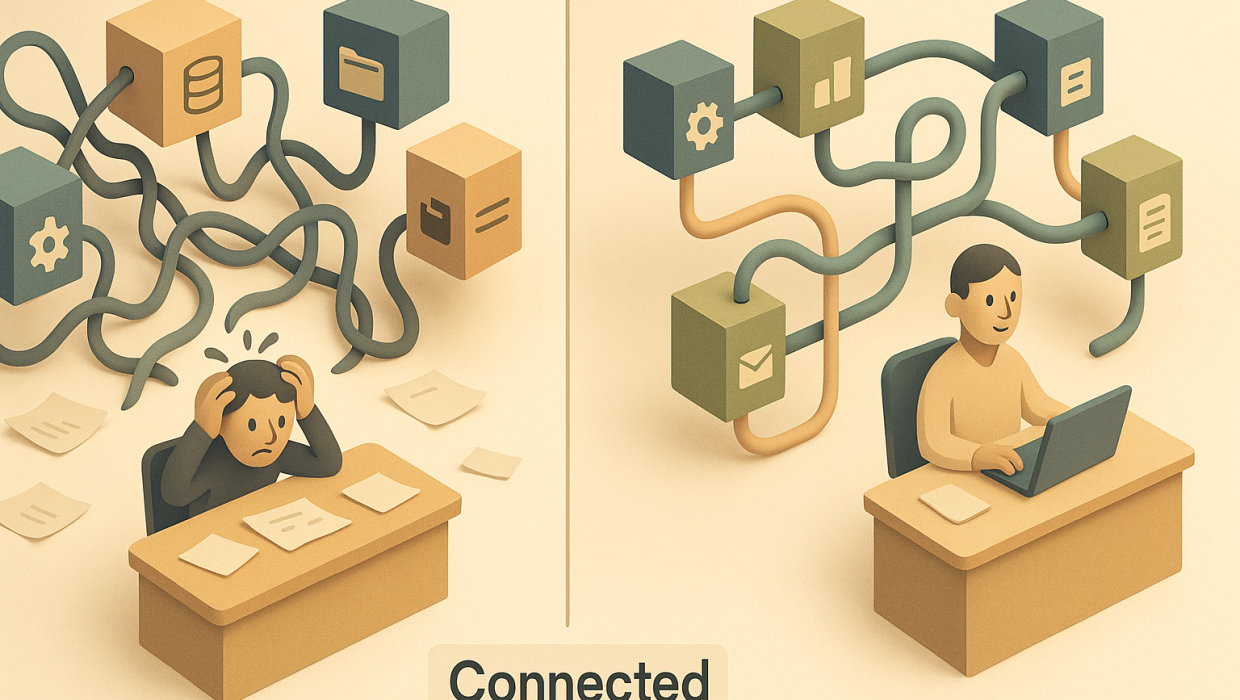
Integration drag. Systems that don’t talk to each other create manual reconciliation work that never shows up on the original project budget but shows up permanently on someone’s calendar.
Maintenance creep. Custom fixes layered on top of an unexamined process tend to multiply rather than resolve. What looks like a small enhancement request is often a symptom of a process problem the software can’t actually solve.
None of these costs appear on a project plan. All of them appear on a P&L, eventually, as reduced productivity, duplicated labor, or a system that quietly falls out of use. This is why a rigorous approach to custom software and internal tools development has to start further back than most companies expect — with the process, not the platform.
Business Process Optimization as the Missing Layer
Business process optimization isn’t a separate initiative from software development — it’s the precondition for software development that actually pays off. Before a single line of code gets written, the more useful question is rarely “what should this system do?” It’s “what is actually happening right now, and why?”
That distinction matters because most inefficiencies aren’t visible from the org chart. They live in the informal workarounds people have built to survive a process that was never designed for how the business operates today. A sales team re-keying data between three tools isn’t a training problem — it’s evidence that the process was inherited, not designed. An approval chain that takes eleven days for a low-risk decision isn’t a bottleneck to automate — it’s a structure to challenge.
Mapping these realities takes discipline most teams skip in the rush to build. It means sitting with the people doing the work, tracing where time and information actually go, and being willing to find that the fix isn’t more software — it’s fewer steps.
Rethinking Enterprise Software Investment as a System, Not a Purchase
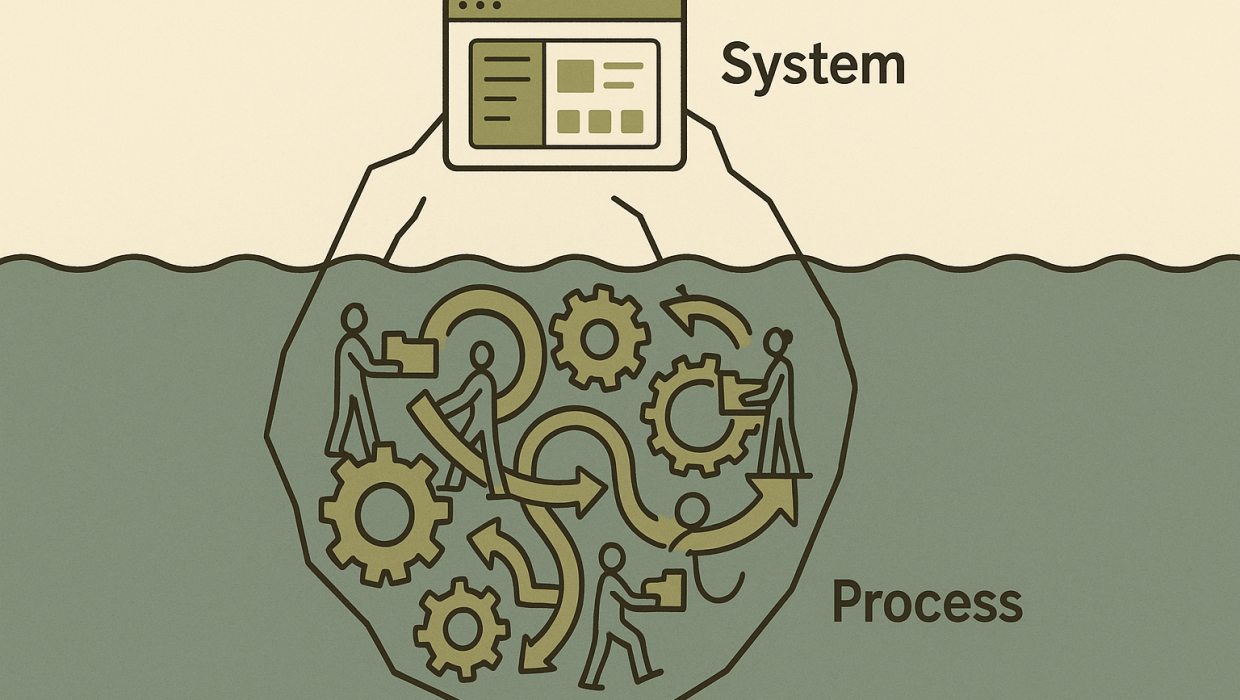
Enterprise software investment decisions are typically framed as procurement problems: which platform, which vendor, which price point. That framing is exactly what allows hidden process costs to hide. A platform decision is a single moment. The system it operates inside — the people, handoffs, exceptions, and judgment calls surrounding it — is ongoing, and it’s where value is actually created or destroyed.
Reframing the investment this way changes what gets evaluated. Instead of asking whether a tool has the right features, the better question is whether the organization has the right process for the tool to support. Instead of measuring success by deployment on schedule, the better measure is adoption without workarounds six months later. This is also where technology choices intersect with broader capability — a custom internal tool rarely operates in isolation, and decisions about where automation can responsibly take over repetitive work or how systems connect to existing infrastructure through underlying IT systems and infrastructure often matter more to ROI than the original feature list did.
A Diagnosis-Before-Build Approach to B2B Technology Solutions
The pattern we see most often with B2B technology solutions is a rush to build driven by urgency — a deadline, a competitor move, a frustrated executive — that skips the diagnostic step entirely. The build happens fast. The disappointment happens slower, but it happens.
A diagnosis-before-build approach flips the sequence. Before scoping a system, we map the actual workflow: where data originates, who touches it, where decisions get made, where delays live, and — critically — which of those delays are structural versus habitual. Some processes are slow because the underlying decision genuinely requires multiple perspectives. Others are slow because nobody has revisited them since a different team owned them three reorganizations ago.
The software was never the problem — the process wrapped around it was.
The software was never the problem — the process wrapped around it was.
This distinction is the difference between building a system that automates dysfunction and building one that removes it. It’s slower at the start. It saves years at the end. You can see how this plays out concretely in our case studies, where the diagnostic phase frequently reshaped the scope of the build before development even began.
What This Looks Like in Practice
Consider a mid-sized agency that came to us wanting a custom project management tool because their existing software “didn’t fit how we work.” A build-first vendor would have scoped a system to replicate their current process, custom fields and all. Instead, the diagnostic phase revealed that the actual problem was a handoff between account management and production that had never been formally defined — three different informal versions existed depending on who you asked.
Building software on top of that would have baked ambiguity into a permanent system. Fixing the handoff first meant the eventual software could be radically simpler, cheaper to build, and easier to adopt, because it only had one process to support instead of three competing ones. That’s the difference business process optimization makes when it precedes development instead of following it — and it’s the same principle that shapes how we approach internal tools and systems development across every engagement, regardless of industry.
The same logic applies to public-facing systems, too. A company investing in a new client portal or custom web platform often assumes the front-end experience is the deliverable. Frequently, the real leverage is in the backend process the portal exposes — if the underlying workflow is inconsistent, the portal just makes that inconsistency visible to customers faster.
Calculating True ROI: A Framework
To get an honest read on custom software ROI, three questions matter more than the initial budget line:
Does the process the software supports still make sense? If nobody could clearly justify why an approval step, report, or handoff exists, automating it doesn’t create value — it preserves waste at greater expense.
What is the true cost of adoption friction? Track how much manual workaround activity persists three, six, and twelve months post-launch. Persistent workarounds are a direct signal that implementation costs are still accruing long after the invoice was paid.
Is the system flexible enough to evolve with the business, or did it calcify a moment in time? Software built around a rigorously diagnosed process tends to flex as the business changes. Software built around an undiagnosed one tends to become the very obstacle the next initiative has to work around.
Running this framework honestly often surfaces uncomfortable answers — but surfacing them before a six-figure build is far cheaper than surfacing them after.
If any of this sounds familiar — a system that technically works but never delivered the efficiency it promised — it’s worth having that diagnostic conversation before committing to another round of development. You can start that conversation here, with no assumption that the answer is more software.
The Real Measure of ROI
Custom software ROI was never really about the software. It’s about whether the organization understood its own process well enough to know what the software should — and shouldn’t — be asked to do. Companies that treat the diagnostic phase as a formality tend to pay for that shortcut indefinitely, in small, distributed costs that never quite show up as a single line item but add up to a system nobody trusts. Companies that treat it as the actual work tend to build things that get used, adopted, and expanded rather than quietly abandoned.
The most expensive software isn’t the one with the biggest budget. It’s the one built to serve a process nobody stopped to question.
RELATED QUESTIONS
Why doesn’t custom software always deliver the ROI companies expect?
Custom software often underdelivers because it automates an existing process without questioning whether that process is efficient in the first place. When broken workflows get digitized instead of redesigned, the software preserves inefficiencies while adding implementation and maintenance costs on top, which quietly erodes the expected return.
What are hidden process costs in software implementation?
Hidden process costs are the expenses that don’t appear in a project budget but show up after launch — things like employees creating manual workarounds, duplicate data entry between disconnected systems, and persistent reliance on old habits because the new tool doesn’t match how work actually happens. These costs accumulate slowly and are often mistaken for adoption or training issues rather than process design failures.
What does “diagnosis-before-build” mean in software development?
Diagnosis-before-build means mapping and questioning an organization’s actual workflows, decision points, and handoffs before any development work begins, rather than starting with feature requirements. It ensures the resulting system supports a genuinely efficient process instead of digitizing dysfunction that already existed.
How can a company measure the true ROI of an enterprise software investment?
True ROI should be measured well beyond launch by tracking whether the underlying process the software supports still makes sense, how much manual workaround activity persists months after go-live, and whether the system can flex as the business changes. A tool with low workaround activity and high sustained adoption is delivering real value; one requiring constant informal patches is quietly costing more than it appears to.
Should business process optimization happen before or after building custom software?
Business process optimization should happen before building custom software, not after. Redesigning or clarifying a workflow first often simplifies the eventual technical build significantly, reduces cost, and prevents the software from locking inefficient or ambiguous processes into a rigid, expensive-to-change system.
Find the Hidden Costs Before They Find You
Start a conversation with Sapiens + Machines to discuss your goals, challenges, and next steps.