Somewhere in your CRM right now, a sales rep is calling a phone number that’s been disconnected for two years. Another is following up with a “hot lead” whose title, company, and buying intent were all misread by a form field that never should have accepted free text. Multiply that by a few hundred records, and you don’t have a sales problem — you have an inaccurate lead data problem wearing a sales problem’s clothes.
Most B2B leaders assume funnel underperformance is a messaging issue, a targeting issue, or a “we need more leads” issue. Often it isn’t. It’s a data integrity issue sitting quietly upstream of every downstream decision your team makes — who gets called first, what gets marked qualified, which deals get forecasted, and where marketing spend gets justified or cut.
The Hidden Cost of Inaccurate Lead Data
Bad lead data doesn’t announce itself. It doesn’t show up as an error message or a system outage. It shows up as a slow, compounding drag: reps losing faith in the CRM, marketing and sales blaming each other for poor conversion rates, and pipeline reports that look confident but are quietly wrong.
Consider what actually happens when lead data is inaccurate or incomplete:
- A lead with buying authority gets scored low because a form defaulted their title to “Other.”
- A qualified enterprise prospect gets routed to the SMB queue because their company size field was never populated.
- Marketing reports a spike in conversions that’s really a spike in duplicate records.
- Sales spends hours on outreach to contacts who unsubscribed, changed roles, or were never real in the first place.
None of these are edge cases. In our work diagnosing funnels for B2B clients, duplicate or malformed records routinely account for 15-30% of “active” leads in a CRM that hasn’t had a structural review in over a year. That’s not a rounding error — that’s a third of your sales team’s time and attention pointed at ghosts.
Where Bad Data Actually Enters the Funnel
The instinct when data goes bad is to clean it. Export the list, run it through a validation tool, delete the duplicates, feel better for a quarter. But cleaning is a symptom-level fix. If the intake points that created the mess are still open, the mess comes back — usually within 90 days.
Bad data tends to enter through a handful of predictable doors:
Unvalidated form fields. Free-text entry where structured dropdowns belong. A “company size” field that accepts “idk” is not a data field, it’s a liability.
Disconnected systems. When your website forms, ad platforms, and CRM don’t share a single source of truth, the same lead gets created three times under three slightly different spellings of their own name.
Manual handoffs. Every time a human re-keys data from one system into another — copying a spreadsheet export into a CRM import, for instance — you introduce a new opportunity for error.
No enrichment or verification layer. Raw form submissions taken at face value, with no automated check against firmographic or contact-verification data before they’re scored and routed.
Stale retention. Contacts who left their jobs, companies that were acquired, emails that bounced eighteen months ago — all still sitting in “active” segments because nothing ever ages them out.
If you’re only addressing the last one, you’re mopping the floor while the pipe keeps leaking.
Sales Funnel Optimization Starts With Data, Not Design
There’s a common — and expensive — assumption that sales funnel optimization is primarily a design and copywriting exercise: better landing pages, tighter nurture sequences, sharper CTAs. Those things matter, but they matter far less than most people think if the data feeding the funnel is already compromised.
Optimizing a funnel built on inaccurate lead data is like tuning the suspension on a car with a cracked frame. You’ll feel a difference for a while. You won’t fix the actual problem, and it will eventually get worse in a more expensive way — usually a blown quarter, a board conversation about pipeline credibility, or a sales team that’s quietly stopped trusting marketing-sourced leads altogether.
This is why our approach to lead generation systems always starts with a diagnosis of the data layer before touching funnel design, ad copy, or nurture sequencing. You cannot optimize what you cannot trust. If the CRM’s picture of a lead is wrong, every “optimization” downstream is just refining a wrong answer.
What Lead Data Integrity Actually Looks Like
Lead data integrity isn’t a one-time cleanup — it’s a standing property of the system, maintained by design rather than by heroics. A funnel with real data integrity has a few concrete characteristics:
Single source of truth. One system of record for lead identity, with every other tool (web forms, ad platforms, email marketing, sales tools) writing into it through a controlled integration rather than a manual export/import cycle.
Validation at the point of capture. Structured fields, required inputs, and format checks that prevent garbage from entering in the first place — this is dramatically cheaper than catching it later.
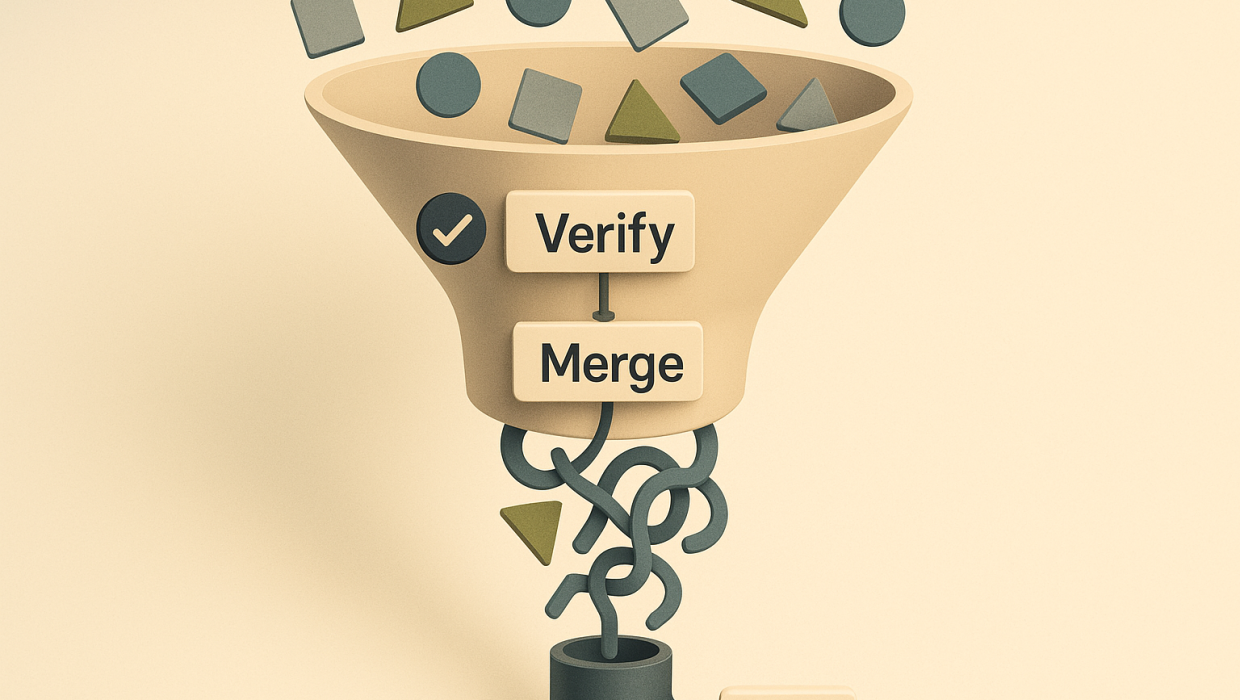
Automated deduplication logic. Rules that merge or flag likely duplicates based on email, domain, and phone matching before a rep ever sees the record twice.
Enrichment before scoring. Firmographic and contact verification applied automatically so that lead scoring is working with real information, not whatever a prospect happened to type into a form at 11pm.
Aging and hygiene rules. Contacts and accounts that go stale get flagged, re-verified, or retired — not left to quietly inflate your “total leads” count while dragging down your conversion percentage.
Get these five things right and most of the “funnel problems” companies pay agencies to fix simply stop existing. Get them wrong and no amount of ad spend or content strategy will save the conversion rate, because the leads reaching your sales team were never accurately understood to begin with.
CRM Data Management as a Discipline, Not a Project
Most organizations treat CRM data management as an occasional cleanup project — something you do once a year, usually after a particularly bad board meeting about pipeline accuracy. That framing is the root problem. Data integrity isn’t a project with an end date. It’s an operating discipline, the same way security or financial controls are.
That means someone owns it. It means routing logic, scoring models, and enrichment rules are documented and reviewed on a cadence, not set once during a CRM implementation and forgotten. It means every new integration — a new ad platform, a new form tool, a new outbound sequencer — gets evaluated for what it will write into the CRM and how, before it goes live.
This is also where automation earns its keep. Done well, automated enrichment, deduplication, and routing rules remove the manual re-keying that causes most errors in the first place — not by replacing the judgment of your sales and marketing teams, but by making sure the information they’re acting on is actually correct. Automation applied to bad data just produces bad decisions faster. Automation applied to a well-diagnosed, well-structured data flow is where the real leverage lives.
Diagnosis Before Build: Fixing the Funnel Instead of Patching It
We approach every lead generation engagement the same way: diagnose before you build. That means before we touch a single automation, integration, or campaign, we map exactly where leads enter your system, what happens to them at each handoff, and where the data quietly degrades along the way.
In practice, that diagnosis often surfaces the real story behind a “lead generation problem.” A client convinced their funnel needed a redesign discovered, on inspection, that 40% of their “new leads” each month were re-entries of contacts already in the CRM under a slightly different email — inflating volume, deflating conversion rate, and making every campaign look worse than it actually was. No new design or copywriting would have fixed that. Only diagnosis would.
If your team suspects something similar is happening — leads that don’t convert the way the volume suggests they should, sales complaining about lead quality, reporting that never quite adds up — it’s worth having that diagnosis done properly before committing to a rebuild. You can see how we structure that process on our lead generation services page, and if you’d rather just talk it through, start a conversation with us directly.
The Broader Stakes: B2B Lead Generation Credibility
For B2B lead generation specifically, data integrity has a credibility dimension that’s easy to underweight. Sales cycles are long, deal sizes are large, and the number of leads any given rep touches in a quarter is small enough that each one matters. A CTO evaluating a technology partner, a marketing director vetting an agency, an agency owner assessing a subcontractor — these are exactly the kinds of decision-makers who will notice, immediately, if your outreach reflects stale or incorrect information about their company. Get their title, their company size, or their recent funding round wrong in an opening email, and you haven’t just wasted a touchpoint — you’ve signaled that your entire operation runs on sloppy foundations.
Accurate data isn’t a back-office concern in B2B — it’s the first impression your funnel makes on exactly the kind of sophisticated buyer you’re trying to earn trust with. That’s the piece of this that’s easy to underestimate until it costs you a deal you should have won.
Accurate data isn’t a back-office concern in B2B — it’s the first impression your funnel makes on exactly the kind of sophisticated buyer you’re trying to earn trust with.
Where to Start
If you’re evaluating whether your own funnel has a data problem masquerading as a marketing problem, start with three questions: Do you know, right now, what percentage of your CRM records are duplicates or stale? Is your lead scoring model working from verified firmographic data or from whatever a form happened to capture? And does anyone in your organization actually own data hygiene as an ongoing responsibility, or does it only get attention when something breaks?
If the honest answer to any of those is “not sure,” that uncertainty is itself the signal. You can see examples of how this diagnosis has played out for other clients in our case studies, or explore the underlying technology stack we use to build lead systems that stay accurate over time rather than degrading the moment nobody’s watching.
Sales funnels don’t usually fail because of a bad campaign. They fail quietly, one inaccurate record at a time, until the aggregate damage is too large to ignore. The good news is that it’s fixable — but only if you’re willing to diagnose the actual source of the problem before spending another dollar trying to optimize your way around it.
RELATED QUESTIONS
How does inaccurate lead data hurt sales funnel performance?
Inaccurate lead data causes misrouted leads, wasted sales outreach on stale or duplicate contacts, and lead scoring models that misjudge who’s actually qualified. Over time it erodes trust between sales and marketing teams and produces pipeline reports that look confident but are quietly wrong, making it far harder to know what’s actually driving or hurting conversion.
What’s the difference between cleaning CRM data and fixing lead data integrity?
Cleaning is a one-time correction — deduplicating and updating existing records — while data integrity is an ongoing system property maintained through validation, enrichment, and routing rules built into the funnel itself. Cleaning without fixing the intake points that created the mess typically means the same errors reappear within a few months.
How much of a typical CRM’s lead data is actually inaccurate or duplicate?
In funnels that haven’t had a structural data review in over a year, duplicate or malformed records commonly account for 15-30% of records marked as active leads. That means a meaningful share of sales team time and attention is being spent on contacts that are stale, duplicated, or never accurately captured to begin with.
Can automation fix bad lead data on its own?
Automation can meaningfully reduce data errors through automated deduplication, enrichment, and validation at the point of capture, but only if it’s applied to a properly diagnosed system. Automating a broken process just produces bad decisions faster, which is why data structure and intake rules should be fixed before automation is layered on top.
Why does a diagnosis-before-build approach matter for lead generation systems?
A diagnosis-before-build approach identifies exactly where and how data degrades across intake, scoring, and routing before any redesign or automation work begins, which prevents teams from rebuilding a funnel around the same underlying flaws. Without that diagnosis, common fixes like new landing pages or nurture sequences often fail to move conversion rates because the real problem was never in the design layer to begin with.
Let's Diagnose What's Actually Broken in Your Funnel
Start a conversation with Sapiens + Machines to discuss your goals, challenges, and next steps.