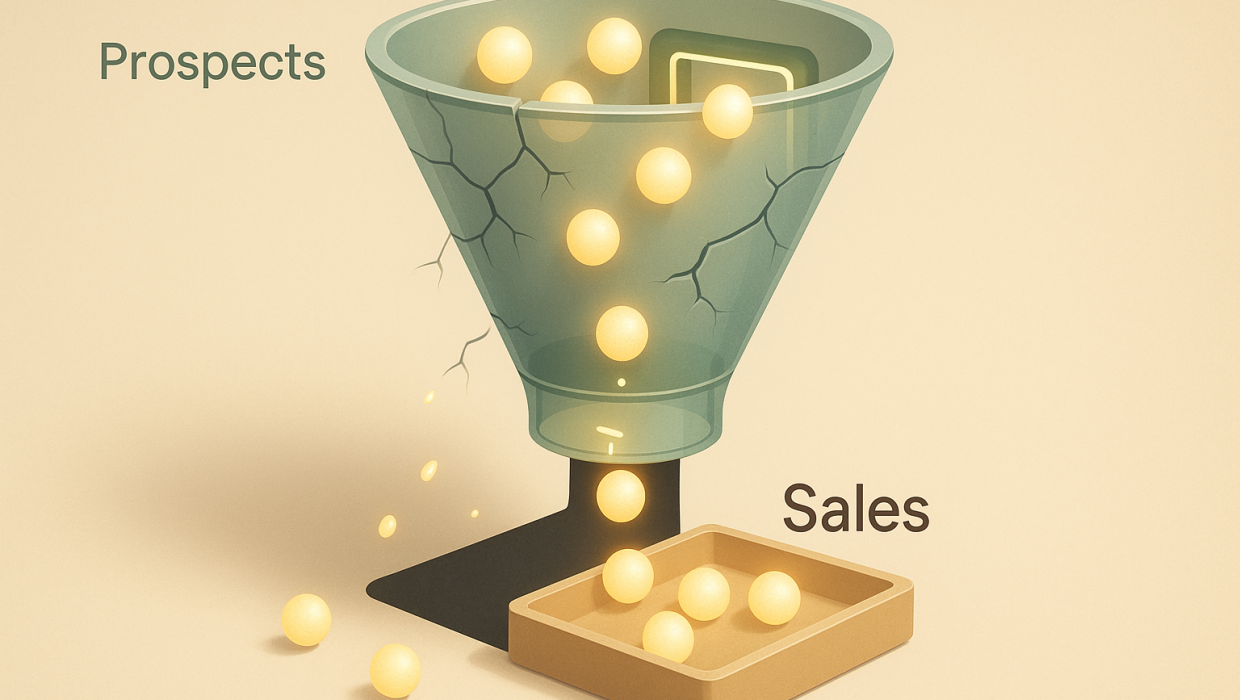
If your sales team keeps saying “the leads just aren’t that good,” the problem probably isn’t your marketing. It’s your lead qualification process. Somewhere between the form fill and the first sales call, high-intent prospects are getting misread, mistimed, or simply missed — and no amount of additional ad spend will fix a filter that’s letting the wrong signals through and the right ones slip away.
This is one of the most common — and most expensive — blind spots we see in B2B organizations. Marketing generates volume. Sales complains about quality. Everyone assumes the other team is the problem. Rarely does anyone stop to ask whether the qualification process itself, the system that’s supposed to separate the ready-to-buy from the just-browsing, is actually doing its job.
The Hidden Cost of a Broken Lead Qualification Process
A lead qualification process isn’t a single tool or a single moment — it’s a chain of decisions. Someone fills out a form. A rule (or a rep) decides whether that person is worth pursuing. That decision gets routed somewhere. Someone follows up, or doesn’t, within some window of time that either preserves the prospect’s interest or lets it cool. Every link in that chain is a place where a good prospect can quietly disappear.
The costs compound in ways that rarely show up on a dashboard. A prospect who filled out a demo request at 9am and doesn’t hear back until the next afternoon has often already booked a call with a competitor. A lead who gets scored purely on job title, with no regard for behavioral signals like repeat site visits or pricing page views, gets deprioritized despite being closer to a decision than anyone realizes. A referral from a top account gets dropped into the same generic nurture sequence as a cold download, because the system has no way to distinguish context.
None of this is a people problem. It’s a systems problem — and it’s exactly the kind of gap that a well-built lead generation infrastructure is designed to close.
Where Good Leads Fall Through the Cracks
In our work with B2B clients, the leaks tend to cluster around a handful of predictable failure points:
Static scoring models. Many companies still score leads using rules built two or three years ago — rules that were never updated as the buyer persona, product, or market shifted. A scoring model that hasn’t been touched since it was built isn’t a system anymore; it’s a fossil.
Manual handoffs. When qualified leads move from a marketing platform to a sales rep via spreadsheet, Slack message, or memory, delay and error are baked into the process. The best B2B lead generation programs eliminate manual handoff entirely in favor of automated, rules-based routing.
Disconnected data. Marketing automation platforms, CRMs, and sales engagement tools often operate as separate islands, each with a partial view of the prospect. Without proper CRM integration, no one — not marketing, not sales, not leadership — has a single accurate picture of where a lead actually stands.
No feedback loop. Sales closes or loses a deal, and that outcome data rarely makes its way back into the scoring model that generated the lead in the first place. Without that loop, the qualification process never gets smarter — it just repeats its mistakes at scale.
Why Automated Lead Scoring Isn’t Optional Anymore
There was a time when a sales development rep could manually eyeball every inbound lead and make a reasonably good call about who to prioritize. That time is gone. Buyer research happens earlier, across more channels, and mostly out of sight — by the time someone fills out a form, they’ve often already read your case studies, compared you to two competitors, and formed an opinion. Manual triage simply can’t keep pace with that volume or that speed.
Automated lead scoring solves this by evaluating every prospect against a consistent, weighted set of criteria — firmographic fit, behavioral intent signals, engagement recency, and account-level context — the moment the data arrives. Done well, it doesn’t replace human judgment; it hands your sales team a ranked, contextualized list so their judgment gets applied where it matters most. This is the augmentation principle in practice: the model doesn’t decide who gets a deal, it decides who deserves a human’s attention first.
The technology to do this well has matured considerably. Predictive models can now incorporate signals that would have been invisible five years ago — time-on-page patterns, content consumption sequences, even the specific pages a prospect revisits before a call. Layering AI-driven automation onto scoring doesn’t just speed up the process, it improves accuracy, because the model can weigh dozens of variables simultaneously in ways a static point system never could.
CRM Integration: The Backbone of a Reliable Pipeline
Automated scoring is only as good as the data feeding it, and that’s where CRM integration becomes non-negotiable. If your marketing platform, website analytics, and sales CRM aren’t talking to each other in real time, your scoring model is working from a partial and often stale picture.
Proper integration means a lead’s score updates the instant new behavior occurs — not in an overnight batch sync, not after a manual export. It means sales reps see the full context of a prospect’s journey inside the CRM they already live in, instead of toggling between four tools trying to reconstruct a timeline. And it means routing rules can act on that data instantly: a re-engaged enterprise account gets flagged to a senior rep within minutes, not discovered during a weekly pipeline review three days later.
This is also where custom-built connective tissue often earns its keep. Off-the-shelf integrations cover the common cases, but most B2B organizations have workflows — territory rules, multi-touch attribution, partner-sourced leads — that generic tools don’t handle well. That’s frequently a job for purpose-built custom software rather than another point solution bolted onto an already crowded stack.
Diagnosis Before Build: Fixing the Right Problem
It’s tempting to respond to a leaky funnel by buying a new tool. Resist that instinct. Most companies don’t have a lead generation problem — they have a lead qualification process problem masquerading as one. Adding another platform on top of a broken process usually just adds a new layer of complexity to diagnose later.
Most companies don’t have a lead generation problem — they have a lead qualification process problem masquerading as one.
The more durable approach is to map the entire lead lifecycle first: every source, every scoring rule, every handoff, every routing decision, end to end. That mapping exercise almost always surfaces the real bottleneck, and it’s rarely where anyone expected. Sometimes it’s a scoring threshold set too high. Sometimes it’s a routing rule that sends enterprise leads to the same queue as self-serve trials. Sometimes it’s simply that no one owns the follow-up SLA, so “fast” means whenever someone gets to it.
This is why any serious lead qualification process engagement should start with diagnosis, not implementation. Building the wrong fix faster doesn’t help anyone — it just produces a well-engineered version of the same problem. We’ve seen this play out concretely with clients whose full turnaround stories are documented in our case studies, where the highest-leverage fix was almost never the one leadership originally assumed it would be.
What a Modern Lead Qualification Process Looks Like
A well-functioning process shares a few consistent traits, regardless of industry or deal size.
Signals That Matter
It weighs behavior alongside firmographics — not just who a prospect is, but what they’re actually doing. A mid-market director who’s visited the pricing page three times this week is a hotter signal than a VP title with zero engagement.
Routing That Reflects Reality
It routes leads based on real account context — territory, deal history, product fit — rather than a single generic queue. High-value accounts should never wait behind low-fit ones simply because both arrived through the same form.
A Closed Feedback Loop
It feeds closed-won and closed-lost outcomes back into the scoring model, so the system improves with every deal cycle instead of running on assumptions from a year ago.
One Source of Truth
It relies on clean, real-time CRM integration so every team — marketing, sales, and leadership — is looking at the same data, updated the same way, at the same time.
Getting all four of these right rarely happens by accident. It takes someone looking at the whole system, not just the piece their department owns — which is exactly the gap a dedicated partner is built to close. If you’re ready to have that conversation, our team is a good place to start.
The Real Question to Ask
Before you invest in more top-of-funnel spend, ask a harder question: if lead volume doubled tomorrow, would your current process handle it gracefully, or would it just double the number of good prospects falling through the cracks? For most companies, it’s the latter — which means the highest-leverage investment isn’t more leads. It’s a qualification process built to actually catch the ones you’re already generating.
RELATED QUESTIONS
What is a lead qualification process in B2B sales?
A lead qualification process is the set of rules, tools, and handoffs a company uses to determine which prospects are worth pursuing and in what order. It typically combines scoring criteria (firmographic fit and behavioral intent), routing logic, and follow-up timing to make sure sales reps focus on the prospects most likely to convert. When any part of that chain breaks down, high-quality leads can get deprioritized or missed entirely.
How does automated lead scoring improve B2B lead generation?
Automated lead scoring evaluates every incoming prospect against consistent, weighted criteria the moment their data arrives, rather than relying on manual review that can’t keep pace with volume. This means sales teams get a ranked list of who to contact first, based on real signals like engagement recency and behavior, instead of guesswork or gut feel. It also allows scoring models to incorporate outcome data over time, so the system gets more accurate with every closed deal.
Why is CRM integration important for lead qualification?
CRM integration ensures that marketing platforms, website analytics, and sales tools share data in real time, giving every team the same accurate, up-to-date picture of each prospect. Without it, lead scores go stale, routing decisions are made on incomplete information, and sales reps waste time reconstructing a prospect’s history across disconnected systems. Proper integration turns the CRM into a single source of truth rather than one of several conflicting ones.
What are the most common reasons good leads get lost?
The most common causes are outdated static scoring rules, manual handoffs between marketing and sales, disconnected data across platforms, and the absence of a feedback loop that feeds deal outcomes back into the scoring model. Each of these creates a point where a genuinely qualified prospect can be misjudged, delayed, or simply missed. Fixing the underlying process almost always matters more than generating additional lead volume.
Should a company fix its lead qualification process before buying new marketing tools?
Yes — buying new tools without first diagnosing the existing process usually just adds complexity on top of an unsolved problem. A proper diagnosis maps the entire lead lifecycle, from source to scoring to routing to follow-up, to find the actual bottleneck before recommending any technology. In most cases, the real fix is a process or integration issue, not a missing platform.
Let's Diagnose Your Lead Qualification Process
Start a conversation with Sapiens + Machines to discuss your goals, challenges, and next steps.