If your paid media strategy still treats Google, Meta, and Reddit as three separate line items competing for budget, you’re not doing multi-channel marketing — you’re doing three single-channel campaigns that happen to run at the same time. True multi-channel media buying strategies work differently: they treat each platform as a distinct instrument in a coordinated system, each playing a role the others can’t, all pointed at the same business outcome. For B2B decision-makers under pressure to prove marketing’s contribution to revenue, that distinction is the difference between a media budget that compounds and one that just spends.
The Problem With Single-Channel Thinking
Most underperforming paid programs share a common root cause: they were built platform-first instead of buyer-first. A team gets good at Google Ads, so Google gets the budget. Someone reads that Meta’s targeting has improved, so a campaign gets stood up there too — with the same message, the same landing page, and the same conversion goal as everything else. Reddit, if it’s used at all, is treated as an afterthought or a test that never graduates past a few hundred dollars.
The result is fragmentation dressed up as diversification. Each platform is judged against the same last-click conversion metric, which systematically undervalues channels that build awareness or trust earlier in the funnel. Google looks like the hero because it captures demand that Meta and Reddit helped create. Leadership sees the attribution report, cuts the “underperforming” channels, and the whole system quietly gets less effective — even though nothing about the market changed.
This is precisely why paid campaign management has to start with a diagnosis of the buyer journey, not a menu of ad platforms. You can’t design a cross-platform advertising strategy until you know where each platform actually sits in the path to purchase for your specific buyer.
What Multi-Channel Media Buying Strategies Actually Require
Diagnosis Before Budget Allocation
Before a single dollar moves, the questions worth answering are: Where does our buyer first encounter a problem they’d search our category to solve? Where do they go to validate a vendor once they’re aware of one? What role does peer opinion play in the decision, and where does that opinion live? For a B2B software buyer, Reddit threads and niche communities often carry more credibility than any ad — which changes what “success” on that platform should even look like.
This diagnostic step is where most agencies skip straight to execution, and it’s where the biggest ROI gains are actually won or lost. A campaign built on an accurate model of the buyer journey will outperform a bigger budget built on assumptions, every time.
A campaign built on an accurate model of the buyer journey will outperform a bigger budget built on assumptions, every time.
Assigning Each Platform a Job, Not a Quota
Once the journey is mapped, each channel gets a specific mandate instead of a generic performance target:
Google captures and converts existing intent. Search campaigns meet buyers who already know they have a problem and are actively looking for a solution — which makes Google the closer, not the opener, in most B2B funnels.
Meta builds and shapes demand before intent exists. Its targeting and creative flexibility make it well-suited to educating a market, retargeting engaged visitors, and keeping a brand present through a longer consideration cycle.
Reddit builds trust in spaces where your buyer already gathers to compare notes. Done well — with a tone that respects the platform’s skepticism toward anything that feels like an ad — Reddit can generate a kind of credibility no other paid channel replicates.
None of these platforms is inherently “better.” They answer different questions at different moments, which is the entire argument for running them together with a shared strategy rather than in isolation.
Building Cross-Platform Advertising That Compounds
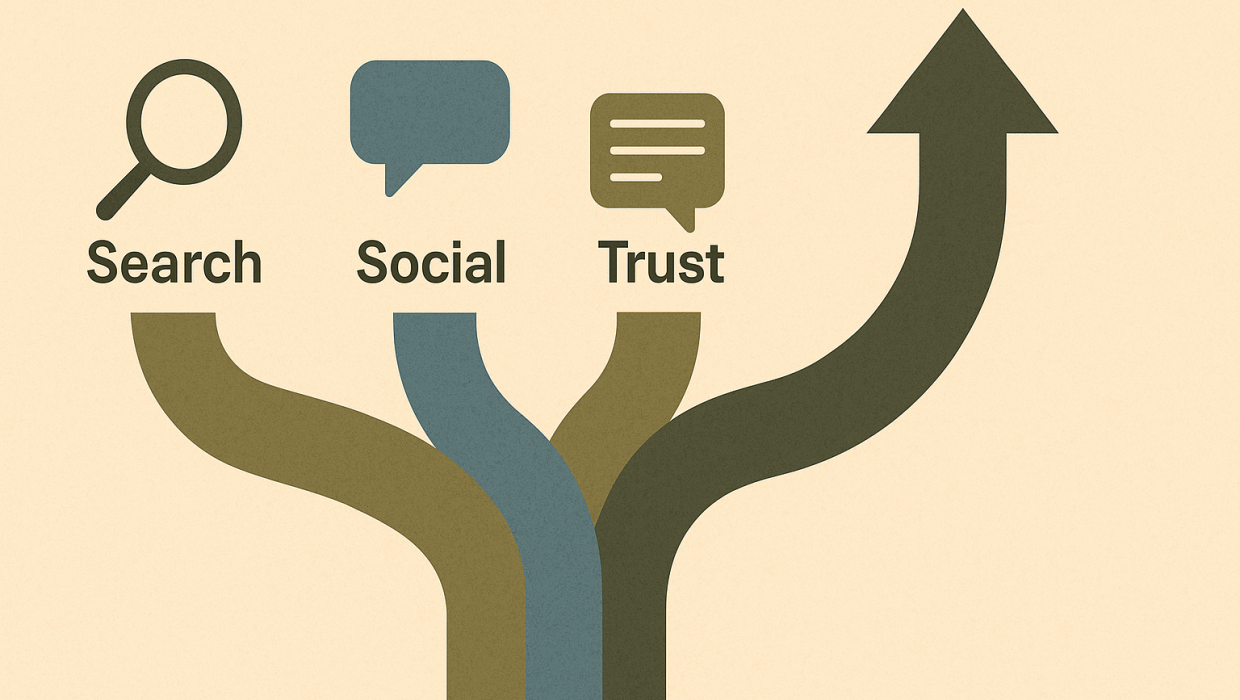
Cross-platform advertising earns its name when the platforms actually talk to each other — not technically, but strategically. A prospect who saw a Meta awareness ad, then searched a branded term on Google, then read a Reddit thread where your company was mentioned favorably, didn’t take three unrelated actions. They took one journey across three surfaces. The media plan should be built to recognize and reinforce that.
In practice, this means:
- Sequencing creative so that top-of-funnel Meta content sets up the language and framing that search ads and landing pages later confirm.
- Coordinating audiences so retargeting pools built from Google search visitors inform Meta lookalike models, instead of each platform building audiences in a vacuum.
- Matching budget pacing to funnel stage, weighting awareness spend earlier in a sales cycle and shifting toward capture-oriented spend as pipeline data shows intent building.
- Using platform-appropriate creative formats rather than repurposing the same asset everywhere — a Reddit post styled like an ad will underperform regardless of budget, no matter how well the same creative performs on Meta.
This is also where lead generation and media buying have to be treated as one motion rather than two handoffs. A perfectly targeted ad that lands on a slow, generic form fails the buyer at the last step — which means the media plan and the conversion path need to be designed together from the outset.
ROI Optimization Is a System, Not a Setting
ROI optimization is frequently treated as a dashboard problem — get the reporting right, and the insights will follow. In reality, most attribution dashboards answer the wrong question. They tell you which channel got credit for a conversion, not which combination of touches actually moved a buyer through the funnel. For multi-touch B2B sales cycles, that distinction matters enormously.
Real ROI optimization requires:
1. A measurement model that reflects the actual buyer journey, using multi-touch or data-driven attribution instead of last-click defaults that flatter whichever channel happens to close the deal.
2. Feedback loops between sales and media data, so that closed-won and closed-lost outcomes — not just form fills — inform which campaigns get more budget.
3. Testing discipline that isolates variables (audience, creative, offer, platform) rather than changing everything at once and guessing at the cause of a performance shift.
The Role of Data Infrastructure
None of this works if the underlying data infrastructure can’t support it — which is a technology problem as much as a marketing one. Connecting ad platform data to CRM data, automating the reporting that would otherwise consume a media buyer’s week, and building the kind of clean, structured data pipeline that makes multi-touch attribution possible are all areas where automation genuinely earns its place — not by replacing the strategist’s judgment, but by giving them a faster, clearer picture to judge from. If you’re serious about scaling multi-channel media buying beyond a single analyst’s ability to manually track it in a spreadsheet, this infrastructure isn’t optional — it’s the foundation the strategy sits on.
Paid Campaign Management in Practice
What does this look like week to week? Effective paid campaign management across Google, Meta, and Reddit isn’t a “set it and check it monthly” exercise. It’s an ongoing cycle of hypothesis, test, measurement, and adjustment — run at a cadence tight enough to catch underperformance early, but disciplined enough not to react to statistical noise.
A B2B software company we’ve worked with, for example, was running Google Search as its only paid channel and hitting a plateau on cost per qualified lead. The diagnosis revealed that a large share of their best-converting search traffic was already familiar with the brand before they searched — meaning something upstream was doing real work that search was simply capturing. Introducing a coordinated Meta layer to build that pre-search familiarity, paired with a Reddit presence in the specific technical communities their buyers frequented, lowered blended cost per lead meaningfully within a single quarter — not by spending more, but by finally measuring and building the full journey instead of just its final step. You can see more examples of this kind of outcome in our case studies.
When to Bring in a Partner
Not every organization needs to build this capability in-house, and trying to force a generalist team to become expert simultaneously in Google’s auction mechanics, Meta’s creative testing cadence, and Reddit’s community norms is often how budgets get wasted. The organizations that get the most out of multi-channel media buying strategies tend to be honest about where their internal expertise ends — and where a dedicated partner’s pattern recognition across dozens of campaigns starts to matter more than another month of internal trial and error.
If your team is spending more time reconciling conflicting platform reports than acting on them, or if your channels are technically “running” but not actually working together, that’s usually the signal it’s time for a second set of eyes. If that sounds familiar, it’s worth a conversation about what a coordinated, diagnosis-first media strategy could look like for your specific funnel — you can start that conversation here.
The Bottom Line
Maximizing ROI across Google, Meta, and Reddit was never really about picking the right platform. It’s about understanding what each one is actually good for, sequencing them around a real buyer journey, and measuring the whole system honestly enough to know what’s working. Get the diagnosis right, and the media plan almost builds itself — get it wrong, and no amount of budget or bidding sophistication will fix a strategy that was never actually coordinated in the first place.
RELATED QUESTIONS
What are multi-channel media buying strategies?
Multi-channel media buying strategies are coordinated approaches to running paid advertising across platforms like Google, Meta, and Reddit, where each channel is assigned a specific role in the buyer journey rather than being run as an isolated, self-contained campaign. Instead of comparing platforms against each other using the same metrics, the strategy sequences and measures them together as one system aimed at a shared business outcome.
How do you measure ROI across multiple ad platforms?
Accurately measuring ROI across multiple ad platforms requires multi-touch or data-driven attribution rather than last-click reporting, since last-click models overcredit whichever channel happens to close a conversion while ignoring the channels that built awareness or trust earlier. It also requires connecting ad platform data to CRM and sales outcome data, so budget decisions are based on closed revenue, not just form fills.
Should B2B companies advertise on Reddit?
Yes, for many B2B companies Reddit can be a valuable channel, particularly for building credibility in niche technical or professional communities where buyers already gather to compare vendors and solutions. The key is treating Reddit differently from Google or Meta — content needs to feel native to the platform’s tone and skepticism rather than looking like a traditional ad, or it will underperform regardless of budget.
What’s the biggest mistake companies make with cross-platform advertising?
The biggest mistake is running the same creative, messaging, and conversion goals across every platform and then judging each one by identical last-click metrics. This approach undervalues channels like Meta and Reddit that often do essential work earlier in the buyer journey, leading companies to cut channels that were actually contributing to results, just not getting credit for them in the attribution report.
How often should paid campaigns be optimized?
Paid campaigns should be reviewed and optimized on an ongoing cycle — weekly at minimum for active testing and budget pacing — rather than checked monthly, since delayed reactions to underperformance compound wasted spend. That said, optimization should be based on statistically meaningful data and isolated variable testing, not reactive changes made in response to normal day-to-day fluctuations.
Ready to Turn Your Ad Spend Into a Coordinated System?
Start a conversation with Sapiens + Machines to discuss your goals, challenges, and next steps.