Most custom software implementation efforts don’t fail because the code was bad. They fail because the wrong problem got solved, beautifully. A CTO greenlights a build, an agency ships clean architecture on schedule, and six months later the tool sits half-used because nobody accounted for how the sales team actually enters data, or how finance reconciles records at month-end, or why three departments have quietly built their own spreadsheet workarounds. The complexity in custom software implementation isn’t primarily technical. It’s organizational, procedural, and human — and treating it as a pure engineering exercise is the single most common reason projects underdeliver.
This matters more now than it did five years ago. Enterprise software development has gotten faster and cheaper at the execution layer — frameworks are mature, AI-assisted development speeds up coding, and cloud infrastructure removes most of the old provisioning headaches. But faster execution just means organizations can build the wrong thing more efficiently. The bottleneck has shifted upstream, to the questions asked before a single line of code gets written.
Why Diagnosis Has to Come Before the Build
Every software vendor will tell you they listen to requirements. Few actually diagnose. There’s a real difference: requirements gathering asks stakeholders what they want, and stakeholders — reasonably — describe the feature set of whatever tool they last used, or whatever their competitor has. Diagnosis asks a different question entirely: what is actually breaking down in how work gets done, and would software even be the right fix?
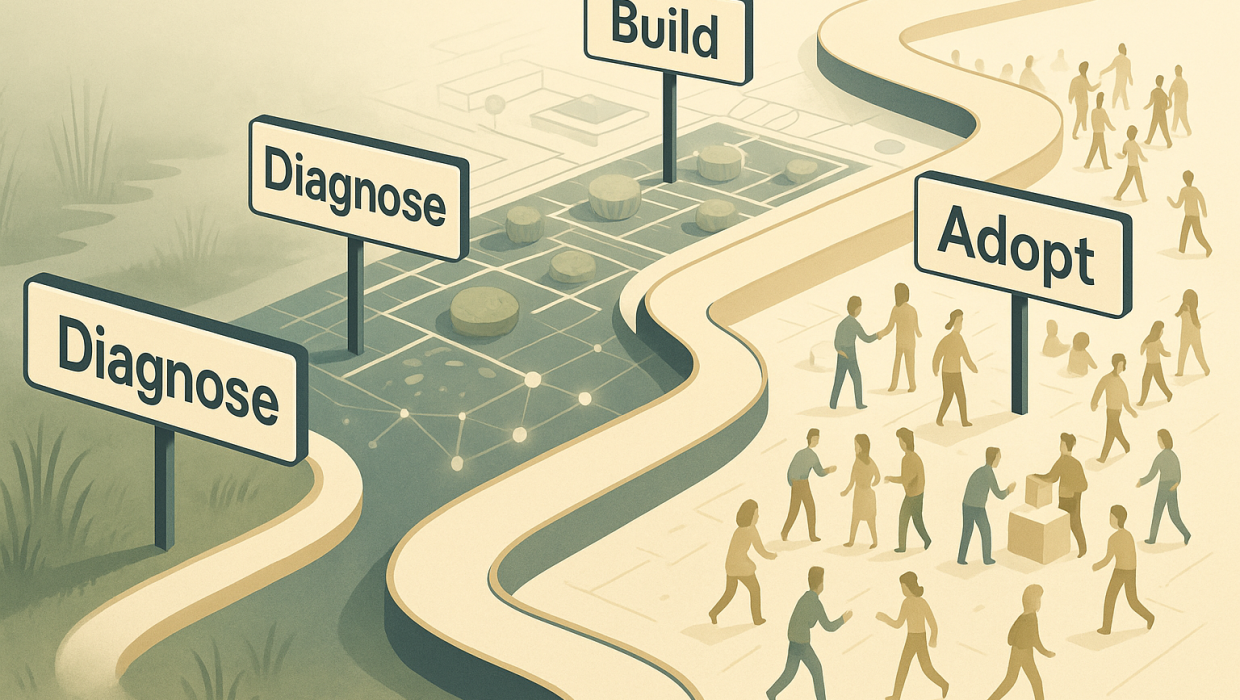
Sometimes it isn’t. We’ve walked into engagements where the “software problem” a client described was actually a data governance problem, or an org chart problem, or a case where three teams needed to agree on a single source of truth before any system could reflect one. Building software on top of unresolved process conflicts just encodes the dysfunction into permanent, expensive form. This is why our approach to custom software implementation starts with mapping how work actually flows through an organization — not how the org chart says it should flow — before any architecture decisions get made.
The Cost of Skipping This Step
Skipping diagnosis doesn’t just risk a mediocre tool. It compounds. Teams that get burned by a poorly diagnosed implementation don’t just distrust that particular system — they develop institutional skepticism toward the next initiative, and the one after that. Change fatigue is real, and it’s cumulative. Every rushed rollout makes the next transformation effort harder to sell internally, regardless of how well it’s executed.
Where Enterprise Software Development Gets Genuinely Complicated
Once the diagnosis is right, the technical complexity is still real — it’s just tractable. Three areas tend to cause the most trouble in practice.
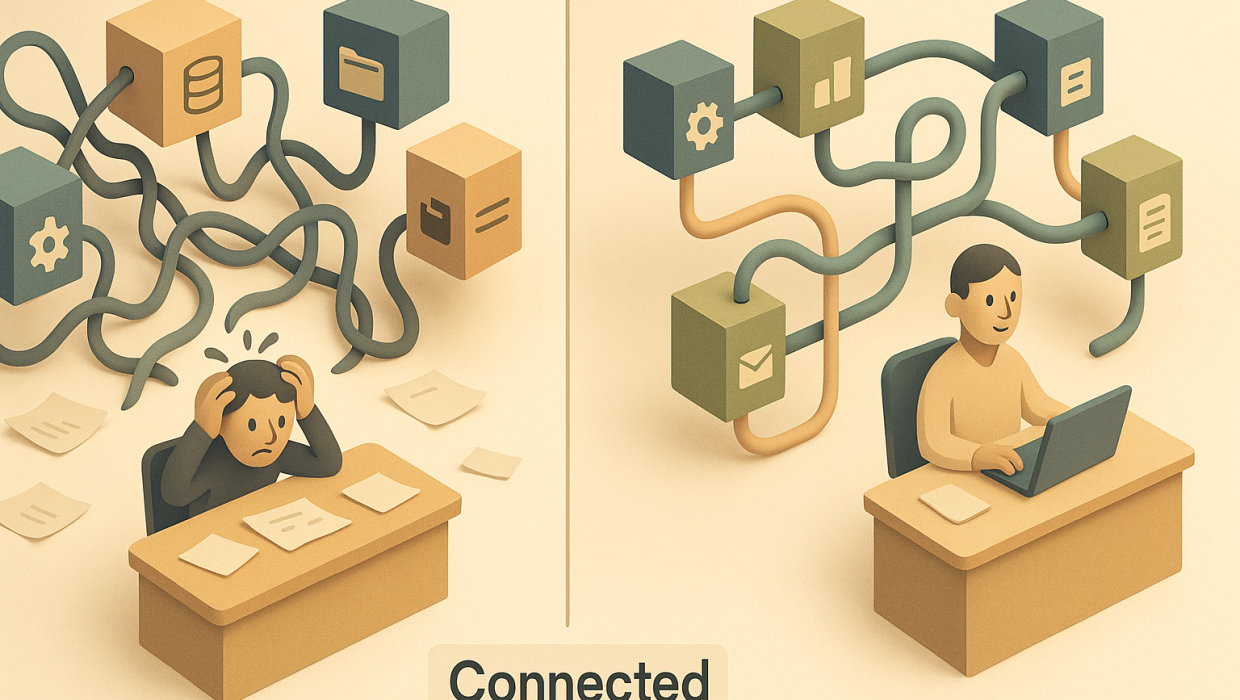
Integration debt. Almost no custom build happens in a vacuum. It has to talk to a CRM, an ERP, a billing system, marketing automation, maybe a decade-old internal tool nobody wants to touch because “it just works.” Technology integration is rarely a clean API-to-API handshake; it’s often a patchwork of legacy systems with inconsistent data models, undocumented business logic buried in old code, and permissions structures that were never designed to be queried by anything new. Underestimating integration work is the single most common cause of blown timelines and budgets in enterprise software development.
Data quality and ownership. Custom software surfaces data problems that were previously invisible because nobody looked closely. Duplicate customer records, inconsistent field definitions across departments, and orphaned data with no clear owner all become visible — and blocking — the moment you try to build a unified system on top of them. Resolving this isn’t glamorous work, but it has to happen before launch, not after.
Security and compliance architecture. The further custom software reaches into core operations, the more it becomes an attack surface and a compliance consideration. This is where implementation work overlaps heavily with broader IT infrastructure planning — access controls, backup systems, and business continuity need to be designed alongside the software itself, not bolted on afterward.
Building B2B Software Solutions That People Actually Use
Adoption is where good technical work most often gets undone. A system can be architecturally sound and still fail if it asks people to change how they work without a clear, felt reason why. This is especially true for B2B software solutions built for internal teams, where there’s no market pressure forcing adoption the way there is with customer-facing products — internal users can simply route around a tool they don’t like, quietly, for months, before anyone notices.
The organizations that succeed treat custom software implementation as an act of translation between how people actually work and what the system asks them to do, not as a technical rollout with a go-live date.
The organizations that succeed treat custom software implementation as an act of translation between how people actually work and what the system asks them to do, not as a technical rollout with a go-live date.
Practically, that means involving end users early enough that the system reflects their actual workflows, not a idealized version of them. It means phased rollouts that let teams build confidence before the stakes get high. And it means designing feedback loops into the implementation itself, so that friction gets surfaced and addressed in week three instead of discovered in a disengagement report six months later. We’ve seen this play out across dozens of engagements, and it’s a pattern consistent enough that it shows up across our case studies regardless of industry: adoption problems are almost always design problems in disguise.
Technology Integration as an Ongoing Discipline, Not a One-Time Project
One shift worth naming explicitly: technology integration used to be treated as a milestone — the moment the new system was “connected” to everything else, followed by a ribbon-cutting and a maintenance contract. That framing doesn’t hold anymore. APIs change, vendors deprecate endpoints, business processes evolve, and increasingly, organizations are layering AI-driven automation on top of systems that were designed before that was even a consideration.
This is where custom software and AI automation intersect in ways worth planning for from day one, even if the initial build doesn’t include AI functionality. A system architected with clean data structures and well-documented APIs is one you can extend later — with automation, with predictive scoring, with document processing — without a costly rebuild. A system architected as a closed, monolithic tool becomes a constraint the moment those needs emerge. Good implementation partners build for the second use case, not just the first.
If your organization is at the stage of evaluating whether a build is even the right move, that’s a conversation worth having before any scoping document gets drafted — you can start a conversation with a team that will tell you honestly if the diagnosis points somewhere other than a full custom build.
What to Actually Look for in an Implementation Partner
Given all of this, the evaluation criteria for a technology partner should look different than most RFP templates suggest. Portfolio quality and technical stack familiarity matter, but they’re table stakes. The more revealing questions are process questions: Does this partner ask about your internal workflows before proposing a solution? Do they have a documented approach to data migration and legacy system integration, or is that treated as an afterthought? What does their post-launch support model actually look like — is adoption tracked, or does the relationship end at deployment?
It’s also worth asking how a partner thinks about scope discipline. Custom software projects are notorious for scope creep, usually because early conversations focused on features rather than outcomes. A partner grounded in diagnosis-first thinking will push back on scope additions that don’t map to a validated problem, even when it’s tempting to say yes to a client request. That discipline is uncomfortable in the short term and valuable in the long term — it’s the difference between a system that solves what it was built to solve and one that becomes an expensive, sprawling compromise.
Our software solutions practice exists specifically to hold that line: build what the diagnosis supports, integrate it cleanly with what already exists, and design for the humans who’ll actually use it every day. That’s a harder sell than a feature list, but it’s the only version of custom software implementation that holds up a year after launch.
The Bottom Line
Complexity in custom software implementation is not a reason to avoid custom builds — it’s a reason to be disciplined about the process that precedes them. The technical execution has genuinely gotten easier. The organizational work of understanding what to build, for whom, and why, has not gotten easier at all, and it’s the part that actually determines whether an implementation succeeds. Treat that work as the project, not as a preamble to it.
RELATED QUESTIONS
What is custom software implementation?
Custom software implementation is the process of designing, building, and rolling out software tailored to a specific organization’s workflows, rather than adopting off-the-shelf tools. It includes not just development but also data migration, integration with existing systems, security architecture, and driving actual adoption among end users. The technical build is often the easiest part; diagnosing the right problem and managing organizational change are usually the harder ones.
Why do custom software projects fail even when the code works?
Custom software projects most often fail due to organizational and adoption issues, not technical defects. A tool can be architecturally sound and still go unused if it doesn’t reflect how employees actually work, if end users weren’t involved early enough, or if the underlying business process problem was never properly diagnosed before development began. Skipping that diagnosis phase is the leading cause of expensive, underused systems.
How long does enterprise software development typically take?
Timelines vary widely depending on scope, but most enterprise software development projects that include integration with legacy systems take anywhere from three to twelve months from diagnosis through launch. Projects that skip a thorough diagnosis phase often appear faster upfront but tend to run over budget and schedule later due to unplanned integration work and rework after poor adoption.
What should a company look for when choosing a technology integration partner?
Look for a partner that asks detailed questions about your internal workflows before proposing a solution, has a documented process for data migration and legacy system integration, and offers post-launch support focused on adoption, not just uptime. Technical skill is table stakes; the differentiator is a disciplined, diagnosis-first process that pushes back on scope that doesn’t map to a validated business problem.
Should custom software be built to work with AI automation from the start?
Yes, even if AI functionality isn’t part of the initial build, custom software should be architected with clean data structures and well-documented APIs so it can support automation, predictive scoring, or document processing later without a costly rebuild. Systems built as closed, monolithic tools tend to become constraints the moment an organization wants to add AI-driven capabilities.
Ready to Diagnose What Your Systems Actually Need?
Start a conversation with Sapiens + Machines to discuss your goals, challenges, and next steps.