Every enterprise leader has lived through some version of the same moment: a server goes down, a vendor’s API silently fails, or a single misconfigured firewall rule takes an entire team offline for an afternoon. Resilience in IT infrastructure is what determines whether that moment becomes a minor footnote or a multi-day crisis. It’s not about preventing every possible failure — that’s impossible — it’s about building systems, teams, and processes that absorb shocks and keep operating while the fire is put out.
For CTOs, marketing directors, and agency owners evaluating technology partners, resilience has quietly become one of the most important criteria in the room. Uptime guarantees and SLAs still matter, but they’re table stakes. The real question is whether your infrastructure — and the people managing it — can adapt when something breaks in a way no one predicted.
What Resilience in IT Infrastructure Actually Means
Resilience is often confused with redundancy, but it’s broader than that. Redundancy is one tool among several. True resilience is the capacity of an entire system — hardware, software, network, vendors, and human operators — to absorb disruption without a proportional loss of function. A resilient system doesn’t just survive an outage; it degrades gracefully, recovers quickly, and gets stronger from the experience because the failure is documented and designed against next time.
A resilient system doesn’t just survive an outage; it degrades gracefully, recovers quickly, and gets stronger from the experience because the failure is documented and designed against next time.
This distinction matters because many organizations invest heavily in redundant hardware while leaving glaring gaps elsewhere — an undocumented dependency on a single engineer’s knowledge, a backup process that’s never been tested end-to-end, or a vendor contract with no clear escalation path. Resilience has to be assessed holistically, not component by component.
The Cost of Fragility Is Rarely Where You Expect It
Most infrastructure failures don’t come from catastrophic events. They come from small, compounding weaknesses: an expired certificate no one owned, a patch that wasn’t tested against a legacy dependency, a monitoring alert that fired into an inbox nobody checks. The financial cost of these failures is well documented, but the reputational and operational cost is often worse — client trust erodes, internal teams lose confidence in their tools, and leadership starts making reactive decisions instead of strategic ones.
This is why resilience needs to be framed as a business strategy question, not purely a technical one. It belongs in the same conversation as revenue protection, client retention, and competitive positioning — because that’s exactly what’s at stake when infrastructure fails at the wrong moment.
The Four Pillars of Technical Resilience
Building resilient infrastructure isn’t a single initiative; it’s an ongoing discipline built on a few consistent pillars.
Redundancy and Failover
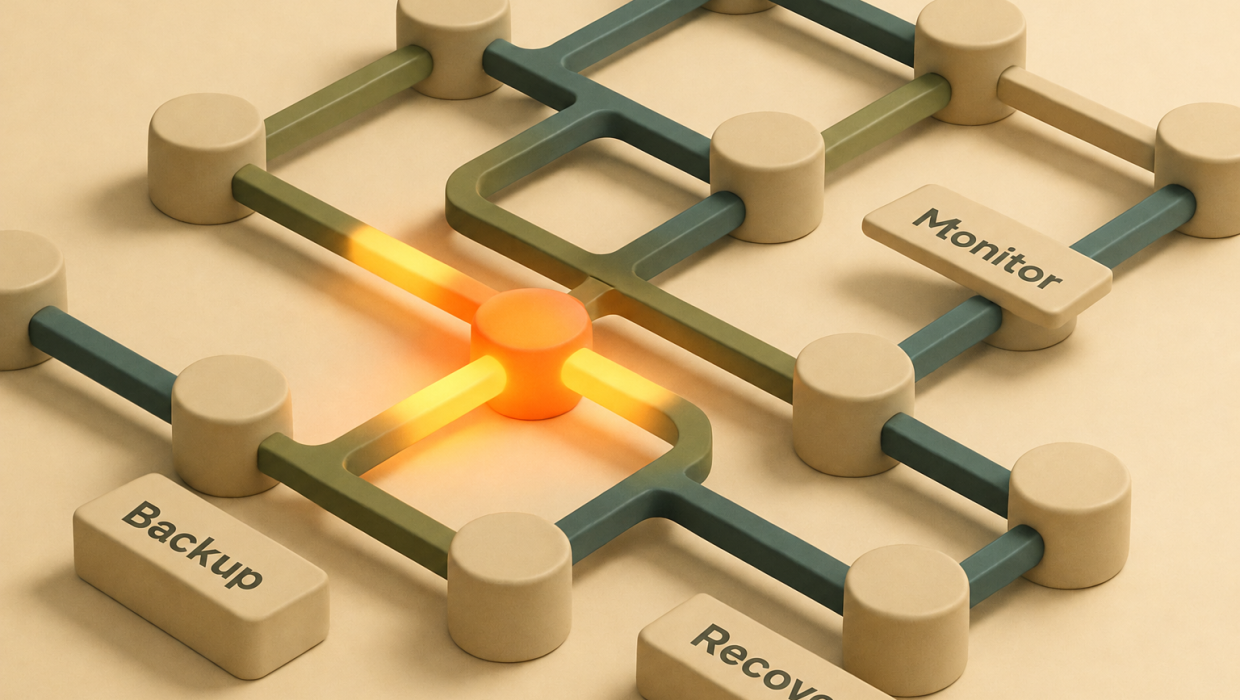
This is the foundation most people think of first: duplicate systems, geographically distributed backups, and failover mechanisms that activate automatically when a primary system fails. But redundancy without regular testing is a false sense of security. A backup that hasn’t been restored in a live drill is a hypothesis, not a safeguard.
Monitoring and Early Detection
Resilient systems are instrumented so that small problems surface before they become large ones. This means real-time monitoring across infrastructure layers, sensible alert thresholds that avoid both silence and noise, and dashboards that translate technical signals into business-relevant context for non-technical stakeholders.
Business Continuity Planning
Business continuity planning is where technical resilience meets organizational readiness. It answers the uncomfortable questions in advance: Who has authority to make decisions during an outage? What’s the communication plan for clients and staff? Which systems absolutely must be restored first, and which can wait? Organizations that treat this as a living document — reviewed and rehearsed regularly — recover from incidents dramatically faster than those that treat it as a compliance checkbox.
People and Process
The most sophisticated infrastructure in the world is only as resilient as the team operating it. Clear runbooks, cross-trained staff, and a culture where flagging a potential problem is rewarded rather than punished all contribute more to real-world resilience than any single piece of hardware.
Diagnosis Before Build: Why Assessment Comes First
One of the most common mistakes we see when enterprises try to improve their technical resilience is jumping straight to solutions — new hardware, a new monitoring tool, a new managed services contract — before understanding where the actual fragility lives. A new firewall doesn’t help if the real risk is an undocumented dependency on a departing employee’s personal knowledge.
Our approach starts with diagnosis, not procurement. Before recommending any tooling or infrastructure change, we map the existing environment, identify single points of failure, and talk to the people who actually operate the systems day to day — because they usually know exactly where the fragile seams are, even if no one has asked them directly. This is the same discipline we bring to every engagement through our IT solutions practice: understand the system as it actually behaves, not as the org chart says it should behave, before recommending a single change.
This diagnostic phase often reveals that the highest-leverage fixes aren’t the most expensive ones. A clearly documented escalation path can prevent more downtime than an additional redundant server. A tested backup restoration process is often worth more than a costlier storage solution that’s never been stress-tested.
Managed IT Services as a Resilience Multiplier
For most mid-market and enterprise organizations, building and maintaining full-time, round-the-clock resilience expertise in-house is neither practical nor cost-effective. This is where managed IT services earn their place — not as outsourced babysitting, but as a force multiplier for an internal team that has plenty of expertise but limited bandwidth to monitor everything, all the time.
A strong managed services partner brings continuous monitoring, faster incident response, and pattern recognition across many environments — insight that’s difficult to develop when you’re only looking at your own infrastructure. They also bring accountability: a documented SLA, a clear point of contact during an incident, and a partner who’s motivated to prevent the fire, not just bill for putting it out.
The best managed IT relationships function less like a vendor and more like an extension of the internal team — one that augments in-house judgment with broader pattern recognition, rather than replacing the institutional knowledge that only your own people have. That’s the model behind our managed IT services, and it’s why the diagnostic conversation always comes before any recommendation about tooling or support tiers.
Building an IT Strategy for Enterprise Resilience
Resilience can’t be bolted onto an infrastructure strategy after the fact — it has to be a design principle from the start. That means a few concrete practices worth building into any enterprise IT strategy:
Map dependencies explicitly. Most organizations understand their primary systems well but have only a vague sense of the third-party services, APIs, and integrations those systems quietly depend on. A single vendor outage can cascade further than anyone expects if those dependencies aren’t documented.
Test recovery, not just backup. Backing up data is necessary but insufficient. The real test is whether a full system can be restored, within an acceptable time window, by someone other than the person who set it up.
Right-size redundancy to business impact. Not every system needs the same level of resilience investment. Enterprise infrastructure support should be tiered — mission-critical systems get the heaviest investment in redundancy and monitoring, while lower-impact systems get proportionally lighter treatment. This is where many organizations either overspend on the wrong systems or underspend on the ones that matter most.
Treat infrastructure and software as connected, not separate. A resilient network means little if the applications running on it aren’t built with the same discipline. Organizations investing in custom software or automating internal workflows through AI and automation tools should apply the same diagnostic rigor to those systems that they apply to core infrastructure — a fragile automation pipeline can create just as much operational risk as a fragile server.
Revisit the plan on a cadence, not just after an incident. The organizations that recover fastest from disruption are the ones that treated their continuity plan as a living document, reviewed quarterly, rather than a binder that was written once and forgotten.
What Resilient Infrastructure Looks Like in Practice
The organizations that get this right don’t necessarily have the biggest IT budgets — they have the clearest picture of where their real risk lives. They know which systems, if they failed tomorrow, would cause a genuine crisis, and they’ve invested accordingly. They’ve tested their recovery processes under realistic conditions, not just tabletop exercises. And they’ve built a relationship with a technical partner who understands their business context well enough to prioritize correctly under pressure, rather than treating every incident as equally urgent.
You can see this pattern across the client engagements documented in our case studies, where the common thread isn’t a specific technology — it’s the discipline of diagnosing the actual point of fragility before recommending a fix.
Getting Started
If your organization hasn’t stress-tested its infrastructure resilience recently — or if you’re not entirely sure where the fragile seams are — that uncertainty is itself useful information. It’s usually the clearest signal that a diagnostic conversation is overdue, not another round of new tooling.
We approach every engagement the same way: understand the system as it truly operates, identify where a shock would do the most damage, and build a plan that’s proportional to real business risk rather than generic best practices. If you’d like to talk through what that could look like for your organization, we’d welcome the chance to start a conversation.
Resilience isn’t a project with an end date. It’s a posture — one that has to be maintained, tested, and refined as your business, your vendors, and your technology stack all continue to change around you.
RELATED QUESTIONS
What does resilience in IT infrastructure actually mean?
Resilience in IT infrastructure means a system’s ability to absorb disruption — whether from hardware failure, human error, or a third-party outage — without a proportional loss of function. It goes beyond redundancy to include monitoring, tested recovery processes, and trained people who can respond effectively when something breaks in an unexpected way.
How is resilience different from redundancy?
Redundancy is one component of resilience, referring to duplicate systems or backups that take over when a primary system fails. Resilience is the broader capacity of an entire organization — including its processes, documentation, and staff — to detect, respond to, and recover from disruption quickly, which redundancy alone cannot guarantee if it’s never tested.
Why do managed IT services help with business continuity planning?
Managed IT services provide continuous monitoring and incident response capacity that most internal teams can’t staff around the clock on their own. A strong managed services partner brings pattern recognition from many environments, faster detection of early warning signs, and clear accountability during an incident, which strengthens a continuity plan well beyond what documentation alone can achieve.
What is the biggest mistake companies make when trying to improve infrastructure resilience?
The most common mistake is investing in new tools or hardware before diagnosing where the actual fragility lives. Many outages stem from small, undocumented weaknesses — an expired certificate, an untested backup, or a single employee’s undocumented knowledge — that no amount of new infrastructure spending will fix unless they’re identified first.
How often should a business continuity plan be reviewed?
A business continuity plan should be reviewed and rehearsed on a regular cadence, ideally quarterly, rather than written once and left untouched. Organizations that treat it as a living document recover from real incidents significantly faster than those that only revisit the plan after something has already gone wrong.
Ready to Pressure-Test Your Infrastructure?
Start a conversation with Sapiens + Machines to discuss your goals, challenges, and next steps.