For twenty years, enterprise search optimization meant one thing: rank higher on Google. That era is closing. Today, buyers ask ChatGPT for vendor shortlists, ask Perplexity to compare platforms, and read Google’s AI Overviews before they ever click through to a website. A fragmented approach — SEO handled by one team, generative engine strategies bolted on as an afterthought by another — no longer holds up. Enterprises that want to stay visible across this new landscape need a single, coherent AEO and GEO strategy, not two disconnected tactics competing for the same budget line.
The Search Landscape Has Fractured — and Then Quietly Fused Back Together
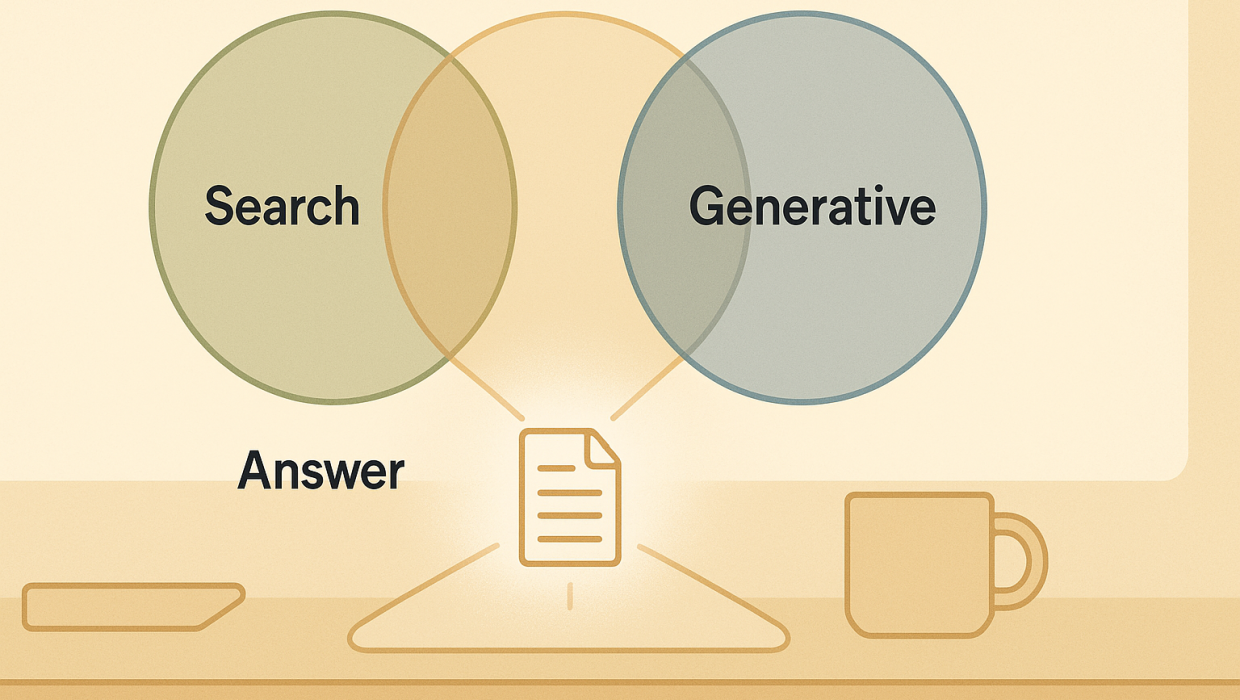
It’s tempting to think of search engines, answer engines, and generative engines as three separate battlefields requiring three separate playbooks. In practice, they’re increasingly reading from the same underlying signals. Google’s AI Overviews, Bing Copilot, ChatGPT, and Perplexity all favor content that is structured, entity-clear, and independently corroborated across the web. The engines are different; the raw material they consume is largely the same.
That convergence is exactly why siloed execution fails. A page optimized purely for traditional keyword ranking, with no attention to how it will be parsed, quoted, or summarized by a language model, will lose ground even if it still ranks on page one. Conversely, content built only for AI citation, without the technical scaffolding search engines need to crawl and trust it, will never earn the visibility to be cited in the first place.
What AEO and GEO Actually Mean for an Enterprise
Answer Engine Optimization: Winning the Zero-Click Moment
Answer engine optimization is about structuring content so it can be lifted directly into a featured snippet, an AI Overview, or a voice assistant’s response — often without the user ever visiting your site. This requires precise question-and-answer formatting, clean schema markup, and content hierarchies that mirror how people actually ask questions, not how internal teams describe their own products.
Generative Engine Optimization: Earning a Place Inside the Model’s Reasoning
Generative engine strategies go a layer deeper. Large language models don’t just scan a page for a snippet — they synthesize an answer from dozens of sources and decide, in effect, which brands deserve to be part of that synthesis. Earning that inclusion depends on consistent entity definition (does the web agree on who you are and what you do?), third-party credibility signals, and content depth that gives a model something substantive to draw from rather than boilerplate to ignore.
Why Treating Them Separately Costs You Visibility
Most enterprises already have an SEO function. Fewer have thought seriously about how that function intersects with AEO and GEO. The result is usually duplicated effort, inconsistent structured data across regional sites, and content that’s been optimized for a 2019 search engine while the buying journey has already moved on. Marketing owns messaging; IT owns the CMS and site architecture; nobody owns the connective tissue between them.
This is precisely the gap a unified AEO and GEO strategy is designed to close. Instead of three teams optimizing for three engines with three sets of assumptions, the technical foundation, content architecture, and citation strategy are built as one system — because that’s how the engines themselves increasingly evaluate you.
The Diagnosis-Before-Build Case for Unification
We don’t start engagements by prescribing a stack of AEO tactics or a generative-content calendar. We start by diagnosing where an enterprise’s visibility actually breaks down — is it a technical crawlability issue, a content depth problem, a missing entity signal, or a trust and citation gap? Enterprises are often surprised to learn that their biggest AEO liability isn’t their own website at all; it’s the absence of consistent, corroborating information about them across the broader web that generative engines rely on to validate a claim.
This diagnostic discipline matters because it protects against the most common failure mode we see: enterprises throwing content volume at a visibility problem that’s actually structural. More blog posts won’t fix a site architecture that confuses crawlers, and better schema markup won’t fix a brand with no independent citations. Our case studies consistently show that the highest-leverage fixes are the ones identified before a single new page gets built.
What Unified Execution Looks Like in Practice
For a B2B technology marketing organization, unified AEO/GEO execution typically touches four layers simultaneously:
Entity clarity. Every property — website, LinkedIn, directories, press mentions, third-party review sites — needs to describe the company, its category, and its differentiation in consistent, machine-readable terms. Generative engines resolve ambiguity by defaulting to whatever’s most repeated and most authoritative, so inconsistency is expensive.
Structured, answerable content. Product and service pages need to directly answer the questions buyers are actually asking, formatted so both crawlers and language models can extract a clean answer. This is content strategy work, but it’s inseparable from technical implementation.
Technical and schema foundation. Markup, site speed, crawl paths, and mobile rendering remain foundational — AI-driven discovery doesn’t replace technical SEO, it raises the stakes on getting it right. Enterprises running complex, multi-region, or multi-brand architectures often need this layer rebuilt in coordination with broader web development work rather than as a bolt-on audit.
Citation and trust building. Since generative engines weight third-party corroboration heavily, this often means coordinated PR, analyst engagement, and review-platform strategy — work that overlaps meaningfully with lead generation and demand efforts, since the same credibility signals that earn AI citations also shorten sales cycles.
Building the Foundation: Where Technology and Content Strategy Meet
Enterprises evaluating a technology or marketing partner for this work should be wary of anyone treating AEO and GEO as a content-only exercise. The technical substrate matters enormously: how your CMS structures data, how your APIs expose product information, and whether your internal systems can keep entity data consistent across dozens of pages and integrations. This is where marketing strategy and systems architecture genuinely converge, and it’s why a unified AEO and GEO strategy has to be built alongside — not downstream of — a company’s broader technology decisions, sometimes informed by AI and automation capabilities that keep structured data current as products and offerings change.
The engines that decide your visibility are themselves built on machine learning, but the judgment about what to say, how to differentiate, and which claims are defensible still has to come from people who understand the business. Optimization without that judgment produces content that’s technically well-formed and strategically empty — visible, perhaps, but forgettable.
The Cost of Waiting
Every quarter an enterprise delays, competitors are accumulating the citations, structured data, and entity consistency that generative engines use to decide who gets mentioned. Unlike traditional SEO, where a strong domain can often catch up with enough time and content, generative engine visibility compounds around trust signals that take longer to build and are harder to reverse-engineer quickly. The enterprises treating this as a 2025 priority rather than a 2027 catch-up project are the ones that will own the answer box, the AI summary, and the shortlist when it matters.
If your organization is still evaluating whether this warrants a dedicated strategy or a patchwork of vendor fixes, that question itself is worth a proper diagnosis. It’s the kind of conversation worth having before another budget cycle passes — and it’s exactly where we’d start if you decided to start a conversation with us.
Bringing It Together
A unified AEO and GEO strategy isn’t a rebrand of SEO with new acronyms attached. It’s a recognition that the mechanisms determining enterprise visibility have multiplied, converged, and raised the bar for coordination between marketing, content, and technology teams. Enterprises that keep these functions separate will keep patching symptoms. Enterprises that unify them — starting with a clear-eyed diagnosis of where visibility actually breaks down — will be the ones showing up consistently, wherever their buyers are asking the questions.
A unified AEO and GEO strategy isn’t a rebrand of SEO with new acronyms attached.
RELATED QUESTIONS
What is the difference between AEO and GEO?
AEO, or answer engine optimization, focuses on structuring content so it can be pulled directly into featured snippets, AI Overviews, or voice assistant responses. GEO, or generative engine optimization, focuses on earning a place inside the synthesized answers produced by large language models like ChatGPT or Perplexity, which depends on entity consistency and third-party credibility rather than just on-page formatting.
Why can’t a company just keep doing traditional SEO and ignore AEO and GEO?
Traditional SEO still matters for crawlability and ranking, but a growing share of buyer research now happens in zero-click answer boxes and AI-generated summaries that never send traffic to a website. Ignoring AEO and GEO means becoming invisible in exactly the moments where buyers are forming their shortlist, even if your site still ranks well in classic search results.
How does generative engine optimization actually work?
Generative engines synthesize answers from many sources and decide which brands are credible enough to include, weighing consistency of how a company is described across the web, independent citations, and content depth. Improving GEO performance typically involves aligning entity information across your website, directories, and third-party mentions, plus building genuine third-party credibility through press, reviews, and analyst coverage.
What should an enterprise do first before investing in AEO and GEO tactics?
The most effective starting point is a diagnostic audit that identifies whether visibility gaps stem from technical crawlability issues, weak content structure, missing schema markup, or a lack of independent citations. Enterprises that skip this step often over-invest in content volume when the real problem is structural, wasting budget without improving visibility.
Does AEO and GEO strategy require rebuilding a company’s website?
Not always, but it frequently requires changes to site architecture, structured data, and how content is organized, since both AI crawlers and language models depend on clean technical foundations to extract accurate answers. For enterprises with complex or multi-region sites, this work is often best coordinated with broader web development rather than treated as a standalone content project.
Ready to Build an AEO and GEO Strategy That Actually Compounds?
Start a conversation with Sapiens + Machines to discuss your goals, challenges, and next steps.