Every business eventually hits the same quiet ceiling: the team is working hard, the tools are all technically “working,” and yet growth feels harder than it should. More often than not, the culprit isn’t a lack of effort or even a lack of technology — it’s a lack of fit. Off-the-shelf software and cobbled-together spreadsheets can only stretch so far before they start costing you more than they save. This is where custom software efficiencies come into play, and why more B2B leaders are taking a hard look at the systems running underneath their operations.
Bespoke software isn’t a luxury reserved for enterprise giants with unlimited IT budgets. It’s a strategic response to a very common problem: generic tools solving generic problems, while your business runs on anything but generic processes.
The Hidden Cost of “Good Enough” Software
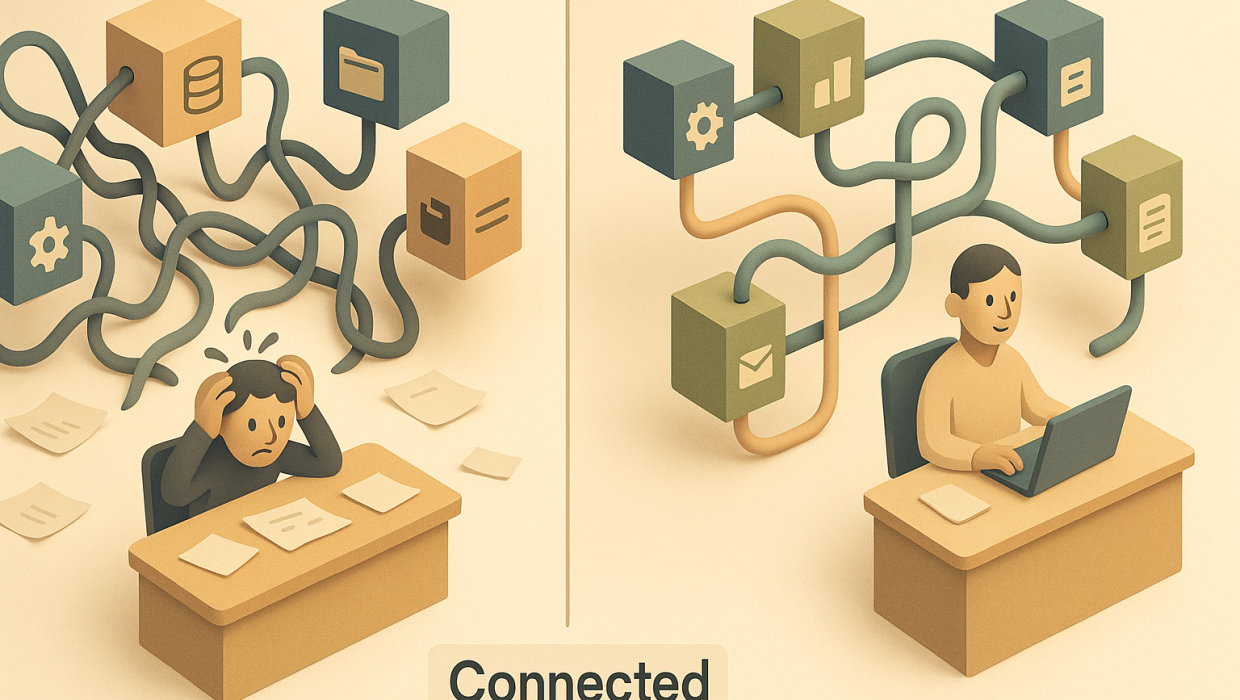
Most organizations don’t consciously choose inefficiency. It accumulates. A CRM gets bolted onto a project management tool. A finance team builds a workaround in spreadsheets because the accounting software doesn’t talk to the fulfillment platform. A marketing director exports data manually every Monday because the analytics dashboard doesn’t sync with the ad platforms. Individually, these are minor annoyances. Collectively, they’re a tax on every hour your team works.
This is the paradox of “good enough” software: it’s rarely bad enough to trigger a change, but it’s never quite good enough to disappear into the background. It lingers, quietly consuming hours, introducing errors, and creating blind spots in reporting. For CTOs and operations leaders, the real cost isn’t the software license — it’s the compounding inefficiency of humans doing what systems should be doing automatically.
Signs Your Business Has an Efficiency Gap
A few patterns tend to show up again and again in organizations that would benefit from a custom-built approach:
- Employees maintain manual “shadow systems” (spreadsheets, personal trackers) to compensate for what the official software can’t do.
- Data has to be re-entered in multiple platforms because systems don’t integrate.
- Reporting requires someone to manually stitch together numbers from three or four different sources before leadership can make a decision.
- New hires need weeks of training just to understand workaround processes that exist only because “that’s how we’ve always done it.”
- Growth initiatives stall because scaling the current process would require scaling headcount at the same rate.
If two or more of these sound familiar, it’s worth asking whether your business is optimized for the tools it has, rather than the tools being optimized for your business.
Why Off-the-Shelf Tools Hit a Ceiling
Commercial software is built to serve the widest possible market, which means it’s designed around averages — average workflows, average team structures, average reporting needs. That’s precisely why it can get a business from zero to a functioning operation quickly and affordably. But it’s also why it eventually becomes a constraint rather than an accelerant.
The businesses that outgrow their software fastest are usually the ones with a genuine competitive edge — a proprietary process, a unique customer journey, a specialized compliance requirement. Ironically, the very thing that makes them competitive is often the thing generic software can’t accommodate. At that point, forcing the business to conform to the software’s limitations means quietly sanding down the edges that made it distinctive in the first place.
This is where a diagnosis-before-build approach matters. Jumping straight to a build — hiring developers and specifying features — without first mapping the actual friction points is how companies end up with expensive software that solves the wrong problem. The right starting point is always a clear-eyed audit of where time, data, and judgment are currently getting lost, and only then a conversation about what to build. Our software solutions work always begins here, because a beautifully engineered system built on a flawed understanding of the problem is still a flawed system.
Internal Tools: The Underrated Growth Lever
When people think “custom software,” they often picture customer-facing products. But some of the highest-return investments happen behind the scenes, in internal tools development that most customers will never see.
Consider a mid-sized agency managing client campaigns across a dozen platforms. Account managers spend hours each week pulling performance data into client-ready reports. A purpose-built internal dashboard that pulls from every ad platform automatically, applies the agency’s specific KPIs, and generates a client-ready summary isn’t just a convenience — it can eliminate days of labor per month, per account manager. Multiply that across a growing client roster, and the tool pays for itself many times over, freeing the team to focus on strategy instead of spreadsheet assembly.
Internal tools tend to have an outsized impact for a simple reason: they’re used constantly, by the people closest to the operational friction. A customer-facing app might be used occasionally by any given user. An internal scheduling tool, approval workflow, or reporting dashboard is often touched daily by the entire team. Small efficiency gains compound fast at that frequency.
Where Internal Tools Typically Deliver the Fastest ROI
- Approval and workflow routing (contracts, purchase orders, content sign-off)
- Client or project reporting dashboards that pull from multiple data sources
- Inventory, scheduling, or resource allocation systems specific to your operating model
- Internal knowledge bases or tools that reduce onboarding time for new hires
- Data entry elimination through system-to-system integrations
Enterprise Systems Optimization Isn’t Just for Enterprises
The phrase “enterprise systems optimization” tends to conjure images of Fortune 500 IT departments, but the underlying discipline — auditing how core systems talk to each other, where data duplicates, and where processes bottleneck — applies just as much to a 40-person company as a 4,000-person one. In fact, smaller and mid-sized businesses often have more to gain, because a single inefficient process can represent a much larger share of total operating capacity.
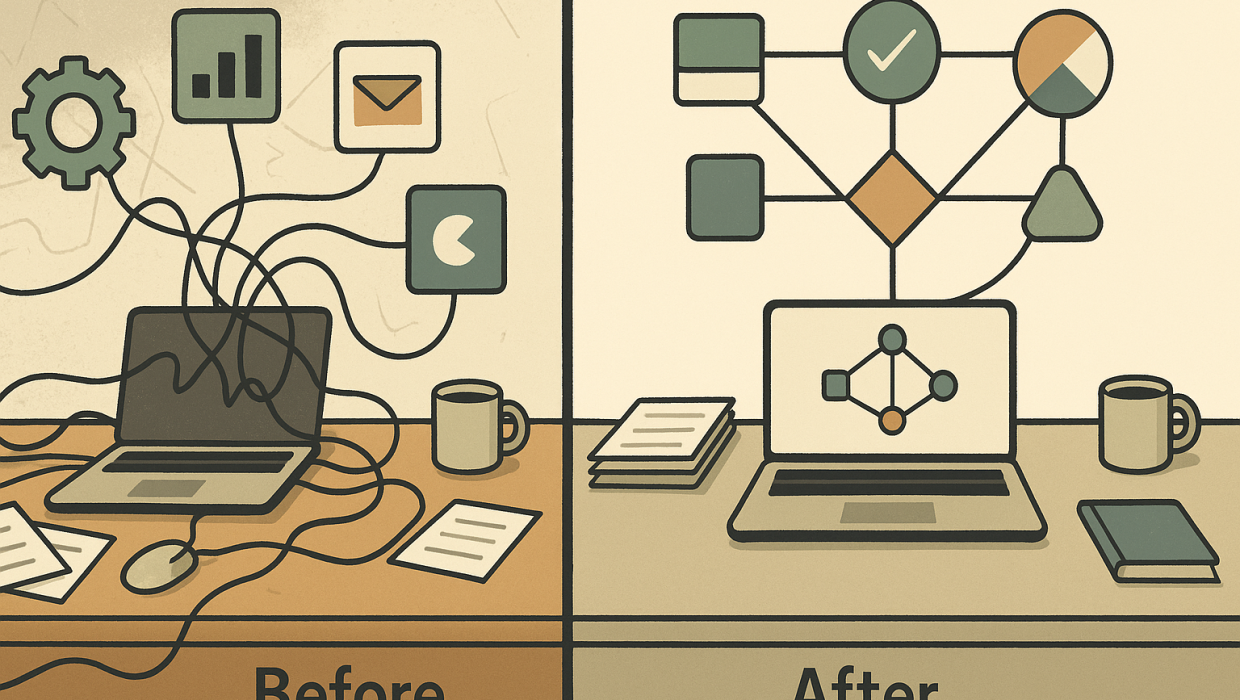
Optimization here doesn’t necessarily mean ripping out everything and starting over. Sometimes it means building the connective tissue — the APIs, integrations, and internal tools — that let existing systems function as one coherent whole instead of a patchwork of disconnected point solutions. A well-designed integration layer can often deliver more value than replacing any single system outright, because it addresses the actual pain point: systems that don’t communicate.
This is also where automation and custom software intersect meaningfully. Once systems are properly integrated, previously manual handoffs — passing a lead from marketing to sales, triggering a follow-up after a support ticket closes, updating inventory across sales channels — can often be automated outright. If you’re exploring where automation fits into this picture, it’s worth pairing a software audit with a look at our AI and automation capabilities, since the two disciplines frequently solve the same underlying problem from different angles.
What Business Growth Technology Actually Looks Like in Practice
It’s easy to talk about business growth technology in the abstract, but the real value shows up in specific, often unglamorous improvements: a sales team that can generate a quote in two minutes instead of twenty. A finance team that closes the books in three days instead of ten. A support team whose ticketing system automatically routes issues based on actual complexity rather than whoever happens to be free.
None of these examples require a moonshot AI initiative. They require a clear understanding of the current process, an honest accounting of where it breaks down, and a system built specifically to close that gap. This is the essential difference between technology for its own sake and technology as a genuine growth lever — one adds complexity, the other removes it.
The businesses that grow fastest aren’t necessarily the ones with the most advanced technology — they’re the ones whose technology fits their actual operations precisely enough that it disappears into the background. That fit is rarely accidental. It comes from treating software development as a strategic exercise in understanding the business first, and only then as an engineering problem.
The businesses that grow fastest aren’t necessarily the ones with the most advanced technology — they’re the ones whose technology fits their actual operations precisely enough that it disappears into the background.
This is also why we approach every engagement through custom software solutions built around a specific operational reality rather than a generic template. A system modeled on someone else’s workflow will always require your team to bend around it. A system modeled on your workflow lets your team move at full speed.
Bringing It Together: Diagnosis Before Build
The single biggest mistake companies make when pursuing custom software isn’t picking the wrong developer or the wrong tech stack — it’s skipping the diagnostic step entirely. Jumping to “we need an app for that” without first mapping where time, money, and judgment are actually being lost tends to produce software that’s technically impressive and strategically irrelevant.
A proper diagnosis looks at the full picture: what data already exists (and where it’s trapped), which processes are genuinely unique to your business versus which are just habit, and where the highest-friction points sit for the people actually doing the work. Only once that picture is clear does it make sense to talk about architecture, integrations, or build timelines. It’s the same logic that underlies strong IT infrastructure decisions and the systems integration work that connects everything from CRM data to campaign reporting.
If any part of this — the manual workarounds, the disconnected systems, the reporting that takes half a day to assemble — sounds familiar, it’s worth a conversation before it’s worth a build. You can see examples of how this diagnostic approach has played out for other companies in our case studies, or reach out directly to start a conversation about what’s actually happening inside your systems today.
The Real Payoff
Efficiency gains from custom software rarely show up as a single dramatic moment. They show up as hours returned to your team every week, as reporting that used to take days now taking minutes, and as new hires who ramp up faster because the tools actually make sense. Over a year, those small compounding gains are often the difference between a team that’s stretched thin and one that has genuine capacity to take on new growth.
The question worth sitting with isn’t whether your current software is “working.” Almost anything can be made to work with enough manual effort. The real question is what your team could accomplish if that effort were redirected toward the work that actually grows the business.
RELATED QUESTIONS
What are custom software efficiencies and why do they matter for business growth?
Custom software efficiencies are the time, cost, and accuracy gains a business achieves when its tools are built around its actual workflows rather than generic templates. They matter because generic software forces teams to build manual workarounds, which quietly drains hours and creates data errors that compound as the business scales.
How do I know if my business needs custom software instead of off-the-shelf tools?
If your team maintains manual spreadsheets to compensate for what your official software can’t do, re-enters the same data across multiple platforms, or needs days to assemble reports from disconnected systems, that’s a strong signal off-the-shelf tools have hit their ceiling. A short diagnostic audit of your current workflows can confirm whether custom software would deliver meaningful ROI.
What is internal tools development and how is it different from customer-facing software?
Internal tools development refers to building software used by your own team — dashboards, approval workflows, reporting systems — rather than products your customers interact with directly. Because internal tools are often used daily by the entire team, even small efficiency improvements compound quickly into significant time and cost savings.
Is enterprise systems optimization only relevant for large companies?
No, enterprise systems optimization applies to businesses of any size, and smaller companies often have more to gain since a single inefficient process represents a larger share of their total operating capacity. The core work involves auditing how existing systems communicate and building the integrations needed to eliminate manual data handoffs.
Why is a diagnosis-before-build approach important when developing custom software?
A diagnosis-before-build approach ensures software is designed around a clear understanding of actual operational friction rather than assumptions about what’s needed. Skipping this step often results in technically sound software that solves the wrong problem, wasting both budget and development time.
Ready to Find the Efficiencies Hiding in Your Systems?
Start a conversation with Sapiens + Machines to discuss your goals, challenges, and next steps.