If you’ve sunk six or seven figures into custom software and the promised custom software synergies — the cross-team efficiency, the unified data, the “do more with less” outcome — still haven’t materialized, you’re not alone, and you’re not imagining it. This is one of the most common frustrations we hear from CTOs, marketing directors, and agency owners: the tools technically work, but the business doesn’t feel any faster, smarter, or more connected than it did before the investment.
The gap usually isn’t a coding problem. It’s a diagnosis problem.
The Synergy Myth: What “Integration” Actually Means
Most teams use “integration” to mean two systems can pass data back and forth. That’s necessary, but it’s not sufficient. Real enterprise software integration means the systems reflect how decisions actually get made in your organization — who needs what information, when, and in what form to act on it. A CRM that syncs with a billing platform is connected. It isn’t necessarily synergistic.
Synergy is a business outcome, not a technical one. It shows up as fewer manual handoffs, faster decisions, and less time spent reconciling conflicting versions of the truth. When custom software fails to deliver it, the software isn’t usually broken — it’s solving the wrong problem, or solving the right problem for only one team instead of the whole organization.
Symptom vs. Root Cause
Leaders often describe the symptom accurately but misdiagnose the cause. “Our tools don’t talk to each other” usually isn’t a data-format issue — it’s a sign that the workflow itself was never mapped before the build started. “Adoption is low” usually isn’t a training problem — it’s a sign the software automated a process that didn’t match how people actually work. Treating symptoms with more code just adds complexity on top of the original miscalculation.
Four Reasons Custom Software Underperforms
1. You Built Before You Diagnosed
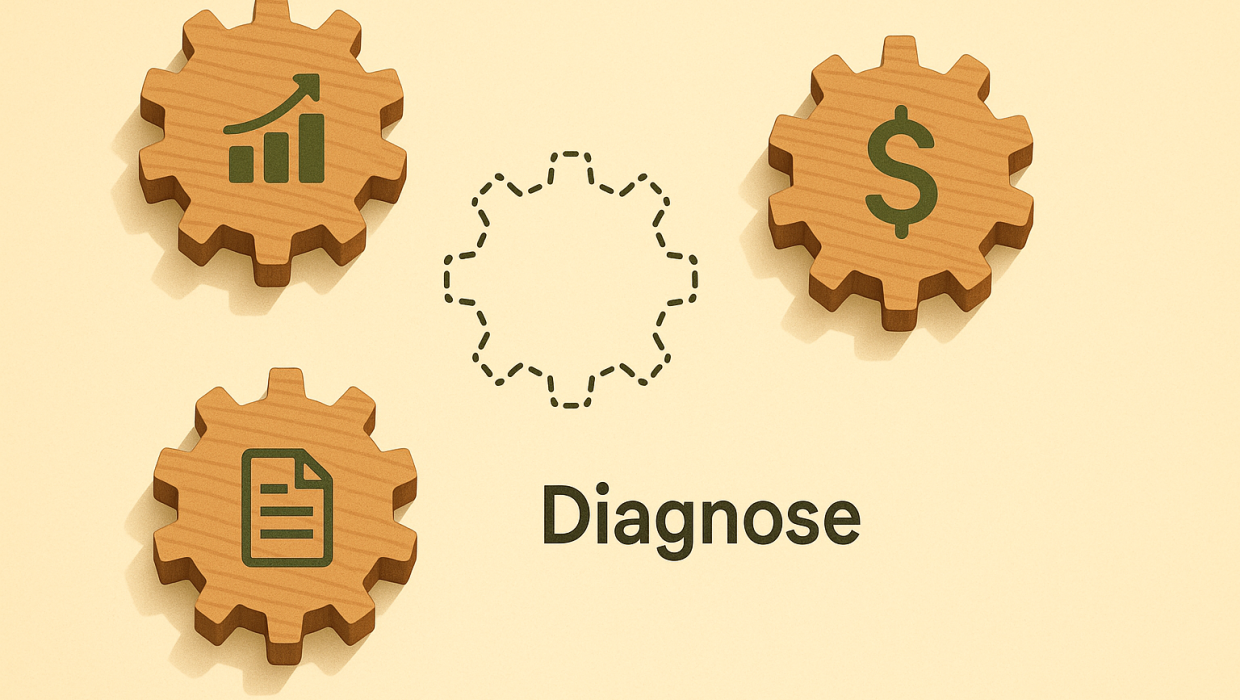
The single most common failure point is sequencing. A team identifies a pain point, gets executive buy-in, and moves straight to specs and sprints. But without a structured discovery phase — mapping current workflows, data ownership, and decision points across departments — the resulting system reflects assumptions, not reality. This is why our own engagements always start with diagnosis before build: understanding what’s actually broken before proposing what to fix. Skipping that step is the single biggest predictor of underwhelming ROI on custom builds.
2. Point Solutions Without a System View
Custom software is frequently commissioned to fix one team’s problem — sales wants better pipeline visibility, ops wants faster approvals, finance wants cleaner reporting. Each tool might do its job well in isolation, yet the organization ends up with three well-built systems that don’t share a common data model. The result is more software, not more synergy. This is precisely where custom software solutions need to be scoped at the system level from the outset, not stitched together retroactively.
3. Data Silos Masquerading as Integration
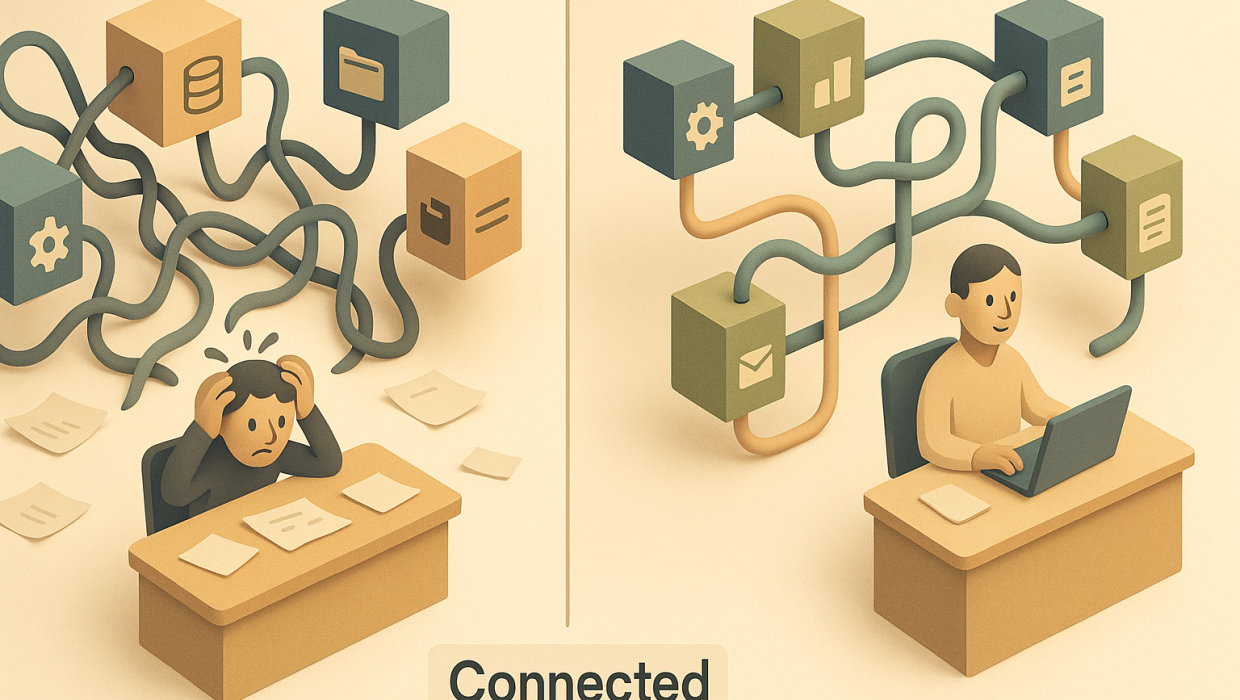
A dashboard that pulls from five sources isn’t integration if those five sources still disagree with each other. True enterprise software integration requires a single source of truth for each core entity — customer, order, asset — with clear rules about which system owns that data and how updates propagate. Without that architecture, “integrated” tools just make silos more visible instead of dissolving them.
4. No Feedback Loop for Human Judgment
Software that automates a decision entirely, without a mechanism for people to review, override, or refine its outputs, tends to degrade trust over time. The teams closest to the work start working around the system rather than through it. Sustainable synergy depends on tools that augment expert judgment rather than sideline it — which is also why thoughtful AI and automation layered onto core systems tends to outperform automation that removes people from the loop entirely.
What Business Process Optimization Actually Requires
Business process optimization isn’t a software feature — it’s an ongoing discipline. It requires periodically asking whether the process a system was built to support is still the right process, whether ownership of key data has shifted, and whether new tools have quietly created new bottlenecks. Organizations that treat their software stack as a static asset, reviewed only when something breaks, are the ones most likely to end up asking why their synergies never materialized.
This is also where the difference between B2B technology solutions bought off the shelf and those built for your specific operating model becomes clear. Off-the-shelf tools optimize for the average customer. Custom systems, done well, optimize for how your business specifically creates value — which is the entire point of building rather than buying.
Diagnosis Before Build: A Different Way to Approach Custom Software Synergies
Most software vendors are incentivized to start building quickly — that’s how they demonstrate progress and justify invoices. But speed to code is not the same as speed to value. A diagnosis-first approach spends real time up front mapping current-state workflows, interviewing the people who actually do the work, and identifying where technology can remove friction versus where the friction is actually a process or communication problem that no amount of software will fix.
This is uncomfortable for teams eager to see something built, but it’s the difference between software that creates measurable custom software synergies and software that simply adds another login to everyone’s day. If your organization is evaluating a new build, it’s worth pressure-testing any proposal that skips straight to architecture diagrams without first walking through how decisions currently get made. If you’re at that stage, it’s a reasonable moment to start a conversation about what a proper diagnostic phase would actually surface for your business.
This is uncomfortable for teams eager to see something built, but it’s the difference between software that creates measurable custom software synergies and software that simply adds another login to everyone’s day.
How to Know If Your Stack Needs an Intervention
A few reliable warning signs suggest your systems need a structural review rather than another patch:
- Teams maintain shadow spreadsheets alongside the “official” system because they don’t trust it.
- Reports from two departments about the same metric consistently disagree.
- New hires need weeks to understand which tool is authoritative for which task.
- Leadership can’t get a real-time answer to a basic operational question without someone manually compiling it.
Any one of these is a signal. Two or more together usually means the underlying architecture — not any single tool — is the problem. In our work, this is where a review of the full technology stack tends to reveal far more than a single team’s complaint initially suggested, and it’s often paired with a look at IT infrastructure to confirm the foundation can actually support the fix.
Making Synergy Real
Delivering on the promise of custom software synergies isn’t about adding more automation or more dashboards. It’s about sequencing the work correctly: diagnose the actual business process, design the system architecture around a single source of truth, build with the people who’ll use it daily, and leave room for human judgment to stay in the loop where it matters most. Organizations that follow that order tend to see the cross-team gains they were promised in the first place — fewer handoffs, faster decisions, and systems people actually want to use.
We’ve walked several B2B companies through exactly this kind of diagnostic rebuild, and the patterns are documented in our case studies, where the common thread isn’t a specific technology but a specific sequence: understand before you build. If your custom software isn’t delivering the synergies it promised, the fix is rarely “more software.” It’s usually a clearer diagnosis of what the software was actually supposed to do — and for whom. Revisiting that question with a partner who approaches custom software and systems development from a diagnostic standpoint, rather than a feature-first one, is often the fastest path back to the ROI you were originally promised.
RELATED QUESTIONS
Why isn’t my custom software delivering the synergies we were promised?
Most custom software fails to deliver promised synergies because it was built to solve one team’s problem rather than the business’s full workflow. Without mapping how data and decisions move across departments before building, the result is often more disconnected tools rather than fewer. The fix is a structured diagnosis of current workflows before any development begins, not additional automation layered on top.
What does “diagnosis before build” mean in software development?
Diagnosis before build means mapping current-state workflows, data ownership, and decision points across an organization before writing any code or choosing an architecture. It ensures the resulting system reflects how the business actually operates rather than assumptions made during a single stakeholder meeting. This approach reduces the risk of building well-engineered software that solves the wrong problem.
What’s the difference between system integration and true synergy?
Integration means two systems can technically exchange data, while synergy means the organization actually makes faster, better decisions as a result. A dashboard pulling from five data sources isn’t synergistic if those sources still disagree with each other. Real synergy requires a single source of truth for core business data, not just connected pipes between tools.
How do I know if our software stack needs a structural overhaul instead of a small fix?
Warning signs include teams maintaining shadow spreadsheets because they don’t trust the official system, two departments reporting different numbers for the same metric, and new hires struggling to know which tool is authoritative. If two or more of these patterns show up together, the issue is usually the underlying architecture rather than any single tool, and a full systems review is warranted.
Should custom software fully automate decisions or keep humans involved?
Software that fully automates decisions without a review or override mechanism tends to erode trust over time, causing teams to work around the system instead of through it. The most durable systems are designed to augment human judgment rather than replace it, keeping people in the loop at key decision points. This balance tends to produce higher adoption and better long-term outcomes than fully hands-off automation.
Ready to Diagnose Why Your Systems Aren't Working Together?
Start a conversation with Sapiens + Machines to discuss your goals, challenges, and next steps.